
There is something strangely powerful about a clock when you are waiting for a particular moment. You look at it once, look away, then somehow two minutes feels like twenty. Maybe you are waiting for a meeting, a lunch break, a phone call, a school pickup, or simply 3:15 PM because that is when something important is supposed to happen. Whatever the reason, the question sounds wonderfully simple: how much more time until 3:15?
The answer depends entirely on your current time. If your clock says 3:00 PM, then there are exactly 15 minutes left. If it says 2:30 PM, you have 45 minutes. At 8 AM, the wait is much longer, while at 3 PM, the target is just around the corner. It sounds like basic arithmetic, but knowing your time remaining can actually change how you plan the next part of your day, and sometimes thats surprisingly useful.
Time also carries emotion. A grandmother waiting to send congratulations after a baby’s arrival may watch the clock because she promised to call at a certain hour. A friend preparing a thoughtful message may have only a few minutes before leaving for work. Even a simple birthday wish can feel more meaningful when it arrives at exactly the right moment. So, lets look at what the clock is really telling us.
How Much More Time Until 3:15?
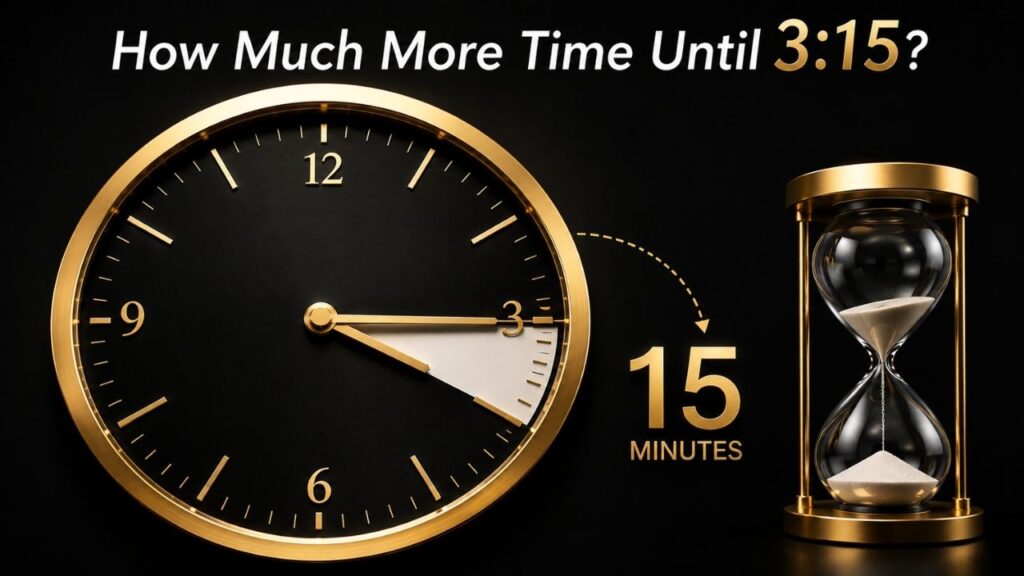
The easiest way to answer how much more time until 3:15 is to compare your current time with the target time. The target is 3:15 PM, so you simply work out the difference between now and 3:15.
For example, if your current time is 3:00 PM, the calculation is very easy:
3:15 PM − 3:00 PM = 15 minutes
That means the minutes until 3:15 PM are 15. You could use those fifteen minutes to finish a message, prepare for an appointment, answer an important email, or just breathe for a second before the next thing begins. Fifteen minutes doesnt look huge on paper, but it can hold quite a lot.
If the clock shows 2:45 PM, then you have 30 minutes remaining. At 2:30 PM, you have 45 minutes. At 2:00 PM, you have 1 hour and 15 minutes. This is simply a time duration calculation, although our brains sometimes make it feel more complicated than it really is.
The important idea is to compare the current time vs. target time rather than guessing from the clock face. Guessing is where little mistakes sneak in, especially when you are tired or rushing. A quick calculation is usually enough, and honestly, the clock is already doing half the work for you.
How to Calculate Time Until 3:15 PM
If you want to know how to calculate how much time until 3:15, begin by identifying the hour and minutes shown on your clock. Then calculate how far away 3:15 is.
Suppose the time is 2:50 PM. From 2:50 to 3:00 is 10 minutes, and from 3:00 to 3:15 is another 15 minutes. Therefore:
10 + 15 = 25 minutes
So there are 25 minutes left.
Another example: if your clock says 1:40 PM, you can count from 1:40 to 2:40, which is one hour, then from 2:40 to 3:15, which is 35 minutes. Your total is 1 hour and 35 minutes.
This method of counting backward or forward is often easier than trying to perform everything in your head at once. When the calculation crosses an hour, break it into smaller pieces. Your brain will thank you for not making it wrestle with unnecessary numbers.
For larger gaps, a time difference calculator or hours and minutes calculator can help. These tools are especially useful when you are calculating schedules across different periods, because a small AM/PM mistake can turn a perfectly innocent calculation into a very wrong one.
Minutes Until 3:15: Quick Examples

Sometimes you don’t need a long explanation. You just want the answer and want to get on with your day. Here are some common examples of the time until 3:15:
- 3:00 PM → 15 minutes
- 2:45 PM → 30 minutes
- 2:30 PM → 45 minutes
- 2:15 PM → 1 hour
- 2:00 PM → 1 hour 15 minutes
- 1:30 PM → 1 hour 45 minutes
- 1:00 PM → 2 hours 15 minutes
- 12:00 PM → 3 hours 15 minutes
- 11:00 AM → 4 hours 15 minutes
- 8:00 AM → 7 hours 15 minutes
The same principle works for other times too. If someone asks how long until 3:15, you dont need a special formula every single time. Identify now, identify the target, and calculate the gap.
It becomes especially easy when the time is close. If it is 3:05 PM, there are 10 minutes. At 3:10 PM, there are only 5 minutes. At 3:14 PM, you’ve got one minute left. And at 3:16 PM, the question has changed from future time to past time.
The Countdown to 3:15 Can Make Time Feel Different
A countdown changes how people experience time. Ten minutes while waiting for an exciting announcement can feel painfully slow, while ten minutes spent watching short videos can disappear before you even notice.
This is a little mystery of time perception. The clock moves at the same speed, but our attention does not. When we stare at the clock, every minute becomes noticeable. When we become absorbed in focused work, those same minutes can vanish quietly.
That is why knowing your time remaining can be useful. Instead of repeatedly checking the clock, you can decide what to do with the remaining period. If you have 20 minutes before 3:15, perhaps you can complete one small task. If you have five minutes, maybe sending one important message is more realistic.
The goal isnt to squeeze productivity out of every breath. Sometimes the best use of ten minutes is simply doing nothing for a moment. Rest is part of a useful schedule too, even if productivity culture occasionally forgets that.
What to Do With 15 Minutes Before 3:15

If your clock says 3:00 PM, you have 15 minutes. That is enough time for several useful little things.
You might review your daily checklist, respond to one urgent message, organize your desk, prepare notes for an upcoming meeting, or check whether you have completed the most important item on your list. Fifteen minutes can also be used for a short focused work session without making a huge commitment.
For people who struggle with procrastination, a small time window can actually feel less intimidating. Instead of saying, “I need to work for the whole afternoon,” tell yourself, “I’ll focus until 3:15.” That tiny boundary can create momentum.
You could also set a timer for ten or fifteen minutes. Put the phone somewhere out of reach, silence unnecessary notifications, and start. When the timer finishes, stop or continue depending on your energy. Simple, but it works pretty nicely.
Using Time Management to Reach 3:15 Without Stress
Good time management isnt really about controlling every minute. It is about knowing what deserves your attention before the minute disappears.
If you know that something must happen at 3:15, use task scheduling to work backward. Ask yourself what needs to be finished before that moment. Then give each task a realistic amount of time. If something takes 20 minutes and you only have 15, thats a useful discovery because you can change your plan before the deadline arrives.
This is where prioritization matters. Not every task deserves the same level of urgency. A deadline five minutes away should probably outrank an email that can wait until tomorrow. Sounds obvious, but when we’re surrounded by notifications, obvious things can become oddly difficult.
Try dividing your remaining time into small blocks. One block might be for planning, another for focused work, and the last few minutes for checking your work. This kind of time blocking can improve work efficiency without making your schedule feel like a military operation.
Managing Distractions Before 3:15
Imagine you have 15 minutes left, but you open TikTok “just for a second.” Then one video becomes another, and suddenly the clock says 3:14. That little minute was not stolen by some mysterious force. It was probably your attention wandering off for a walk.
Social media distractions, phone distractions, and other digital interruptions can make a short period disappear quickly. You dont always need to eliminate them completely, but you can create boundaries around them.
Turn off notifications during focused work time. Put your phone face down. Close unnecessary browser tabs. If you are working on something important, give yourself permission to ignore non-urgent messages until the task is done.
Even Netflix can wait fifteen minutes. Usually.
The bigger lesson is that managing distractions is really about protecting attention. Time is measurable, but attention is the thing that determines what those minutes actually become.
Time Tracking and Productivity: Where Did the Hours Go?
Have you ever reached the end of a workday and wondered where all the Hours went? You started with a plan, answered a few messages, attended a meeting, checked social media, handled unexpected interruptions, and somehow the afternoon disappeared.
This is where time tracking can be useful. Tracking how long tasks actually take gives you information that guessing cannot. A productivity tracker or time tracking software can help you see how much time goes into meetings, focused work, administrative tasks, and interruptions.
Tools such as StaffWatcher, for example, belong to the broader category of time-tracking and productivity tools. The point isnt to watch the clock nervously. The point is to understand your working patterns so you can make better decisions later.
If you discover that a task you thought took 20 minutes actually takes an hour, your future task scheduling becomes more realistic. That is a quiet form of productivity optimization, and it can make a surprisingly big difference.
Why Time Awareness Improves Productivity

Time awareness gives ordinary tasks a boundary. Knowing that you have until 3:15 can make you more decisive because the endpoint is visible.
Without a deadline, people often stretch tasks. We polish things that dont need polishing, check messages repeatedly, or spend twenty minutes choosing what to do next. With a clear target time, decisions become easier.
This doesnt mean every minute should feel urgent. Constant urgency can be exhausting and may actually hurt concentration. Instead, think of deadlines as information. They tell you when something matters and help you decide what can wait.
The best kind of productivity isnt frantic. It is deliberate. You know what matters, you understand how much time you have, and you make reasonable choices with the minutes available.
A Small Time Calculation Can Support Better Planning
Consider someone who has an appointment at 3:15 PM. They need ten minutes to finish a task, five minutes to gather their things, and ten minutes to travel. Suddenly, calculate time difference is no longer just a math exercise.
If it is currently 2:45 PM, they have 30 minutes. Their total planned activities require 25 minutes, leaving only five minutes of breathing room.
That five-minute buffer matters. Unexpected interruptions happen. Someone calls. A document refuses to print. Traffic behaves like it has personal issues. Planning with a little spare time can prevent small problems from becoming major ones.
This is why deadline awareness and realistic planning are valuable. A schedule should have some flexibility because real life, unfortunately, does not follow spreadsheets very obediently.
When 3:15 Is Connected to a Special Message

Not every countdown is about work. Sometimes 3:15 PM is simply the time you promised to call someone.
Imagine a family welcoming a newborn baby girl. The grandparents may be waiting for a photograph, a video call, or the first opportunity to send their congratulations. A friend might have prepared a sweet message but wants to send it after the family has had a little quiet time.
In these moments, time becomes emotional rather than merely numerical.
A simple message such as “Congratulations on your beautiful baby girl! May her life be filled with love, laughter, and countless wonderful moments” can mean much more than its words suggest. It says, in a small way, “I am here, and I am sharing this moment with you.”
The exact wording can vary by family and culture. Some families celebrate with prayers and blessings, some gather for a meal, some give gifts, and others simply send messages through phones. The traditions differ, but the feeling is remarkably similar: a new life has arrived, and people want to surround that arrival with kindness.
Read more blog: What Time Does Sheetz Stop Selling Alcohol?
Frequently Asked Questions
how much time until 3:15
The time until 3:15 depends on the current time. For example, if it is 3:00 PM, there are 15 minutes left until 3:15 PM.
how much longer until 3:15
If the current time is 3:00 PM, you have 15 minutes longer to wait until 3:15. The exact time remaining changes according to the current time.
how long until 3 15
How long until 3:15 depends on what time it is now. Simply calculate the difference between the current time and the target time of 3:15 PM.
how long until 3:15
The remaining time until 3:15 can be calculated by comparing the current time with 3:15 PM. For instance, at 2:45 PM, there are 30 minutes remaining.
how much more time until 3:15
The amount of time left until 3:15 depends on the current time. At 3:00 PM, for example, there are exactly 15 minutes remaining.
Conclusion
So, how much more time until 3:15? The answer is always hiding in the relationship between your current time and the target of 3:15 PM. If it is 3:00 PM, you have 15 minutes. If it is 2:30 PM, you have 45. If it is 8 AM, you have 7 hours and 15 minutes.
But the more interesting question is what you do with those minutes.
A countdown can be a source of pressure, but it can also be a small invitation to pay attention. Use the time to finish something important, send a thoughtful wish, prepare for a meeting, call someone you love, or simply sit quietly for a moment.
Time management, after all, isn’t only about productivity. It is about making room for the things that matter. Sometimes that means focused work. Sometimes it means prioritizing a deadline. And sometimes it means sending a heartfelt congratulations to a family celebrating the arrival of a beautiful baby girl.
The clock will reach 3:15 whether we are ready or not. We cannot bargain with it, pause it, or ask for another five minutes. What we can do is notice where we are, understand our time remaining, and choose what deserves our attention before the next moment arrives.
Maybe thats the real value of asking how much more time until 3:15. It is not just a calculation. It is a tiny reminder that minutes become memories, schedules become days, and ordinary moments can become meaningful when we actually notice them.
If you have a favorite way to use fifteen minutes, or a special newborn wish that someone once sent you, share it with others. Sometimes the smallest message, sent at just the right time, is the one people remember for years.
