
There is a strange little moment in every student’s life when the clock seems to personally dislike them. You look at it once, then somehow two minutes later you look again, expecting a miracle, but nope the minute hand has barely moved. The teacher is explaining something, the room is quiet-ish, your classmates are staring at their notes, and your brain is already packing its imaginary backpack and leaving the classroom. If you have ever wondered how to pass time in class without getting yourself into trouble, you are definitely not the only one.
A boring class can make ten minutes feel like an entire geological era. Yet class time does not always have to be something you simply survive until the bell rings. With a little creativity, you can turn boredom into learning, small tasks, social interaction, or even a quiet brain break. The trick is not always to make the class disappear, but to make your mind busy enough that you stop checking whether the clock has moved. Thats when time gets sneaky and starts moving normally again.
Whether you’re sitting through long lectures, a repetitive lesson, or a subject that simply isn’t your favorite, there are plenty of harmless things to do in a boring class. Some can improve your focus, while others help with productivity, creativity, or simply staying awake. The best option depends on what your teacher allows, of course, because no clever trick is worth getting a lecture about following classroom rules.
How to Pass Time in Class Without Ignoring the Lesson

The first answer to how to pass time in class may sound almost backwards: actually become more involved in what is happening. A lesson feels much longer when you’re mentally somewhere else. When you start engaging with material, however, your brain has a job to do. Suddenly the lecture isn’t just noise floating around the room anymore, it becomes a puzzle that needs solving.
Try listening for three things you genuinely don’t understand, three things you already know, and one thing that surprises you. Write those observations down in your notes. This tiny game creates a reason to pay attention, and it can make an otherwise tedious lesson feel more active.
- Turn ordinary taking notes into a mini challenge by looking for the three most important ideas.
- Write one question about the topic that you would ask your teacher if you had the chance.
- Summarize each major point in your own words instead of copying every sentence.
- Look for connections between today’s lesson and something you studied earlier.
- Create a tiny list of unfamiliar words and figure out their meanings later.
- Try to predict what example the professor or teacher might give next.
- Listen for facts that could appear on a future test, because apparently exams have a talent for remembering what we ignore.
- At the end of class, write a two-sentence summary of what you actually learned.
This approach is useful because it changes your goal. Instead of asking, “How long until this ends?” you begin asking, “What can I get from these next ten minutes?” That shift in time awareness is surprisingly powerful.
How to Make Class Go Faster With Creative Note-Taking
One of the easiest answers to how to make class go faster is to make your notebook more interesting. Standard notes can sometimes look like a wall of tiny words, and even your own handwriting may eventually look like it has joined a secret society. Using creative note-taking techniques gives your brain something visual to organize.
You can experiment with color-coded notes, simple sketches, arrows, boxes, symbols, and mind mapping. These aren’t merely ways to decorate a notebook. Used sensibly, they can support memory and make complicated information easier to review later.
- Use one pen color for definitions and another for examples.
- Create visual notes when the subject involves processes, relationships, or sequences.
- Draw quick diagrams beside difficult concepts.
- Try doodling while taking notes, but keep the doodles connected to the topic when possible.
- Turn a page into a mind map with the main idea in the center.
- Use arrows to connect causes and effects.
- Draw tiny symbols beside information you want to remember.
- Rewrite one difficult paragraph as a simple chart.
- Make a miniature timeline for history, science, literature, or any topic involving events.
- Leave a small “questions” section at the edge of the page for things you want to research later.
The beautiful part is that the class can feel shorter because you’re creating something while listening. Your hands are occupied, your brain has structure, and your attention has somewhere useful to land. It is a much better form of distraction than secretly counting ceiling tiles, which, yes, has happened in classrooms everywhere.
Things to Do in a Boring Class When You Need Mental Stimulation
Sometimes the subject really is repetitive. Maybe you’ve already understood the basic idea, but the teacher is explaining the same concept from twelve different angles. In those moments, your mind needs mental stimulation, not necessarily more random entertainment.
One option is to challenge yourself with deeper questions. Ask yourself why the concept matters, where it could be used, what would happen if one part changed, or whether you can explain it to someone younger. These questions create active learning, which is much more engaging than simply watching the seconds crawl.
- Imagine explaining the topic to a ten-year-old using simple words.
- Think of a real-world situation where today’s lesson could be useful.
- Invent a hypothetical problem involving the subject.
- Compare today’s concept with something from another class.
- Try to identify the strongest argument and the weakest argument in a discussion.
- Predict what the next chapter might cover.
- Make a mental quiz and answer it without looking at your notes.
- Think about how the topic connects with a hobby or interest you already have.
- Find one thing about the lesson that you disagree with and consider why.
- Turn complicated information into a simple story in your head.
These are excellent productive things to do in class because they don’t require you to escape the lesson. Instead, you give your brain a second layer of activity.
How to Stay Awake in Class When Your Energy Is Gone
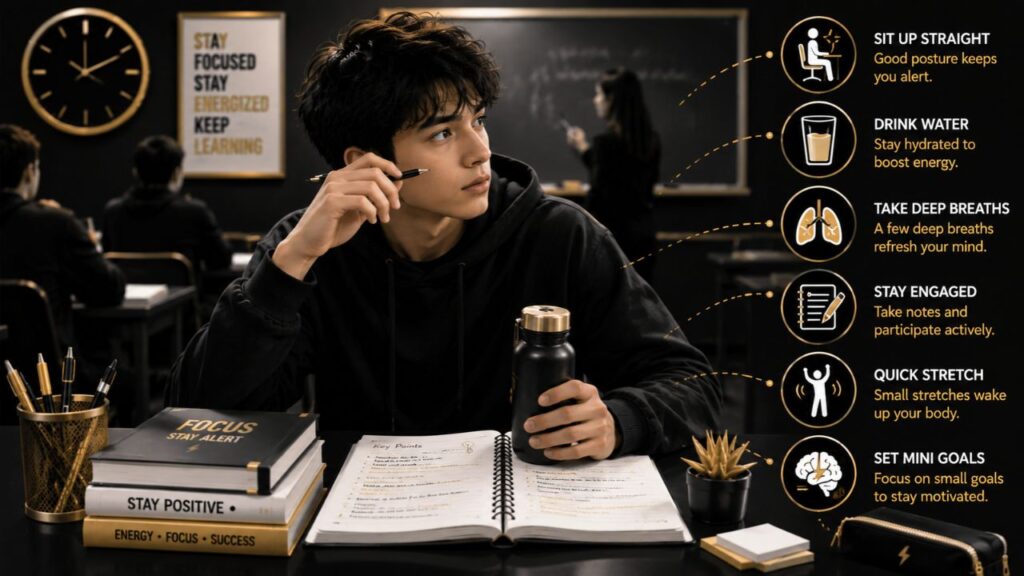
Learning how to stay awake in class becomes especially important during early mornings, after lunch, or near the end of a long school day. Sometimes you’re not bored because the material is bad; you’re tired because your body has reached the “please, no more information” department.
Start with basic things. Sit in a position that keeps you alert rather than curling over your desk. Take reasonable sips of water if permitted. Keep your notebook open and actively write. If classroom rules allow it, a small healthy snack before or during an appropriate break can also help, although snacks should never become an excuse to turn the desk into a tiny restaurant.
- Sit where you can clearly hear the teacher.
- Keep both feet grounded instead of collapsing into your chair.
- Take a few slow breaths when your mind feels foggy.
- Write keywords while listening rather than staring passively.
- Drink water when appropriate.
- Use a short stretch or bathroom break between classes to reset your energy.
- Avoid staring continuously at your phone, since scrolling can make returning to the lesson even harder.
- If permitted, quietly use a simple fidget spinner or stress ball to manage restlessness.
- Change your note-taking method when your attention begins fading.
- Set a tiny goal such as staying fully attentive for the next five minutes.
The goal isn’t to fight sleep through sheer heroic suffering. It’s to give your brain small signals that you’re still participating. Sometimes that is enough to bring your concentration back from its little vacation.
Productive Things to Do in Class When the Lesson Is Slow
A slow lesson can also become an opportunity to finish small academic tasks. This is where classroom productivity becomes useful. If the lesson has genuinely slowed down and your teacher permits independent work, use the spare mental space wisely.
You might organize notes, review vocabulary, plan an assignment, or prepare questions for a future study group. These small actions can reduce the workload waiting for you after school, which is basically giving your future self a tiny gift.
- Organize messy notes from an earlier lesson.
- Review flashcards quietly.
- Make a checklist for upcoming assignments.
- Plan the steps of a class project.
- Complete a small piece of homework if independent work is allowed.
- Review difficult vocabulary.
- Rewrite confusing notes in clearer language.
- Prepare questions for your next study session.
- Organize your backpack or digital school folders during an appropriate independent period.
- Check your weekly schedule and improve your time management.
Don’t turn this into aggressive multitasking, though. Doing five unrelated things at once usually means doing five things badly. Choose one small task, finish it, and return your attention to the lesson when needed.
Creative Ways to Pass Time in Class Through Doodling
For some students, drawing is not a sign that they have stopped listening. In fact, simple doodling can give restless hands something to do while the mind continues processing information. The important distinction is whether your drawing supports concentration or completely steals it away.
Try drawing tiny visual representations of what the teacher is explaining. If you’re learning about cells, sketch a rough cell. If you’re studying geography, draw a crude map. If you’re reading literature, sketch a symbol representing a character. It doesn’t need to look like museum art, honestly, nobody is handing out a gallery contract during third period.
- Draw symbols beside major concepts.
- Sketch a simple diagram of the lesson.
- Create visual metaphors for difficult ideas.
- Use borders or boxes to separate important sections of your notes.
- Draw arrows showing relationships.
- Make tiny character sketches during literature discussions.
- Turn vocabulary words into simple visual associations.
- Use doodling while taking notes to keep your hands active.
- Create a visual summary at the bottom of the page.
- Keep the drawings small enough that they don’t replace your actual notes.
When doodling can improve concentration, it is usually because it gives the hands a modest task while the brain continues listening. But if you notice yourself missing what the professor just said because you’re deeply designing a dragon in the corner, the dragon has officially won.
How to Stay Focused in Class by Turning the Lesson Into a Game
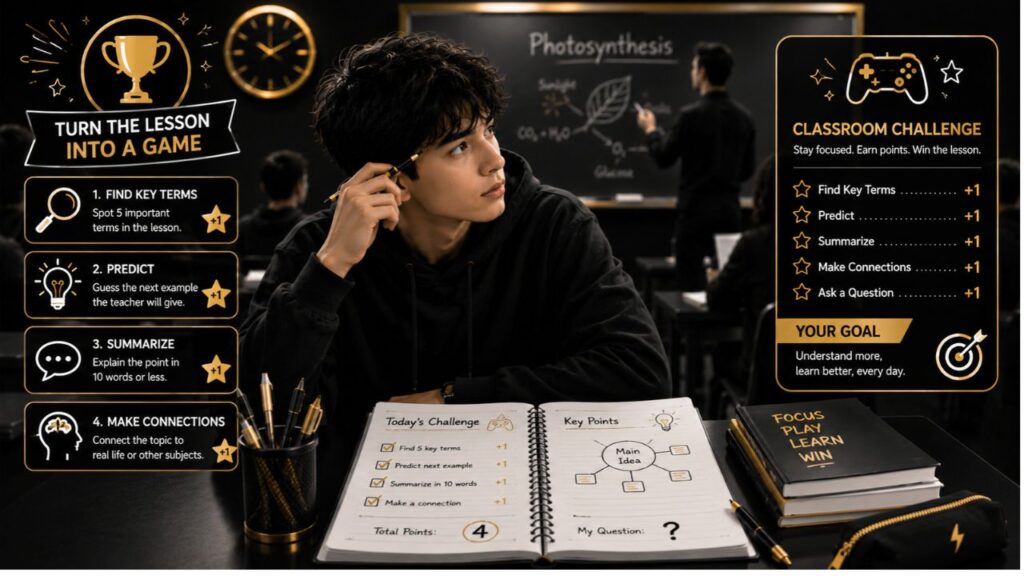
Games can make repetitive activities feel more engaging, and you don’t need a phone or an app to create one. You can build quiet mental challenges directly into the lesson. This can be particularly useful when you’re asking how to stay focused in class but your attention keeps wandering.
For example, challenge yourself to identify five key terms before the end of the lesson. Or try predicting the next example your teacher will use. These little competitions create curiosity, and curiosity tends to pull attention forward.
- Count how many key concepts you can identify.
- Predict the answer before the teacher explains it.
- Try to summarize a section in exactly ten words.
- Give yourself a point whenever you correctly remember something from a previous lesson.
- Find one connection between the lesson and everyday life.
- Make a mental list of possible test questions.
- Challenge yourself to explain the topic without using technical vocabulary.
- See if you can remember the first concept after twenty minutes.
- Guess which topic will appear in the next lesson.
- Try to discover the “main idea” hiding underneath all the smaller details.
The objective is not to turn school into a video game. It is simply to make your brain curious again, because motivation often follows engagement instead of appearing magically beforehand.
Ways to Pass Time at School by Connecting With Classmates
Not every useful classroom activity has to be solitary. Your classmates can become friends, study buddies, project partners, or people you simply exchange a few words with during appropriate moments. Social connection can make class time feel less isolated.
Of course, talking while the teacher is teaching can become a distraction for everyone, so timing matters. Use breaks, group assignments, discussions, or permitted partner work to build connections.
- Compare notes with a classmate after the lesson.
- Ask someone how they understood a difficult topic.
- Form a small study circle before an exam.
- Offer to share useful study resources.
- Work together during group assignments.
- Join a discussion group when one is available.
- Help a classmate understand something you’ve already learned.
- Ask classmates about their approach to a difficult project.
- Build a reliable group for reviewing before tests.
- Turn casual networking into genuine academic connections rather than forced small talk.
There is a quiet kind of camaraderie that grows in classrooms. Years later, people sometimes remember the person who helped them understand one impossible chapter more clearly than they remember the chapter itself.
Mindful Breaks and Brain Breaks During Long Classes
When a lesson is especially long, your brain may need a reset rather than another trick for entertainment. A brief brain break can restore attention, especially when your mind has become saturated with information.
If your classroom allows movement, use an appropriate moment to stretch, refill water, or take a bathroom break. If you need to stay seated, close your eyes for a few seconds when appropriate and take several slow breaths. This isn’t dramatic meditation; it is simply giving your nervous system a moment to stop sprinting.
- Take three slow breaths.
- Relax your shoulders.
- Stretch your fingers beneath the desk if appropriate.
- Look away from your notes for a few seconds.
- Drink some water.
- Mentally reset before beginning a new section.
- Use a short mindful break between demanding tasks.
- Notice your breathing instead of checking the clock.
- Focus on one sound in the classroom for a few seconds.
- Return to the lesson with one clear goal.
Small breaks can help with improving concentration, but they work best when they’re actually short. A “two-minute phone break” has an uncanny habit of becoming a fifteen-minute expedition through videos, messages, and things you absolutely did not plan to watch.
How to Make a Boring Lecture Go Faster

If you’re searching for how to make a boring lecture go faster, don’t spend the entire period staring at the clock. Clock watching creates a strange psychological trap: the more frequently you check the time, the more aware you become of every passing second.
Instead, divide the lesson into smaller mental sections. Tell yourself that you only need to focus until the next example, then the next topic, then the next activity. A two-hour lecture becomes less intimidating when your mind sees several small destinations instead of one enormous desert.
- Divide the lesson into ten- or fifteen-minute attention blocks.
- Set a goal for each section.
- Write a short summary whenever the topic changes.
- Look for examples rather than only definitions.
- Ask yourself questions while listening.
- Change your note format when your attention drops.
- Sit somewhere that makes it easier to hear.
- Avoid unnecessary distraction from your phone.
- Take appropriate short breaks when permitted.
- Focus on reaching the next milestone rather than the final bell.
This technique works because time management for students isn’t only about schedules and planners. It also involves managing how your mind experiences time.
Fidgeting in Class: Helpful or Distracting?
Some students concentrate better when their hands have a quiet activity. Fidgeting in class may involve tapping a pen, moving a small object, or using a discreet fidget toy for students. For certain people, that small movement can make sitting still feel less mentally exhausting.
Still, classroom rules matter. A fidget spinner that helps you concentrate is useful; a fidget spinner that launches across the room during an exam has entered a completely different category of educational adventure.
- Choose a quiet object that won’t distract others.
- Keep movement subtle.
- Avoid anything that produces repeated noise.
- Stop using it if it interferes with note-taking.
- Ask your teacher if you’re unsure whether a fidget tool is acceptable.
- Consider squeezing a stress ball gently during listening activities.
- Use movement as a support for focus, not as entertainment.
- Notice whether the object genuinely improves your concentration.
- Put it away if you start paying more attention to the object than the lesson.
The best tool is the one that becomes almost invisible to you. If you’re constantly thinking about it, it isn’t helping much.
Using Technology Without Turning Class Into Phone Time
Phones, tablets, laptops, and productivity apps can be useful, but they are also magnificent machines for transforming thirty seconds of boredom into forty minutes of distraction. So technology needs boundaries.
If devices are allowed, use them for time tracking, organizing assignments, reviewing notes, or accessing approved learning resources. A time tracker can help you understand how much time you actually spend studying, although you don’t need to track every second of your school life like you’re running a NASA mission.
Tools such as StaffWatcher may be relevant in workplace monitoring contexts, but students generally benefit more from simple study planners, task managers, timers, or school-approved learning platforms. The important thing is the purpose of the tool, not the brand name.
- Use a timer for focused study sessions when permitted.
- Keep distracting notifications turned off.
- Use digital flashcards for revision.
- Organize assignments in a task-management app.
- Store class notes where you can find them easily.
- Use approved educational resources to research difficult topics.
- Track study sessions after class rather than constantly checking a timer during the lesson.
- Put entertainment apps out of easy reach.
- Use technology to support productivity, not replace attention.
Technology should make your academic life lighter, not turn every lesson into a battle between your homework and a notification saying somebody posted a cat video.
How to Avoid Boredom in Class Without Getting in Trouble
The safest answer to how to avoid boredom in class is to choose activities that don’t disrupt anyone else. Classroom boredom is real, but your solution shouldn’t become another student’s problem.
Avoid loud conversations, throwing objects, distracting classmates, secretly recording people, or repeatedly using your phone against school rules. Those things may technically “pass time,” but they also create consequences that make the remaining school day feel even longer.
- Keep your activities quiet.
- Follow the teacher’s instructions.
- Use independent work periods wisely.
- Choose note-taking over unrelated entertainment.
- Save social conversations for appropriate moments.
- Keep snacks limited to times when they are allowed.
- Avoid distracting classmates.
- Use breaks instead of constantly leaving your seat.
- Put devices away when they aren’t permitted.
- Remember that learning is still the main purpose of the classroom.
A little boredom is not necessarily a disaster. Sometimes the ability to tolerate a dull moment without immediately reaching for entertainment is actually a useful life skill.
Read more blog: What Time Does Sheetz Stop Selling Alcohol?
Frequently Asked Questions
How to Pass Time in Class
You can pass time in class by staying quietly engaged with simple activities, such as organizing your notes, making a to-do list, or planning your next task.
Conclusion
Learning how to pass time in class is really less about making time disappear and more about changing what you do with it. A slow classroom doesn’t have to become an hour of staring at the wall, and it doesn’t need to become a secret competition between you and the clock.
Try creative note-taking, mind mapping, quiet doodling, active listening, small academic challenges, appropriate social interaction, or short brain breaks. Use time management, reduce unnecessary distraction, and give your brain something meaningful to chew on. Even when the subject isn’t fascinating, there is usually one useful idea hiding somewhere inside the lesson.
And if absolutely nothing else works, remember this: the bell will ring eventually. It always does. Your job is simply to reach that moment without turning the classroom into a circus.
The most successful students aren’t necessarily the ones who never feel boredom. They’re often the ones who learn how to handle boredom without allowing it to control their focus, motivation, or productivity. That’s a skill that reaches far beyond school.
So next time a lecture feels endless, don’t fight the clock. Give your brain a small mission, keep your attention moving, and let the minutes quietly do their thing. You may discover that the class didn’t actually become shorter—you just became better at moving through it.
