
There are some questions that look almost too simple to ask, and what time zone is Illinois is one of them. Then you schedule a meeting with somebody in New York, plan a road trip through Chicago, or wake up wondering why your phone shows a different hour than a friend’s phone, and suddenly the question becomes surprisingly useful. Time has a funny habit of hiding inside ordinary things.
The short answer is this: Illinois is in the Central Time Zone. Throughout the year, Illinois uses Central Standard Time (CST) during standard time and Central Daylight Time (CDT) when Daylight Saving Time is in effect. CST is UTC−6, while CDT is UTC−5. Current time-zone references list Illinois as having one time zone statewide.
That means the Land of Lincoln generally moves through the calendar with one shared clock system. Whether you’re checking the Chicago time zone, arranging something in Peoria, or asking about the Springfield Illinois time zone, the answer is Central Time. It sounds neat and tidy, and thankfully, in this case, it mostly is.
But there is more to understanding Illinois time than memorizing three letters. The abbreviations change during the year, clocks move forward and backward, and comparisons with Eastern Time, California, or the East Coast can become a little slippery if you don’t know which part of the year you’re looking at.
What Time Zone Is Illinois In?
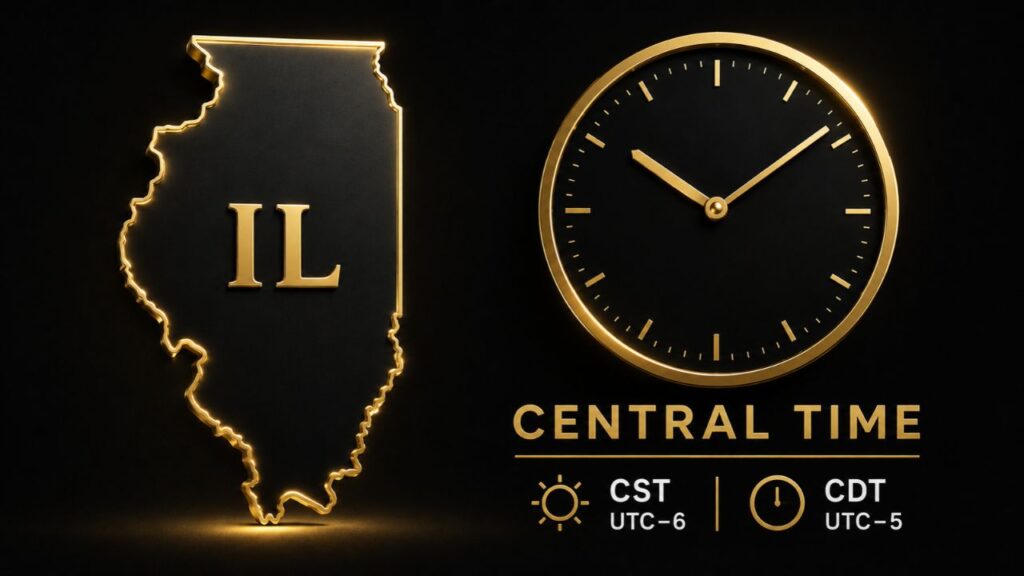
So, what time zone is Illinois in exactly? Illinois is in the Central Time Zone, often written simply as CT or Central Time. The state’s major cities, including Chicago, Springfield, and Peoria, follow this time zone. Current references identify Illinois as having a single time zone rather than separate Central and Eastern sections.
During standard time, Illinois observes Central Standard Time (CST), which is six hours behind Coordinated Universal Time (UTC−6). During the daylight-saving portion of the year, clocks move ahead by one hour and Illinois observes Central Daylight Time (CDT), which is five hours behind UTC (UTC−5).
This distinction matters because someone might casually say, “Illinois is CST,” and technically that isn’t always true. Illinois is in Central Time, while CST is the standard-time version of that zone. During daylight saving, the correct abbreviation becomes CDT. It’s a tiny distinction, but tiny distinctions are exactly where time-zone mistakes tend to sneak in.
For everyday purposes, you can remember it like this:
- Illinois time zone: Central Time
- Standard-time abbreviation: CST
- Daylight-time abbreviation: CDT
- CST UTC offset: UTC−6
- CDT UTC offset: UTC−5
- Major cities: Chicago, Springfield, Peoria
- Statewide time zone: Central Time
So if a website asks you to select the Illinois time zone, “Central Time” is normally the selection you want. No need to hunt for an obscure Illinois-only abbreviation hiding behind the digital clock.
Illinois Time Zone Today: CST or CDT?
One of the most common searches is Illinois time zone today, because knowing the general time zone doesn’t automatically tell you whether the state is currently observing CST or CDT.
In 2026, Illinois moved from CST to CDT on March 8 and is scheduled to return from CDT to CST on November 1. Therefore, on September 3, 2026, Illinois is observing Central Daylight Time (CDT), with a UTC−5 offset.
This is where the phrase Illinois daylight saving time becomes important. When daylight saving is active, clocks are advanced by one hour. When it ends, clocks return to standard time. The clock does not permanently change the state’s time zone; instead, the abbreviation and UTC offset change for part of the year.
A simple memory trick is almost embarrassingly easy:
CST = winter/standard time
CDT = daylight-saving time
Of course, the exact dates aren’t identical every year, so don’t build an important flight, meeting, or deadline around a memory like “it always changes on the second Sunday.” Check the applicable year’s calendar instead. For 2026, the Illinois schedule is March 8 for the spring change and November 1 for the autumn change.
Central Standard Time and Central Daylight Time Explained
Central Standard Time (CST) is the standard-time version of Illinois’s clock. It corresponds to UTC−6, meaning Illinois local time is six hours behind UTC.
Imagine UTC is showing 6:00 p.m. During CST, Illinois would show noon. The arithmetic isn’t mysterious, though it can feel oddly dramatic when you’re trying to schedule a call with someone several countries away.
Central Daylight Time (CDT) is one hour ahead of CST. Its offset is UTC−5. So if UTC shows 6:00 p.m. while Illinois is observing CDT, local Illinois time would be 1:00 p.m.
The important point is that CST and CDT aren’t two different Illinois regions. They are two seasonal forms of Central Time.
That’s why the safest phrase when you’re uncertain is simply Central Time Illinois. If you’re creating a calendar invite or discussing a future appointment, you can then verify whether the relevant date falls under CST or CDT.
Is Illinois CST or EST?
No, Illinois is not generally Eastern Standard Time (EST). It is in Central Time.
This confusion sometimes happens because Illinois borders states that use different time zones, particularly around the eastern side of the state. Geography, state boundaries, and time-zone boundaries don’t always line up in a way that feels perfectly logical. Still, Illinois itself is generally classified as one time zone: Central Time.
So when somebody asks, “Is Illinois CST or EST?” the practical answer is:
Illinois uses Central Time, not Eastern Time.
During standard time, that’s CST. During daylight saving time, it’s CDT.
This is also why the claim that a portion of northwestern Illinois uses Eastern Time is misleading. Illinois does not currently have a separate Eastern Time portion; current references list one time zone for the state.
Chicago Time Zone: What Time Does Chicago Use?

If you’ve ever searched what time zone is Chicago Illinois, you’re looking at Central Time.
Chicago follows the same Central Time system as the rest of Illinois. In 2026, Chicago observes CDT during daylight saving time and returns to CST on November 1.
This is particularly useful because Chicago is such a major transportation, business, entertainment, and communications hub. A person arranging a conference call may say “2 p.m. Chicago time,” while somebody else sees “2 p.m. Central Time.” Those are referring to the same local clock.
Imagine someone in California says, “Let’s talk at 2.” Someone in Chicago says, “Sure.” Then someone in New York says, “Absolutely.” Three people have agreed to one meeting and, without specifying a time zone, potentially agreed to three different hours. That tiny omission can turn a perfectly respectable meeting into a calendar comedy.
For business communications, write the time zone clearly.
For example:
- 2:00 p.m. CT
- 2:00 p.m. CDT
- 2:00 p.m. CST
For an important event, including the actual date and time-zone information in the calendar invite is even better.
What Time Zone Is Springfield, Illinois In?
The answer to what time zone is Springfield Illinois in is also Central Time.
Springfield, the state capital, follows the same Illinois clock system as Chicago. That means it observes CST during standard time and CDT during daylight saving time.
This can be helpful for travelers because Springfield is a common stop for people interested in Illinois history. Someone visiting the Lincoln Museum might arrive from a different state and assume the local clock follows the time they left behind. It doesn’t work that way; once you’re in Springfield, you use local Central Time.
And yes, your phone normally handles the clock adjustment automatically, provided its date, location, and time-zone settings are configured correctly. Still, understanding the rule yourself is handy when you’re comparing schedules manually.
What Time Zone Is Peoria, Illinois In?
If your question is what time zone is Peoria Illinois in, the answer remains Central Time.
Peoria uses the same statewide time-zone arrangement as Chicago and Springfield. During standard time, it is on CST (UTC−6); during daylight saving time, it uses CDT (UTC−5).
That consistency is useful for people traveling across Illinois. You can drive from Chicago toward Springfield and continue into Peoria without needing to reset your watch because you’ve crossed an Illinois time-zone boundary. The road may seem long, the coffee may disappear quickly, but the time zone stays pleasantly boring.
Illinois Time Difference With New York and the East Coast
One of the most useful applications of knowing the Illinois time difference is comparing Illinois with New York.
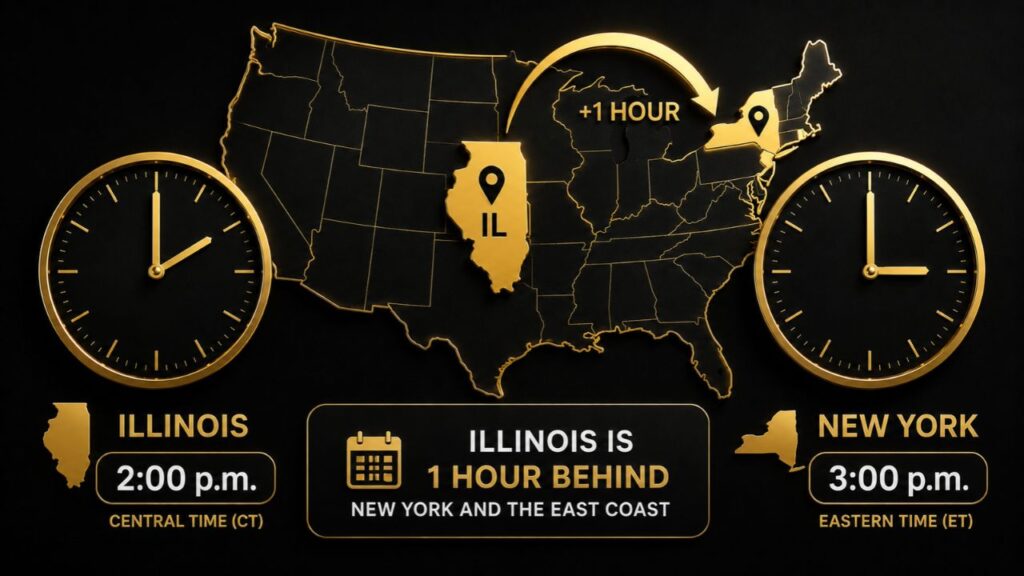
New York follows Eastern Time, while Illinois follows Central Time. This normally makes Illinois one hour behind New York. Current time-zone references likewise show Central Illinois as one hour behind New York.
So, as a basic example:
- New York: 3:00 p.m.
- Illinois: 2:00 p.m.
The same one-hour relationship generally applies when both locations are observing their corresponding daylight or standard schedules.
This is especially important for people working with the East Coast. If someone in New York says, “Let’s meet at 10 a.m.,” you should immediately wonder whether they mean 10 a.m. Eastern or whether they already converted the time for you.
A calendar system will usually make this easier, but human beings still have to enter the correct information first, which is where the comedy begins.
Illinois Time Compared to California
The Illinois time compared to California relationship is larger than the difference with New York.
California uses Pacific Time, while Illinois uses Central Time. In the usual seasonal relationship, Illinois is two hours ahead of California.
For example:
- California: 9:00 a.m.
- Illinois: 11:00 a.m.
That difference matters for meetings, customer support, family calls, online events, and work schedules.
Someone in California might consider 8 a.m. perfectly normal, while someone in Illinois may be starting their morning earlier than expected if the appointment is scheduled without conversion. The phrase “morning meeting” sounds harmless until everyone realizes they are imagining a different morning.
Illinois Time Conversion: A Simple Method
When doing Illinois time conversion, start by identifying the source location and its time zone. Then identify whether Illinois is currently observing CST or CDT.
For example, suppose you’re converting a New York appointment to Illinois time. New York is one hour ahead of Illinois, so you subtract one hour from the Eastern Time appointment.
If the New York meeting is at 4:00 p.m., the Illinois time is generally 3:00 p.m.
For California, Illinois is generally two hours ahead. So a 4:00 p.m. California appointment corresponds to 6:00 p.m. in Illinois.
The basic process is:
- Identify the original location.
- Identify its time zone.
- Check whether daylight saving time applies.
- Determine Illinois’s current offset.
- Calculate the time difference.
- Confirm the resulting local time.
- Put the correct zone into your schedule.
It takes less than a minute, but that minute can save an hour of confusion.
Does Illinois Observe Daylight Saving Time?
Yes, Illinois observes Daylight Saving Time.
During the 2026 cycle, Illinois switched from CST to CDT on March 8. It is scheduled to switch back from CDT to CST on November 1. The clocks move forward by one hour at the spring transition and backward by one hour at the autumn transition.
This is why searching for Illinois current time without considering the date can produce an incomplete answer. “Illinois time” is not always represented by the same three-letter abbreviation.
The state’s underlying zone is Central Time; the seasonal clock designation changes.
That’s also why a digital clock can seem to “know” something you don’t. It isn’t being clever, really. Your device is simply applying time-zone rules stored in its software.
Why Time Zones Matter for Meetings and Schedules

Time zones become much more important when life leaves your own neighborhood.
A person might live in Illinois, work with colleagues in New York, have relatives in California, and communicate with clients overseas. Suddenly, time scheduling becomes less about knowing what time it is and more about knowing whose time you’re talking about.
For recurring meetings, always include a time zone when participants are spread across regions. Instead of saying “Thursday at 3,” write “Thursday at 3 p.m. Central Time.”
Modern calendar systems often convert meeting times automatically for each participant, which is wonderfully convenient. But automation doesn’t remove the need for clear communication. If someone manually creates an event in the wrong zone, the software can faithfully make the wrong appointment very efficiently.
This is where time management and good schedule habits overlap.
A few practical habits help:
- Include the time zone in important invitations.
- Use calendar software that recognizes regional time zones.
- Check recurring events after daylight-saving changes.
- Confirm international meetings in both locations.
- Avoid relying only on a remembered UTC offset.
- Check the actual date before making a conversion.
Illinois Time Zone and Travel Across the State
For a traveler, the good news is that Illinois’s statewide Central Time arrangement keeps things fairly straightforward.
Suppose you’re planning a Chicago to Springfield road trip. You don’t need to worry about switching between Central and Eastern Time while traveling between those two Illinois cities. Both use Central Time.
The same principle helps when traveling to Peoria. Your navigation app may show arrival times based on local time automatically, but understanding the underlying system gives you another way to catch mistakes.
The situation can become more complicated when your road trip crosses state boundaries. Nearby Indiana, for example, has more complicated time-zone geography than Illinois, with different parts of the state following different clock arrangements.
So the moment a trip crosses state lines, don’t assume the neighboring state’s clock behaves exactly like Illinois’s. Geography says “neighbor,” but time zones say “not so fast.”
Technology, Time Tracking, and Illinois Local Time
Technology has made time zones easier and, somehow, more confusing at exactly the same time.
Your phone can display Illinois local time automatically. A computer can convert a meeting from Eastern Time to Central Time. A scheduling application can calculate the corresponding hour for someone on another continent. Even time tracking software may store work activity according to a particular time zone.
Tools such as StaffWatcher and similar workplace time-tracking systems can make accurate time records important when employees or teams operate across locations. The key issue is not merely recording an hour; it’s understanding which clock that hour belongs to.
For example, an employee may log in at 9:00 a.m. Illinois time while a manager reviewing the record is physically located in New York. If the system displays everything in the manager’s time zone, the same event could appear as 10:00 a.m.
Neither clock is necessarily wrong. They’re simply displaying the same moment through different time-zone settings.
That’s why good digital systems distinguish between a timestamp and a local display. It sounds technical, but the everyday result is simple: fewer “I thought you meant 9” conversations.
Common Mistakes About the Illinois Time Zone
There are several small misconceptions worth clearing up.
One is that Illinois uses Eastern Standard Time (EST) because it borders states associated with Eastern Time. It doesn’t. Illinois is in Central Time.
Another is treating CST as the permanent name of Illinois’s time zone. CST is used during standard time; during daylight saving, the abbreviation becomes CDT.
A third mistake is assuming the phrase “Illinois current time” has one permanent UTC offset. It doesn’t. The offset changes seasonally because Illinois observes daylight saving time.
And finally, some people believe Illinois has a separate Eastern Time area. Current references identify Illinois as having one time zone, Central Time.
These mistakes are understandable because time zones were never designed to be emotionally satisfying. They’re administrative boundaries layered onto geography, politics, transportation, economics, and history. A map doesn’t always explain why the clock behaves the way it does.
How to Avoid Time-Zone Confusion
The best strategy is to stop treating time zones as something you calculate only after a mistake has happened.
When arranging an appointment, write the zone. When traveling, check your device. When planning an online event, confirm the host’s location. When scheduling across states, don’t assume everyone sees the same clock.
For important schedules, include both the city and time zone when possible. “10 a.m. Chicago time” is clearer than “10 a.m.” And if you’re arranging something far into the future, check the daylight-saving rules applicable to that date rather than relying on today’s offset.
This is especially useful for recurring work. A weekly meeting that looks correct for several months can behave unexpectedly around clock changes if the calendar event was created incorrectly.
The smartest time-management habit isn’t memorizing every time zone on Earth. It’s knowing when you need to check.
A Quick Illinois Time Zone Cheat Sheet

If you’re in a hurry and just want the answer without sending your brain on a three-hour philosophical journey about clocks, keep this nearby:
| Question | Answer |
|---|---|
| Illinois time zone | Central Time |
| Standard time | Central Standard Time (CST) |
| CST offset | UTC−6 |
| Daylight time | Central Daylight Time (CDT) |
| CDT offset | UTC−5 |
| Chicago | Central Time |
| Springfield | Central Time |
| Peoria | Central Time |
| New York comparison | Illinois is generally 1 hour behind |
| California comparison | Illinois is generally 2 hours ahead |
| Daylight Saving Time | Observed |
| Current September 2026 designation | CDT |
The table is simple, but simple is exactly what you want when you’re about to send a calendar invite and don’t have time for a geography lesson.
Read more blog: What Time Does Sheetz Stop Selling Alcohol?
Frequently Asked Questions
What time zone is Illinois?
Illinois is in the Central Time Zone. It uses CST during standard time and CDT during daylight saving time.
Is Illinois in Central Time?
Yes. Illinois is in Central Time statewide under the current time-zone arrangement.
Is Illinois CST or CDT?
It depends on the date. Illinois uses CST (UTC−6) during standard time and CDT (UTC−5) during daylight saving time.
What time zone is Chicago in?
Chicago is in the Central Time Zone and follows the CST/CDT seasonal clock system.
What time zone is Springfield, Illinois, in?
Springfield is in Central Time, just like the rest of Illinois.
What time zone is Peoria, Illinois, in?
Peoria is also in Central Time.
Is Illinois one hour behind New York?
Yes, in the normal seasonal relationship between Central and Eastern Time, Illinois is one hour behind New York.
What is Illinois’s UTC offset?
Illinois uses UTC−6 during CST and UTC−5 during CDT.
Does Illinois observe daylight saving time?
Yes. Illinois observes daylight saving time, changing between CST and CDT.
Does all of Illinois have the same time zone?
Under the current arrangement, yes: Illinois has one time zone, Central Time.
Conclusion
So, what time zone is Illinois? The answer is pleasantly straightforward: Illinois is in the Central Time Zone.
During standard time, the state uses Central Standard Time (CST), UTC−6. During daylight saving time, it uses Central Daylight Time (CDT), UTC−5. Chicago, Springfield, Peoria, and other Illinois communities follow this Central Time arrangement.
The bigger lesson is that knowing a time zone is not just a geography fact. It affects phone calls, travel plans, work shifts, online events, meetings, digital calendars, and everyday communication. One hour can look tiny on a clock and surprisingly large inside a missed appointment.
Illinois makes the basic rule easy enough: remember Central Time, then remember that Central Time can be CST or CDT depending on the season.
And when in doubt, check the date, check the local time, and check the time zone before pressing “send.” It takes a few seconds, which is much cheaper than explaining to somebody in New York why you accidentally invited them to a meeting an hour late.
