
There are moments when a digital clock gives you a time that looks almost like a little puzzle. You glance at your phone, see 16:40, and for a second your brain says, “Wait… what time is that again?” It happens more often than people admit, specially when travelling, reading an international schedule, checking a work timetable, or trying to understand a message from someone who uses the 24-hour time format every day.
The simple answer is wonderfully uncomplicated: 16:40 in 24-hour time = 4:40 PM in the 12-hour clock. That means 16:40 is an afternoon time, not a morning time. Once you understand the small trick behind the conversion, the number stops looking mysterious and starts behaving like an ordinary clock time.
Still, there is something interesting hiding inside this tiny calculation. Time formats shape the way we organise meetings, remember appointments, plan journeys, manage work hours, and even communicate with people who live thousands of miles away. A number such as 16:40 can look cold and technical, yet it might represent the exact moment you leave work, meet a friend, catch a train, or finally close your laptop after a long day.
| 24-Hour Time | 12-Hour Time |
|---|---|
| 16:40 | 4:40 PM |
Step 1: What Time Is 16:40?

16:40 in 24-hour time = 4:40 PM in the 12-hour clock.
The easiest way to understand what time is 16:40 is to remember that the 24-hour clock counts the hours continuously from midnight through the evening. Midnight begins at 00:00, and the day continues until 23:59, just before the next midnight arrives.
So, when you see 16:40, the “16” represents the sixteenth hour of the day. Because it is greater than 12, you subtract 12 from 16:
16 − 12 = 4
The minutes stay exactly the same, so 16:40 becomes 4:40 PM. Nothing happens to the 40 minutes. They simply come along for the ride, which is a nice little mercy from mathematics.
If somebody asks, “What does 16:40 mean?”, the answer is therefore 4:40 PM. If they ask, “Is 16:40 AM or PM?”, it is PM, because the hour falls after noon.
Why 16:40 Can Look Confusing at First
The 24-hour clock feels slightly strange if you grew up using the 12-hour clock. In the familiar system, we keep repeating the numbers from 1 through 12, then use AM and PM to tell us which half of the day we’re talking about. The 24-hour system skips that repetition altogether.
Instead of saying 4:40 PM, it says 16:40. At first, that can feel like the clock has suddenly started speaking in code, but it really has not. It is simply counting.
For example, 1:00 PM becomes 13:00, 2:00 PM becomes 14:00, and 3:00 PM becomes 15:00. Then we reach 16:40, which translates to 4:40 PM. After that comes 17:00, or 5:00 PM, and the pattern keeps going.
This is why learning a few reference points makes military time conversion much easier. Once 13 means 1 PM, 14 means 2 PM, 15 means 3 PM, 16 means 4 PM, and so on, the rest begins to feel almost automatic.
16:40 in Standard Time
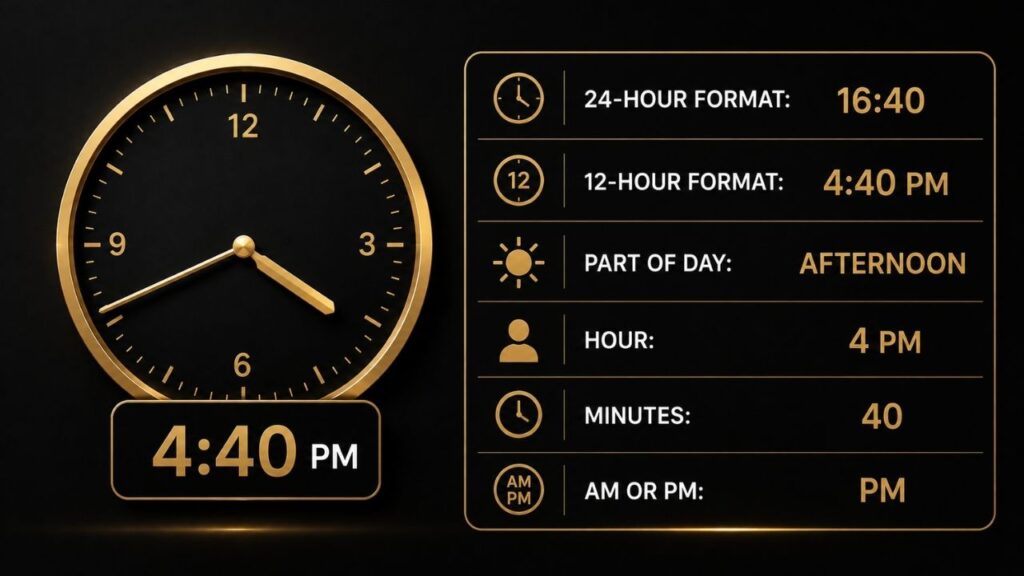
If you searched for 16:40 in standard time, you were probably looking for the same answer in the familiar 12-hour format. In that format, 16:40 is 4:40 PM.
The term “standard time” can sometimes be confusing because it also has another meaning in discussions about time zones and daylight-saving rules. But when people casually ask for a conversion from military or 24-hour time into standard clock notation, they generally mean the 12-hour format used with AM and PM.
So the conversion is:
- 24-hour format: 16:40
- 12-hour format: 4:40 PM
- Part of day: Afternoon
- Hour: 4 PM
- Minutes: 40
- AM or PM: PM
Notice how little actually changes. The 40 stays 40. Only the hour needs translating, and thats the part people sometimes overthink.
How to Convert 16:40 to PM
Learning how to convert military time doesn’t require a complicated formula. For afternoon hours from 13:00 through 23:59, simply subtract 12 from the hour.
For 16:40:
16 − 12 = 4
Therefore:
16:40 → 4:40 PM
You can use the same method with other afternoon times. For example, 18:20 becomes 6:20 PM, while 21:15 becomes 9:15 PM. The minutes don’t need any conversion at all, which makes the process surprisingly friendly.
There is one important exception to remember: midnight and noon behave differently. 00:00 means midnight, while 12:00 means noon. You don’t subtract 12 from 12:00 and call it 0:00 in ordinary 12-hour notation. That would make your schedule look like it has fallen into a small black hole.
A Quick 24-Hour Clock Conversion Chart
A simple military time chart can make understanding military time much easier, especially when you’re learning it for the first time.
- 00:00 = 12:00 AM
- 01:00 = 1:00 AM
- 02:00 = 2:00 AM
- 03:00 = 3:00 AM
- 04:00 = 4:00 AM
- 05:00 = 5:00 AM
- 06:00 = 6:00 AM
- 07:00 = 7:00 AM
- 08:00 = 8:00 AM
- 09:00 = 9:00 AM
- 10:00 = 10:00 AM
- 11:00 = 11:00 AM
- 12:00 = 12:00 PM
- 13:00 = 1:00 PM
- 14:00 = 2:00 PM
- 15:00 = 3:00 PM
- 16:00 = 4:00 PM
- 17:00 = 5:00 PM
- 18:00 = 6:00 PM
- 19:00 = 7:00 PM
- 20:00 = 8:00 PM
- 21:00 = 9:00 PM
- 22:00 = 10:00 PM
- 23:00 = 11:00 PM
From this chart, 16:40 is easy to spot: it sits forty minutes after 16:00, making it 4:40 PM.
What Is 16:40 in Regular Time?
When someone asks “What is 16:40 in regular time?”, they normally want the 12-hour version. The answer is 4:40 PM.
Think of the 24-hour clock as a long hallway with 24 numbered doors. The first twelve doors belong to AM, while the later twelve belong to PM. Door 16 is therefore the same as door 4 in the PM half of the day. A slightly odd image, maybe, but it makes the relationship easier to remember.
At 4:40 PM, the afternoon is moving toward evening. Depending on the season and where you live, there may still be plenty of sunlight, or the day may already be beginning to soften into dusk. The clock says 16:40, but the world outside gives that number its atmosphere.
16:40 and the Afternoon
The meaning of a time isn’t always just mathematical. 16:40 belongs to the late-afternoon portion of the day, a peculiar little stretch when work is winding down for some people while others are just getting into the second half of their routines.
A student might see 16:40 and think about the end of classes. A parent may see it as the moment to leave the office before traffic becomes unbearable. Someone travelling through Europe might see it printed on a train timetable and know immediately that the departure is at 4:40 PM.
In cities such as Brussels, a schedule written using the 24-hour system can make daily travel feel much cleaner. Imagine Megan standing near the Grand Place, checking a digital itinerary that says 16:40. She doesn’t need to wonder whether it means 4:40 in the morning or evening. The number itself has already settled the argument.
16:40 in Travel and International Schedules
One of the biggest advantages of the 24-hour time format is clarity. When airlines, railway systems, hospitals, emergency services, and international organisations publish schedules, they often need to eliminate ambiguity.
Consider the difference between “4:40” and “16:40.” The first one leaves you asking whether someone means AM or PM. The second one doesn’t. It has already answered the question.
This becomes especially useful when travelling between countries where different conventions are common. You might normally use a 12-hour clock at home but encounter 24-hour schedules abroad. A little time conversion knowledge prevents silly mistakes that can become expensive very quickly.
Missing a meeting because you confused 4:40 AM with 4:40 PM is not exactly the kind of adventure anybody puts on their holiday wishlist.
16:40 and Military Time
The phrase 16:40 military time is common in searches, although the formal conventions used by military organisations can include additional details in spoken communication. In everyday internet usage, people generally use “military time” to refer to the 24-hour clock.
So if you see:
16:40
you can read it as:
“Sixteen forty” in a 24-hour setting, or simply “4:40 PM” when converting it to the 12-hour system.
The key skill is not memorising hundreds of examples. It is recognising the pattern. Hours from 13 through 23 belong to the PM portion of the day, and subtracting 12 gives the familiar hour.
12-Hour vs 24-Hour Clock

The debate between the 12-hour vs 24-hour clock is less about which system is “right” and more about what feels natural in a particular place or situation.
The 12-hour system is friendly and familiar for many people. Saying “I’ll call you at 4:40 PM” sounds conversational and instantly understandable in many English-speaking environments.
The 24-hour system, however, is beautifully precise. Saying “I’ll call you at 16:40” removes the AM/PM question entirely. For timetables, work schedules, transportation, and international communication, that precision can be extremely helpful.
Neither system is a villain. They’re just two different ways of putting labels on the same passing hours.
Using 16:40 for Time Management
Knowing what time is 16:40 can become surprisingly useful when you’re trying to improve time management. Precise time awareness helps people understand where their hours are actually going instead of vaguely remembering that “the afternoon disappeared.”
Suppose you have work scheduled from 13:00 to 16:40. That’s three hours and forty minutes. If you break the period into smaller tasks, you can assign realistic blocks to each one rather than throwing every task into the same enormous afternoon bucket.
For example, you might reserve the first hour for focused work, the next hour for meetings, another hour for project management, and the remaining forty minutes for administrative tasks. This is where task prioritization becomes useful. The clock isn’t managing your work for you, but it does give you a boundary.
16:40, Deadlines, and Work Hours
Deadlines become less frightening when they’re visible and specific. A vague instruction such as “finish this in the afternoon” can stretch like chewing gum. A deadline of 16:40 is much harder to misunderstand.
If a project must be completed by 16:40, you can work backward. Perhaps the final review needs twenty minutes, formatting needs thirty minutes, and the actual writing needs two hours. Suddenly the deadline becomes a planning tool rather than merely a threat sitting at the end of your day.
This is one reason time tracking tools can be helpful. They show how long activities really take, which can improve future estimates. You might believe a report takes forty minutes, only to discover that it usually consumes an hour and twenty minutes. The clock has a slightly rude habit of telling the truth.
Time Tracking and Productivity
Modern time tracking tools are often used by freelancers, remote workers, teams, and businesses to monitor projects and manage work hours. A timestamp such as 16:40 can become part of a larger record showing when a task ended or when a person moved from one activity to another.
Tools and services such as StaffWatcher, for example, are associated with workplace monitoring and activity tracking. The important point isn’t that everyone should track every second of their life. Constant measurement can become exhausting too. The useful part is understanding patterns.
If you notice that your productivity falls sharply after 16:40, perhaps demanding creative work belongs earlier in your day. If your energy improves during late afternoon, you may want to schedule certain tasks there instead. Good time management skills are often less about squeezing more work into a day and more about putting the right work in the right part of it.
Digital Clocks Make 16:40 Easier to Read
A digital clock is probably where most people encounter times like 16:40 today. Phones, computers, smart watches, transport displays, office systems, and many appliances can display the 24-hour format.
Reading a digital clock in this style is mostly a matter of recognising the hour. The colon separates hours from minutes, so 16:40 means sixteen hours and forty minutes from midnight.
Once you’ve seen enough examples, the conversion becomes almost subconscious. You glance at 16:40 and your brain quietly says “4:40 PM” without needing to perform the subtraction consciously. Thats one of those tiny skills that feels unimportant until you suddenly need it.
Pop Culture Can Make Time Formats Memorable
Even fictional worlds occasionally give us reasons to think about time, schedules, and precise moments. Batman might be associated with the nighttime streets of Gotham, where every minute feels like it belongs to a different kind of clock.
Likewise, films and television shows often display digital timestamps to establish where characters are in a story. A Netflix drama might flash a particular time on screen, while a mystery such as Time Quest could use timestamps to create urgency around an event.
These examples aren’t necessary for understanding 16:40, of course. But they remind us that time is more than numbers. In stories, 4:40 PM can be the moment before someone arrives, the moment after someone leaves, or the moment when everything changes.
How to Read 16:40 Without a Calculator

You don’t need a military time calculator every time you encounter a number above 12. For common afternoon hours, a simple mental shortcut works perfectly.
See the hour.
If it is between 13 and 23, subtract 12.
Keep the minutes unchanged.
For 16:40:
16 − 12 = 4
40 stays 40
Result:
4:40 PM
That’s it. The entire 16:40 time conversion can be completed in a few seconds. If you’re regularly working with international schedules, you may eventually stop thinking of it as conversion at all.
When a Time Converter Is Useful
Although mental conversion is easy, a time converter becomes valuable when you are dealing with time zones, dates, or complicated schedules. Converting 16:40 from a 24-hour clock to 4:40 PM is simple, but converting 16:40 in one city to another location may require more information.
For example, a meeting at 16:40 in Europe could occur at a very different local time for someone elsewhere. Daylight-saving rules, geographic location, and the date itself can affect the result.
This is where digital productivity tools and scheduling platforms can save headaches. They handle the mechanical part so people can focus on the actual meeting, which is generally preferable to spending twenty minutes arguing with a clock.
A Small Daily Habit: Check the Clock With Intention
Time awareness doesn’t mean staring at the clock every five minutes. In fact, doing that can make a productive afternoon feel painfully slow.
Instead, use specific checkpoints. Perhaps 12:00 is your midday reset, 14:00 is your progress check, and 16:40 becomes your afternoon closing point. You can ask yourself: What did I finish? What still matters today? What can wait until tomorrow?
This kind of daily planning gives time a structure without turning your life into a spreadsheet. The objective is preparedness, not obsession.
Practical Examples of 16:40
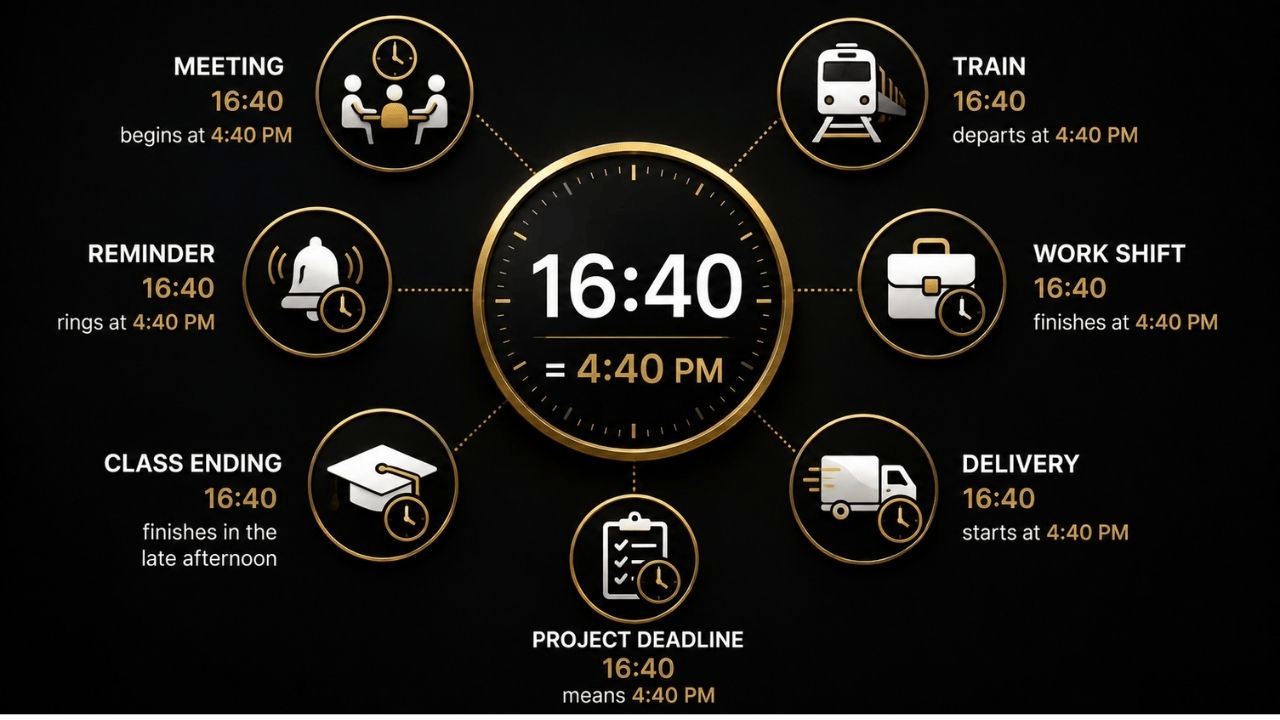
Here are a few ordinary situations where 16:40 in 12-hour format might appear:
- A meeting scheduled for 16:40 begins at 4:40 PM.
- A train leaving at 16:40 departs at 4:40 PM.
- A work shift ending at 16:40 finishes at 4:40 PM.
- A reminder set for 16:40 rings at 4:40 PM.
- A delivery window beginning at 16:40 starts at 4:40 PM.
- A class ending at 16:40 finishes in the late afternoon.
- A project deadline marked 16:40 means 4:40 PM local time.
The situation changes, but the conversion doesn’t. That’s the comforting thing about exact timekeeping: the clock doesn’t care whether you’re catching a train or trying to finish a report.
Common Mistakes When Converting 16:40
One common mistake is treating 16 as though it were a normal 12-hour clock number. It isn’t. The 24-hour system allows hours up to 23, so the number 16 needs conversion.
Another mistake is changing the minutes. Some people see 16:40 and start performing unnecessary calculations on both numbers. Don’t. The minutes remain 40.
A third mistake is forgetting noon and midnight. 00:00 is midnight, while 12:00 is noon. These reference points are important because they show where the two systems meet and where the AM/PM labels change.
Finally, don’t confuse local time with time-zone conversion. Knowing that 16:40 equals 4:40 PM tells you the clock format. It doesn’t automatically tell you what time it is somewhere else.
The Deeper Lesson Behind a Simple Time Conversion
It may seem excessive to spend so much attention on four digits, but small calculations often reveal larger habits. Timekeeping is really about communication. A clear timestamp helps two people understand the same moment without needing a long explanation.
That becomes increasingly important in remote work, international travel, online meetings, project planning, and global communication. A team member in Europe, another in Asia, and another in North America may all look at the same schedule and interpret it differently if the format isn’t clear.
The humble 24-hour clock solves one small part of that problem. It gives every hour its own identity.
Read more blog: What Time Does Sheetz Stop Selling Alcohol?
Frequently Asked Questions
16:40 military time
16:40 military time is 4:40 PM in the 12-hour clock. It represents an afternoon time in the 24-hour time format.
what time is 16:40
16:40 is 4:40 PM in regular time. To convert it, simply subtract 12 from 16 while keeping the 40 minutes unchanged.
16:40 time
16:40 time means 4:40 PM. It is written in the 24-hour clock and refers to the late afternoon.
16/40
16/40 is not a standard time format. If you mean 16:40, it converts to 4:40 PM.
16+40
16 + 40 = 56. This is a mathematical addition, not a standard way to write a time.
Conclusion
So, what time is 16:40? The answer is simple: 4:40 PM.
If you’re learning how to read military time, remember the basic rule for afternoon hours: when the hour is greater than 12, subtract 12 and keep the minutes unchanged. In this case, 16 becomes 4, while 40 remains 40. Therefore, 16:40 = 4:40 PM.
But there is a little more value in knowing this than simply winning a tiny argument with a digital clock. Understanding time formats can improve travel planning, scheduling, productivity, project management, deadline awareness, and everyday communication. It helps you move between systems without hesitation.
And perhaps that’s the nicest way to think about time. A clock is not really telling you what to do. It is quietly showing you where you are. At 16:40, you are four hours and forty minutes into the PM side of the day, standing somewhere between what has already happened and what still might.
Maybe you’re finishing work. Maybe you’re heading home. Maybe you’re waiting for someone at 4:40 PM. Maybe you’re simply looking at a clock because curiosity brought you here. Whatever the reason, now you know the answer without needing to squint at the numbers twice.
16:40 means 4:40 PM.
Simple, precise, and pleasantly less mysterious than it first looked. And if you start noticing other 24-hour times around you, try converting them mentally before reaching for a calculator—you may find that your brain learns the pattern faster than you expect.
