
There are funny little questions that sneak into your day without knocking. One of them is what time was it 19 minutes ago. It sounds almost too tiny to deserve attention, yet somehow it hangs around in your mind like the smell of fresh coffee after everyone’s already left the kitchen. Earlier today I caught myself staring at a digital clock, not because I had somewhere dramatic to be, but because I wondered where nineteen whole minutes had wandered off to. It felt oddly important, even if it wasnt.
If the current conversation time is 2:16, then Step 1: What time was it 19 minutes ago? The answer is 1:57. A tiny calculation, sure, but it’s funny how one small subtraction can become the start of a much bigger conversation about how we spend our lives. What time was it 19 minutes ago? At first glance it’s simply a time calculation, a quick subtract 19 minutes exercise. Yet underneath that neat answer sits something much softer time awareness, personal reflection, and maybe even a little reminder that every minute quietly counts.
Those nineteen minutes might’ve been spent laughing with a friend, doom-scrolling on a smartphone, crossing something off a to-do list, sipping herbal tea, or simply staring out the window pretending to think while actually thinking about absolutely nothing. And honestly, thats okay too. Every minute tells a tiny story, even when we don’t notice it happening.
| Current Time | 19 Minutes Ago | Calculation |
|---|---|---|
| 2:16 | 1:57 | 2:16 − 19 minutes = 1:57 |
Step 1: What Time Was It 19 Minutes Ago?
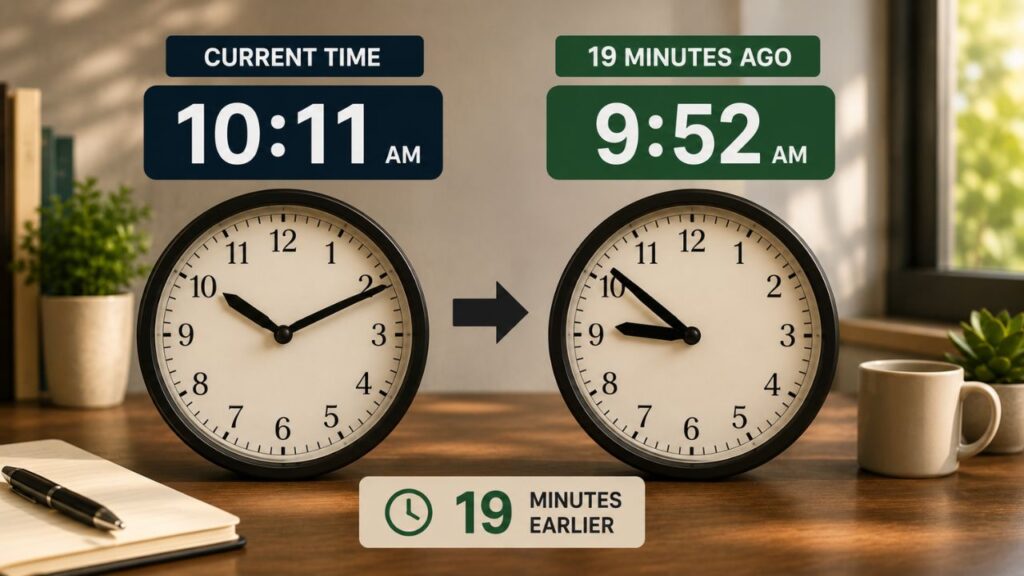
Let’s begin with the obvious because sometimes obvious things deserve a little celebration.
If the clock currently reads 2:16, subtracting nineteen minutes gives us 1:57. That’s the exact answer. A simple clock calculation that takes only seconds.
Yet it’s curious how this little bit of arithmetic pops up in everyday life more often than people realize.
Maybe you’re checking when medication was taken.
Maybe you’re reviewing a message timestamp.
Maybe a recipe timer went off.
Maybe you’re trying to remember when your coffee was poured because now it tastes suspiciously colder than your motivation.
Knowing what time was it 19 minutes ago isn’t just about numbers. It’s about context.
It’s about remembering.
It’s about reconnecting little events that make up a normal day.
That’s why a time calculator or a quick mental subtraction becomes surprisingly useful.
The more you think about it, the more you notice that our days are stitched together by tiny moments rather than giant milestones. Funny thing is, we mostly remember the giant ones.
Why a Tiny Time Difference Can Feel Surprisingly Big
Nineteen minutes isn’t an hour.
It isn’t even half an hour.
Yet nineteen minutes can completely change the outcome of a day.
Think about it.
A bus leaves.
Bread finishes baking.
An interview starts.
A child falls asleep.
Your favorite song finishes six times over.
Someone sends a text that changes everything.
Or maybe… nothing happens at all.
That last possibility matters too.
When we talk about time difference, we’re really talking about opportunity. Every minute quietly asks whether we noticed it. Sometimes we answer yes. Sometimes we answer with another episode on television. Eh, life happens.
There’s something beautifully human about realizing that current time instantly becomes history. By the time you finish reading this sentence, another few seconds have already joined yesterday’s collection.
What Time Was It 19 Minutes Ago? A Question That Builds Time Awareness
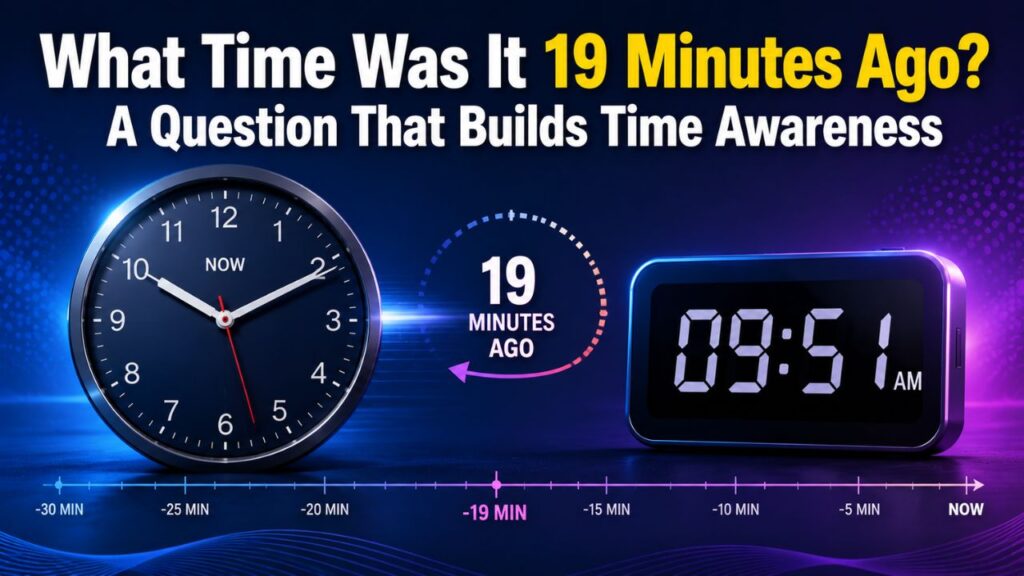
The question what time was it 19 minutes ago carries more weight than people first expect.
It gently nudges us toward time awareness.
Instead of racing ahead to tomorrow, it asks us to glance backward not years, not months, just nineteen minutes.
Can you remember what you were doing?
Were you focused?
Distracted?
Laughing?
Working?
Waiting?
It’s almost like giving your memory a tiny stretch.
This habit develops stronger self-awareness, especially when paired with short moments of reflection.
Some people even keep a small notebook beside the kitchen table where they jot down important events throughout the day. Others rely on a productivity app that quietly records activities without much fuss.
Neither method is perfect, and thats probably the point.
Perfection isn’t required.
Awareness is.
Every Minute Has a Personality
Minutes aren’t identical.
One minute during a holiday feels different from one minute waiting outside an examination room.
A minute spent watching rain feels slower.
A minute spent laughing disappears suspiciously fast.
That’s why every minute and every second carry emotional weight beyond what any clock can display.
Our brains measure experiences differently than calendars do.
Scientists studying attention have repeatedly shown that our perception of time changes depending on emotion, novelty, and focus. It’s one reason vacations seem to fly by while waiting rooms seem determined to bend reality.
Maybe that’s why nineteen minutes can sometimes feel like five.
Other times it feels like forever, honestly.
Productivity Starts With Small Questions
Productivity isn’t always about squeezing more work into the day.
Sometimes it’s about asking better questions.
Questions like:
- Where did the last nineteen minutes go?
- Was I working toward my priorities?
- Did I get distracted?
- Did I actually need that distraction?
- What can I improve during the next nineteen minutes?
- Which task deserves my attention first?
- Am I making progress or simply staying busy?
- Did my actions match today’s goals?
- What helped me stay focused?
- What interrupted my momentum?
These reflections naturally improve personal productivity without becoming exhausting.
Instead of judging yourself, simply observe.
Observation often changes behavior all by itself.
The Pomodoro Technique and the Curious Case of Nineteen Minutes
One of the world’s best-known focus systems is the Pomodoro Technique.
Traditionally it recommends working for about twenty-five minutes followed by a 5-minute break.
Interestingly, nineteen minutes sits comfortably inside that focus window.
Imagine checking the clock and realizing you’ve already completed nineteen focused minutes.
You’re closer than you think.
That realization alone can encourage you to keep going rather than abandoning the task.
Many people combine this approach with time blocking, focus sessions, and gentle workflow optimization instead of forcing themselves into impossible schedules.
Good habits aren’t loud.
They’re quietly repeated.
The Tools That Help You Keep Track
Modern life gives us countless ways to measure time.
Some are simple.
Some are almost ridiculously advanced.
A traditional clock still works beautifully.
A digital clock offers instant precision.
Your smartphone probably tracks everything from alarms to appointments.
A kitchen timer remains surprisingly satisfying because it asks for only one job.
Meanwhile, platforms like StaffWatcher and other time tracker solutions help businesses understand workflows and employee activity, although they’re most effective when used thoughtfully rather than as constant surveillance.
For personal use, many people enjoy lightweight productivity tools that measure time allocation, highlight distractions, and support planning your day without making life feel mechanical.
Technology works best when it quietly supports your goals instead of constantly demanding your attention. Thats easy to forget sometimes.
Reflection Questions Worth Asking Yourself
If you knew exactly what happened nineteen minutes ago, what would it reveal?
Perhaps ask yourself:
- Was I present?
- Was I multitasking unnecessarily?
- Did I procrastinate?
- What mattered most?
- What can I repeat tomorrow?
- What should I stop doing?
- Did I protect my attention?
- Was I moving closer to my goals?
- Did I enjoy the moment?
- What deserves gratitude today?
These questions strengthen reflection on time, encourage mindfulness practice, and help identify hidden procrastination habits before they quietly grow into permanent routines.
Time Management Is Really About Choices

People often think time management means organizing calendars.
It does.
But only partly.
Real workflow management is choosing where attention belongs.
Every decision has an opportunity cost of time.
Watching one video means not reading one chapter.
Scrolling means not stretching.
Complaining means not creating.
Resting, however, is different.
Rest isn’t wasted.
It’s an investment.
Healthy life balance includes intentional breaks alongside meaningful work.
Otherwise efficiency eventually collapses under exhaustion.
Oddly enough, some of the most efficient work happens after stepping away for ten quiet minutes with a cup of coffee.
Building Better Habits One Minute at a Time
People love dramatic transformations.
Real life usually prefers tiny adjustments.
Improving daily productivity doesn’t require waking at 4 AM or buying expensive planners.
Instead, consider habits like these:
- Review yesterday before planning today.
- Practice simple goal setting every morning.
- Use task prioritization before checking notifications.
- Create realistic break schedule routines.
- Track one habit consistently.
- Reduce unnecessary multitasking.
- Celebrate small wins.
- Reflect before sleeping.
- Protect deep-focus periods.
- Leave room for unexpected moments.
These little changes gradually improve efficiency improvement, goal alignment, and overall personal development.
Not overnight though. Real life is rarely that cinematic.
A Tiny Story From Ordinary Life
Years ago, a grandfather supposedly told his grandson something wonderfully simple.
“The clock doesn’t steal your day. It only reports what you gave away.”
Whether those exact words were spoken doesn’t really matter.
The idea sticks.
Imagine sitting together at the kitchen table, sharing tea while an old wall clock ticks without hurry.
No motivational speeches.
No productivity gurus.
Just quiet wisdom.
That’s often enough.
Sometimes the best lessons arrive dressed as ordinary conversations.
Mindfulness Hidden Inside a Clock
Mindfulness often sounds complicated.
Actually, it’s beautifully ordinary.
Notice your breathing.
Notice the room.
Notice the sounds.
Notice where your thoughts keep wandering.
That’s present moment awareness.
When someone asks what time was it 19 minutes ago, they unknowingly invite a gentle mindfulness exercise.
You pause.
You remember.
You reconnect.
You become just a little more present.
And strangely, that backward glance often helps you move forward with greater intention.
Making Every Minute Count Without Obsessing
There’s an important balance here.
Not every minute needs optimization.
Some minutes exist for laughter.
Some exist for boredom.
Some exist for healing.
Trying to maximize every second quickly becomes exhausting.
Instead, think about making every minute count by making more of them meaningful rather than merely productive.
That distinction changes everything.
Your daily routine should support your wellbeing, your relationships, your ambitions, and your curiosity not just your checklist.
Because people remember moments, not schedules.
Practical Ways to Calculate Time Quickly
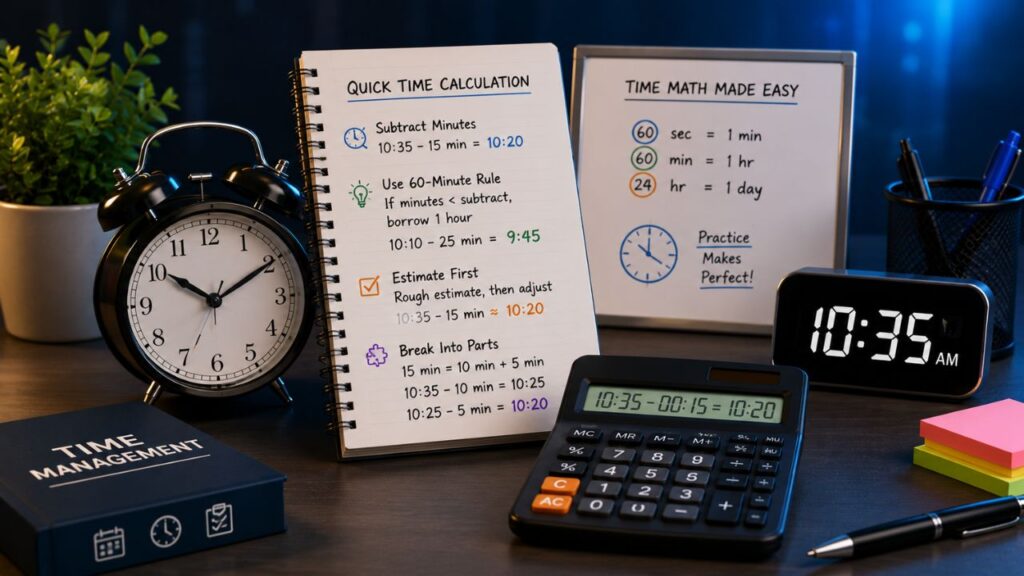
If you frequently need to calculate time, here are a few simple approaches:
- Count backward mentally from the current hour.
- Use your phone’s clock application.
- Ask a voice assistant.
- Open an online time calculator.
- Check timestamp histories in messaging apps.
- Keep a small notebook for important events.
- Use calendar reminders for recurring activities.
- Try a dedicated time tracker if you enjoy reviewing patterns.
After a little practice, subtract minutes from current time becomes surprisingly natural.
It’s almost like learning mental arithmetic you stop noticing the effort after a while.
Read more blog: How Much Time Till 2:50
Frequently Asked Questions
what time was it 19 minutes ago
To find what time it was 19 minutes ago, simply subtract 19 minutes from the current time. A time calculator makes this quick and accurate.
what time was it 19 min ago
Finding what time it was 19 min ago is easy—take the current time and subtract 19 minutes. This works for any clock or time zone.
19 mins ago
The exact time 19 mins ago depends on your current time. Just subtract 19 minutes to get the correct result instantly.
19 minutes ago from now
To calculate 19 minutes ago from now, subtract 19 minutes from the present time. It’s a simple way to check a recent past timestamp.
Conclusion
So, what time was it 19 minutes ago?
If the current time is 2:16, the answer is 1:57.
Simple.
Yet beneath that answer lives something much richer.
Questions about managing every minute, improving focus techniques, reducing distractions, embracing mindful living, strengthening workflow management, encouraging planning, supporting continuous self-improvement, and appreciating time as one of life’s most valuable resources.
Every passing minute quietly becomes part of your story.
Some will be forgotten.
Others will stay forever.
The beautiful thing is that another nineteen minutes are already waiting to become something meaningful.
What were you doing nineteen minutes ago?
More importantly… what will you choose to do during the next nineteen?
