
There are funny little moments that somehow carry way more weight than they probably should. Looking at a clock, noticing the current time, and wondering, “how much time till 2:50?” is one of those tiny questions that sneaks into ordinary afternoons.
It doesn’t seem important at first, but then your brain starts making plans, adjusting expectations, and quietly rearranging the rest of the day. Its kinda amazing how something so small can shape the next few hours.
If you’re asking this question based on the current time in this conversation, the answer is refreshingly straightforward.
| Category | Keywords / Entities |
|---|---|
| Primary Keyword | How Much Time Till 2:50 |
| Related Keywords | Time until 2:50, How long until 2:50, Minutes until 2:50, Countdown to 2:50, Time left until 2:50 |
| NLP Entities | Time, Clock, Countdown, Current Time, Minutes, Hours, Deadline, Timer |
| Semantic Keywords | Time calculation, Time difference, Time remaining, Clock reading, Time management |
| LSI Keywords | Countdown timer, Digital clock, Analog clock, Time tracker, Schedule, Planning, Productivity, Reminder, Alarm, Time blocking |
| User Intent | Check remaining time until 2:50 quickly and accurately |
How Much Time Till 2:50?
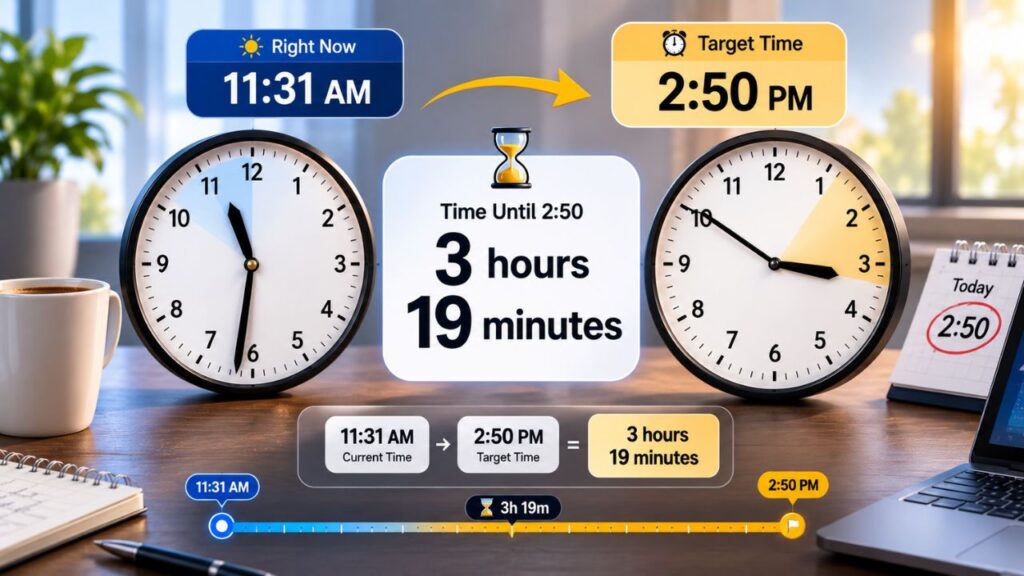
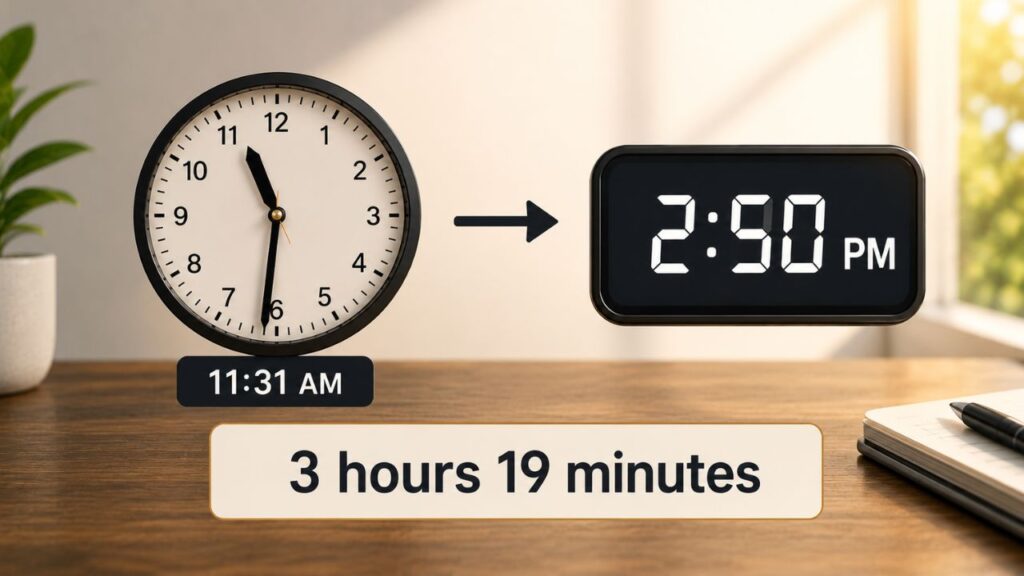
Right now, the local time is 11:31 AM.
That means the time until 2:50 PM is:
⏳ 3 hours 19 minutes
That’s your countdown to 2:50, and while it might simply be a piece of time calculation, it can also become a surprisingly useful checkpoint for your afternoon. Three hours and nineteen minutes isn’t just a number. It’s enough time to finish meaningful work, enjoy a proper lunch, catch up on messages, squeeze in a workout, or even watch an episode on Netflix without feeling guilty. Well… maybe two episodes if we’re being honest, though that can get risky.
Why We Constantly Wonder About the Time Until 2:50
Questions like how much time until 2:50, time left, or minutes left aren’t really about numbers alone. They’re about knowing where we stand. Humans naturally measure progress against little milestones, and a specific time often becomes one of those invisible finish lines.
Maybe 2:50 PM is when:
- A meeting begins.
- School finishes.
- A train leaves.
- Your favorite livestream starts.
- A project deadline arrives.
- A reminder goes off.
- Someone important calls.
- Your work shift ends.
- You finally get a coffee break.
- You promised yourself you’d stop scrolling Instagram.
Funny enough, once your mind has a target, every glance at the digital clock or traditional clock starts feeling slightly different. The numbers almost seem to move with personality, if that makes any sense.
Understanding the Time Calculation
Working out the time difference isn’t difficult, although many people still double-check because nobody wants to accidentally arrive late.
Starting point:
- Current time: 11:31 AM
- Target time: 2:50 PM
Breaking it down:
- From 11:31 AM to 12:31 PM = 1 hour
- From 12:31 PM to 1:31 PM = 1 hour
- From 1:31 PM to 2:31 PM = 1 hour
- From 2:31 PM to 2:50 PM = 19 minutes
Total:
3 hours 19 minutes
This simple bit of mental math helps build better time awareness, and honestly, doing these calculations in your head every now and then keeps the brain nicely awake.
Time Until 2:50 as a Productivity Checkpoint
One of the smartest ways to use the countdown to 2:50 is by treating it like a mini deadline instead of waiting until the very last minute.
With 3 hours 19 minutes, you can comfortably fit several focused work sessions.
For example:
- Complete two important items on your to-do list.
- Respond to emails before they pile up.
- Organize your calendar.
- Update your weekly planner.
- Finish a presentation.
- Prepare for an afternoon meeting.
- Review tomorrow’s schedule.
- Handle one task you’ve been avoiding.
Having a visible deadline countdown naturally improves focus, even when the deadline is completely self-imposed. Weirdly enough, our brains seem to enjoy racing invisible finish lines.
Why Deadlines Make Us Work Better
There’s an interesting relationship between urgency, procrastination, and task completion.
When time feels unlimited, distractions multiply.
When only a few hours remain, suddenly:
- Social media feels less tempting.
- Decisions become easier.
- Priorities become clearer.
- Energy often increases.
- Small tasks finally get done.
This doesn’t happen because the work became easier. It happens because the brain recognizes a real endpoint.
Many experts studying personal productivity and deadline management describe this as improved cognitive prioritization. You stop debating what to do and simply begin doing it. Thats usually half the battle already.
Time Blocking Before 2:50
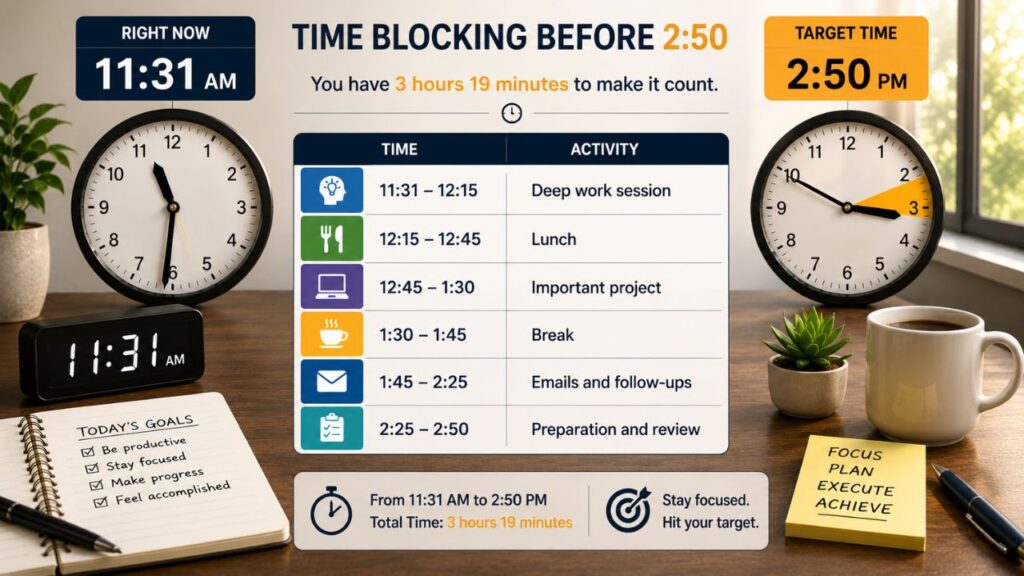
The time blocking method works beautifully with a fixed afternoon target.
Here’s one example using the remaining 3 hours 19 minutes:
| Time | Activity |
|---|---|
| 11:31–12:15 | Deep work session |
| 12:15–12:45 | Lunch |
| 12:45–1:30 | Important project |
| 1:30–1:45 | Break |
| 1:45–2:25 | Emails and follow-ups |
| 2:25–2:50 | Preparation and review |
Notice how every block has a purpose. That’s one reason calendar blocking continues to be popular among professionals trying to improve work efficiency.
Using Pomodoro-Style Sprints
Another excellent way to approach the time until 2:50 is through Pomodoro-style sprints.
Instead of worrying about the full countdown, divide it into focused work periods.
You could complete:
- Four 25-minute sessions.
- Five short breaks.
- One review session before 2:50.
Breaking large tasks into manageable chunks reduces time perception problems. A long afternoon suddenly feels much less overwhelming.
Helpful Tools for Tracking Time
Modern technology makes time tracking incredibly simple.
Popular tools include:
- Built-in phone timer.
- Stopwatch apps.
- Reminder notifications.
- Calendar alerts.
- Smartwatch alarms.
- Digital assistants.
Professional teams sometimes use platforms like StaffWatcher for monitoring productivity, tracking work sessions, and improving overall workflow. While it’s designed for businesses, it highlights how valuable structured time tracking has become in modern workplaces.
Traditional Clock vs Digital Clock
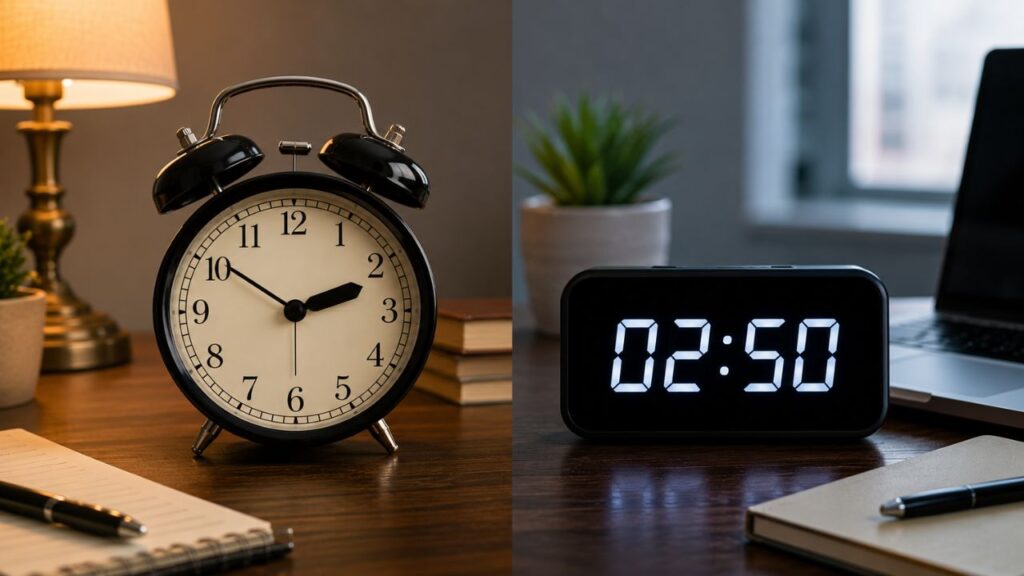
Both styles tell exactly the same time, but people often experience them differently.
A digital clock:
- Shows exact numbers.
- Makes time calculation quicker.
- Helps during scheduling.
- Reduces mental guessing.
A traditional clock:
- Shows movement visually.
- Makes passing time feel more natural.
- Helps children learn clock hands.
- Strengthens overall timekeeping skills.
Some people even switch between both because each offers a different way of understanding the passing hours. Bit odd maybe, but it works.
Avoiding Procrastination Before 2:50
If you’re staring at the remaining 3 hours 19 minutes, don’t let them quietly disappear.
Try these simple habits:
- Begin with the hardest task.
- Silence unnecessary notifications.
- Keep only one browser tab open.
- Set an alarm for checkpoints.
- Drink water regularly.
- Review your planning ahead strategy.
- Celebrate small progress.
Every completed task creates momentum, and momentum is often stronger than motivation.
Scheduling Habits That Actually Work
Building consistent scheduling habits doesn’t require complicated systems.
Instead:
- Review your daily planning every morning.
- Keep a realistic work schedule.
- Leave room for flexibility.
- Reserve focused hours for difficult work.
- Batch similar tasks together.
- Protect your breaks.
- Reflect before ending the day.
Good routines aren’t rigid. They’re dependable enough to guide you without becoming exhausting.
Making Better Decisions With Time Awareness
Developing stronger time awareness changes more than your calendar.
You begin noticing:
- How long tasks actually take.
- Which meetings waste time.
- Which routines improve organization.
- Where distractions usually appear.
- Which projects deserve more attention.
This naturally improves goal setting, planning session quality, and overall personal organization.
Over weeks, those small observations add up into meaningful improvements.
When 2:50 Represents Something Important
Sometimes 2:50 isn’t simply another time on the clock.
It could represent:
- An interview.
- A doctor’s appointment.
- School pickup.
- A presentation.
- Boarding a flight.
- An online class.
- A client meeting.
- A family celebration.
- The end of a stressful workday.
- The beginning of something exciting.
Attaching emotional meaning to a specific time changes how we experience the entire countdown timer.
Quick Mental Tricks for Calculating Time Differences
If calculators aren’t available, simple quick calculations can help.
Remember to:
- Count full hours first.
- Add remaining minutes afterward.
- Double-check AM and PM.
- Visualize the clock hands if needed.
- Estimate before calculating exactly.
With practice, calculating hours remaining becomes almost automatic.
How Time Management Supports Better Living
Strong time management isn’t about squeezing every minute full.
It’s about choosing intentionally.
That includes:
- Better task management.
- Less stress.
- Improved concentration.
- Healthier daily routine.
- Better work-life balance.
- More meaningful breaks.
- Increased productive habits.
Ironically, people who schedule rest usually accomplish more than people who never stop working.
Read more blog: Countdown to 12 AM
Frequently Asked Questions
How much time until 2:50 PM?
Based on the current local time of 11:31 AM, the remaining time until 2:50 PM is 3 hours 19 minutes.
What’s the easiest way to calculate remaining time?
Subtract the current time from your target time by counting complete hours first and then adding the leftover minutes.
Should I use a countdown timer?
Absolutely. A visible countdown timer improves focus, encourages task completion, and reduces unnecessary procrastination.
Can better scheduling improve productivity?
Yes. Combining calendar blocking, time blocking, clear priorities, and regular reviews creates noticeable improvements in work efficiency over time.
how long till 2:50
The time left until 2:50 depends on the current time. Simply subtract the current time from 2:50 PM to find the remaining hours and minutes.
how long until 2:50
To know how long until 2:50, compare your current time with 2:50 PM. A countdown timer can provide the exact remaining time instantly.
how much time until 2:50
The amount of time until 2:50 changes throughout the day. Check the current time to calculate the exact hours and minutes remaining.
how many minutes until 2:50 today
The number of minutes until 2:50 today depends on the current time. Subtract the current time from 2:50 PM to get the exact minutes left.
time until 2:50
The time until 2:50 is simply the difference between the current time and 2:50 PM. It updates continuously as the day progresses.
Conclusion
The question how much time till 2:50 seems wonderfully ordinary, yet it opens the door to smarter planning and calmer afternoons.
Today, the answer is simple:
3 hours 19 minutes remain until 2:50 PM.
What you choose to do with those hours matters much more than the calculation itself. Whether you’re preparing for an important meeting, working through your to-do list, organizing your calendar, practicing better self-discipline, or simply trying to stay present, every minute becomes part of a bigger story.
Instead of watching the countdown slip away, let it gently remind you that time isn’t only something we measure. It’s something we quietly shape, minute by minute, choice after choice. And somehow, thats where the real magic of every ordinary afternoon begins.
