
There is something oddly comforting about knowing exactly what the clock will say a few minutes from now. Fifteen minutes sounds tiny, almost like a blink that the clock somehow decided to stretch, but those little minutes can be surprisingly useful. They can be the difference between arriving on time and rushing through the door, between catching a meeting and joining it with that slightly guilty “sorry, I’m late” feeling.
When someone searches What Time Is 15 Minutes From Now, they usually want a quick, practical answer. Maybe a call starts soon, an appointment is approaching, a recipe needs another quarter hour, or a person simply wants to know what the clock will show after a short wait. Whatever the reason, 15 Minutes From Now is a simple future time calculation based on the current time.
The good news is that you dont need complicated mathematics for it. Add 15 minutes to the current hour and minute, watch for the hour to change, and you have your answer. A 15 Minutes From Now Calculator can make this even easier by handling the calculation instantly, especially when seconds, midnight, or different time zones make mental arithmetic a little annoying.
What Does 15 Minutes From Now Actually Mean?
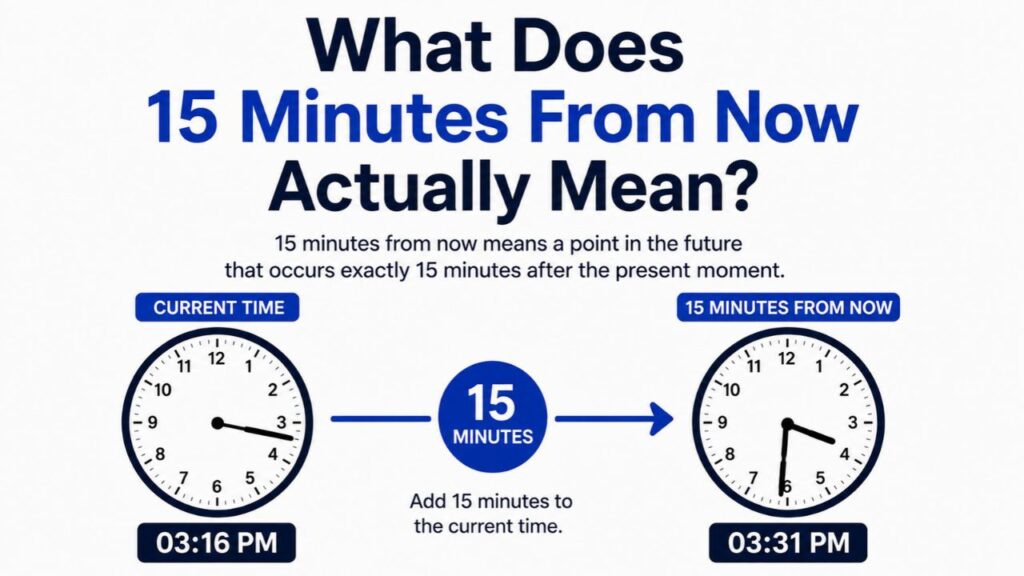
The phrase 15 minutes from now simply means a point in the future time that occurs exactly 15 minutes after the present moment. If your current time is 3:16 PM, for example, adding 15 minutes gives 3:31 PM.
So, the basic time calculation is beautifully ordinary:
3:16 PM + 15 minutes = 3:31 PM
This is sometimes called time addition, because you are adding a specific time duration to a starting point. Nothing mysterious is happening behind the clock face, even if the answer can feel oddly important when you’re waiting for something.
The phrase can also appear in several different searches, including what time will it be in 15 minutes, 15 minutes later, 15 minutes ahead, or what is 15 minutes after the current time. They all point toward the same basic idea: find the present moment, then move forward by 15 minutes.
How to Calculate 15 Minutes From Now
You can calculate the answer yourself without any special tool. Start by looking at the current time on your phone, computer, watch, digital clock, or analog clock.
Suppose the clock says 8:20 AM. Add 15 minutes:
8:20 AM + 15 minutes = 8:35 AM
If the clock says 8:50 AM, however, the calculation crosses into the next hour:
8:50 AM + 15 minutes = 9:05 AM
That little jump is where people sometimes make mistakes. The minutes reach 60 and reset to zero, while the hour increases by one. Its simple, but when you’re distracted, even simple things can suddenly become weirdly complicated.
A practical way to calculate 15 minutes from now is to count forward in five-minute pieces. From 8:50 AM, five minutes brings you to 8:55, another five reaches 9:00, and the final five lands at 9:05.
This method works well for quick minutes calculation because five-minute increments are easy to visualize on a clock.
Using a 15 Minutes From Now Calculator
A 15 Minutes From Now Calculator is useful when you want an instant answer without manually checking the minutes. A typical time calculator online takes the current time, adds the requested duration, and presents the resulting future time.
For example, if an online time tool receives a current time of 3:16 PM, it can automatically return:
3:31 PM
Some tools provide an embedded calculator directly on a website or blog, so readers dont have to leave the page. This can create a smoother user experience, particularly for people who are checking several different intervals.
A good calculator may also provide an online clock, digital display, or dynamic clock that updates continuously. In that setup, the result changes naturally as the real world keeps moving, which is handy because “15 minutes from now” is not a permanent number. It keeps running away from us, very politely.
What Time Will It Be in 15 Minutes?
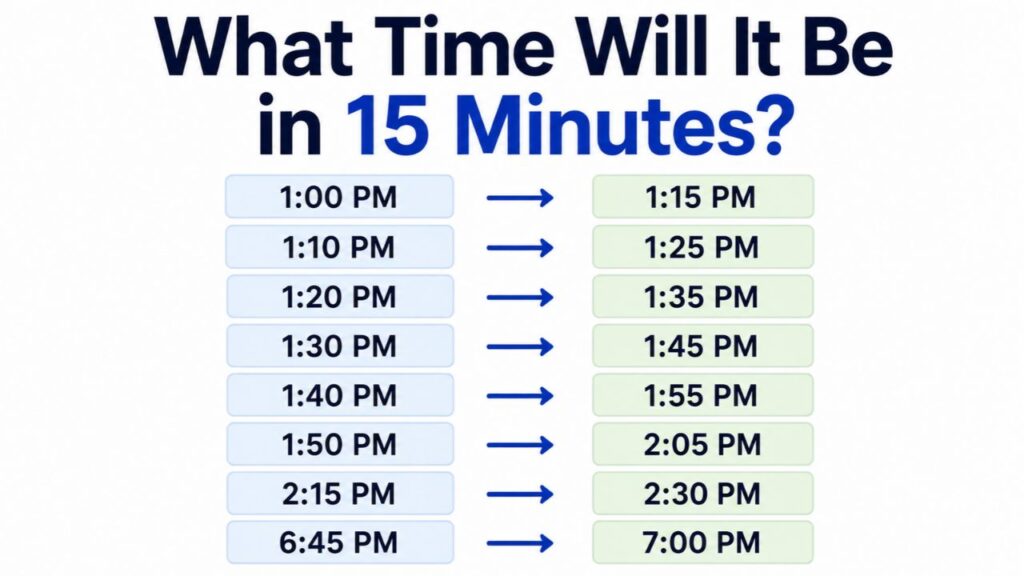
If you are wondering what time will it be 15 minutes from now, the calculation depends entirely on the exact starting time. Fifteen minutes is a fixed time duration, but the answer changes every minute.
Here are a few easy examples:
- 1:00 PM → 1:15 PM
- 1:10 PM → 1:25 PM
- 1:20 PM → 1:35 PM
- 1:30 PM → 1:45 PM
- 1:40 PM → 1:55 PM
- 1:50 PM → 2:05 PM
- 2:15 PM → 2:30 PM
- 6:45 PM → 7:00 PM
Notice what happens around the hour boundary. When the starting time is 1:50 PM, fifteen minutes later is 2:05 PM, not 1:65 PM. Clocks dont use 65-minute hours, thankfully.
This is why a future time calculator can be useful when accuracy matters. It performs the small bit of time arithmetic that people often get wrong while multitasking.
A Simple 3:16 PM Example
The example 3:16 PM → 3:31 PM is especially easy because it stays inside the same hour.
Start with:
Current time: 3:16 PM
Add 15 minutes:
16 + 15 = 31
Therefore:
Future time: 3:31 PM
This is a same-hour calculation, so you don’t need to adjust the hour. The minute hand on an analog clock would simply move forward by a quarter of a full hour, while the digital display would change from 3:16 to 3:31.
It is a nice little example of how time awareness can make everyday planning easier. No grand system required, just knowing where the next fifteen minutes are going.
When 15 Minutes Crosses Into the Next Hour
The calculation becomes slightly more interesting when the starting minutes are above 44.
Consider 11:55 AM:
11:55 AM + 15 minutes = 12:10 PM
Here, five minutes takes the clock to noon, and the remaining ten minutes move beyond noon. This is where time calculation requires a little more attention.
Another example is:
11:50 PM + 15 minutes = 12:05 AM
This calculation crosses not only an hour but also today’s date. The result belongs to the next calendar day.
That matters for scheduling, appointments, reminders, travel, work shifts, and events. A person looking at 11:50 PM might casually think “fifteen minutes later,” but a digital scheduling system needs to know that the date itself has changed.
12-Hour and 24-Hour Time Formats
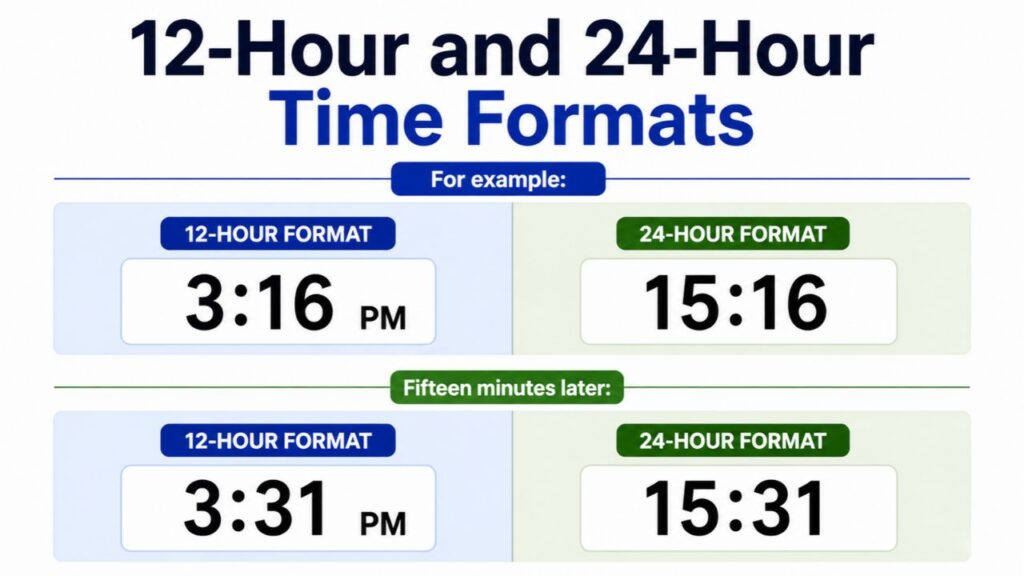
People commonly use the 12-hour time format, where times include AM and PM. Others prefer the 24-hour time format, especially for transportation, healthcare, technical work, and international scheduling.
For example:
12-hour format: 3:16 PM
24-hour format: 15:16
Fifteen minutes later:
12-hour format: 3:31 PM
24-hour format: 15:31
The underlying time is exactly the same. Only the way it is displayed changes.
A time calculator may offer both formats because users have different habits. A traveler might naturally think in 24-hour notation, while someone planning a casual coffee meeting may prefer AM and PM. Neither is more “correct”; they’re simply different ways of presenting the same moment.
Digital Clock vs. Analog Clock
A digital clock shows time using numbers, which makes adding minutes relatively straightforward. If the display reads 6:42, you can immediately see the minute value and add 15.
An analog clock, on the other hand, represents time with hands. The hour hand, minute hand, and second hand create a visual picture of where you are within the hour.
Fifteen minutes corresponds to one quarter of an hour. On an analog clock, that means moving the minute hand three large five-minute marks forward. From the 12 position, fifteen minutes later the hand reaches the 3.
This visual approach can be especially helpful for children learning time awareness. Instead of thinking of minutes as abstract numbers, they can see the passage of time physically moving around the clock face.
Why Exact Time Matters for Scheduling
Fifteen minutes can sound insignificant until you put it inside a real schedule. A fifteen-minute difference can change whether a person catches a bus, joins a conference call, finishes an exam section, or arrives before a restaurant reservation disappears.
That is why scheduling, planning, and time management depend on reliable calculations.
Imagine you have a meeting at 4:30 PM and want to leave 15 minutes beforehand. You know you should leave at 4:15 PM. If the journey itself takes 15 minutes, you might need to begin preparing even earlier.
The point is not that fifteen minutes is huge. The point is that small blocks of time accumulate. One quarter-hour today, another tomorrow, another next week, and suddenly your calendar has a personality.
Everyday Reasons People Calculate 15 Minutes Ahead
People calculate short future intervals for all sorts of ordinary reasons.
- Setting a reminder before an appointment
- Checking when a short cooking step will finish
- Planning a quick break from work
- Knowing when a meeting begins
- Estimating a short commute
- Preparing for a phone call
- Setting a study or exercise interval
- Timing a household task
- Planning a pickup or drop-off
- Staying on schedule during a busy day
The beauty of a 15-minute future time calculator is that it handles the boring arithmetic while you handle everything else.
Sometimes convenience is not about doing something difficult. It is about not having to think about a tiny thing for the tenth time that day.
15 Minutes From Now for Work and Productivity
In professional life, fifteen minutes can be used as a compact productivity unit. A person might spend 15 minutes answering messages, organizing a desk, reviewing a document, preparing notes, or planning the next task.
This connects time management with realistic scheduling. Instead of saying, “I’ll get to it sometime later,” you can give the task a small window and define when that window ends.
For example, if you begin reviewing emails at 10:05 AM, a fifteen-minute block ends at 10:20 AM. That gives the task a clear boundary.
Short blocks can also reduce the psychological weight of large tasks. “Work on the report for fifteen minutes” feels much more approachable than “finish the entire report,” which is the sort of sentence that makes a perfectly innocent Tuesday feel personally hostile.
Using 15 Minutes for Personal Planning
Outside work, fifteen minutes can be a useful planning unit too. You might use it to tidy a room, prepare tomorrow’s clothes, write a short message, check a calendar, or simply sit quietly without doing anything productive at all.
Not every minute needs to become a productivity contest.
A time planning tool can help you understand when a short activity will end, but the real benefit is awareness. Knowing that something ends at 7:45 instead of “around quarter to eight-ish” can make the rest of your evening easier to organize.
This is where staying on schedule becomes less about strictness and more about knowing what your day actually looks like.
Time Zones and 15 Minutes From Now
For someone calculating time locally, adding 15 minutes is usually straightforward. But communication across time zones can introduce another layer.
Suppose one person is in New York and another is in London. If they are arranging a call, both people need to know their local current time, the relevant time zone differences, and the agreed meeting time.
The fifteen-minute addition itself does not change because of the time zone. What changes is the displayed local clock time.
Reliable real-time updates and a trustworthy time source therefore matter when international scheduling is involved. A calculator that automatically knows the correct zone can prevent the classic “I thought that was your time” problem.
Why Real-Time Updates Improve Accuracy
A static answer to “15 minutes from now” becomes outdated almost immediately. If you ask at 2:00 PM, the answer is 2:15 PM. If you ask again at 2:04 PM, the answer has already moved to 2:19 PM.
This is why a real-time clock or dynamic clock can be more useful than a fixed calculation when you need the answer at the exact moment you’re checking it.
The best tools typically rely on a dependable time source and update continuously. They may show seconds, the current time, today’s date, and the calculated future moment together.
For practical planning, that little bit of automation can make the experience faster and less error-prone.
Related Time Calculations You Can Make
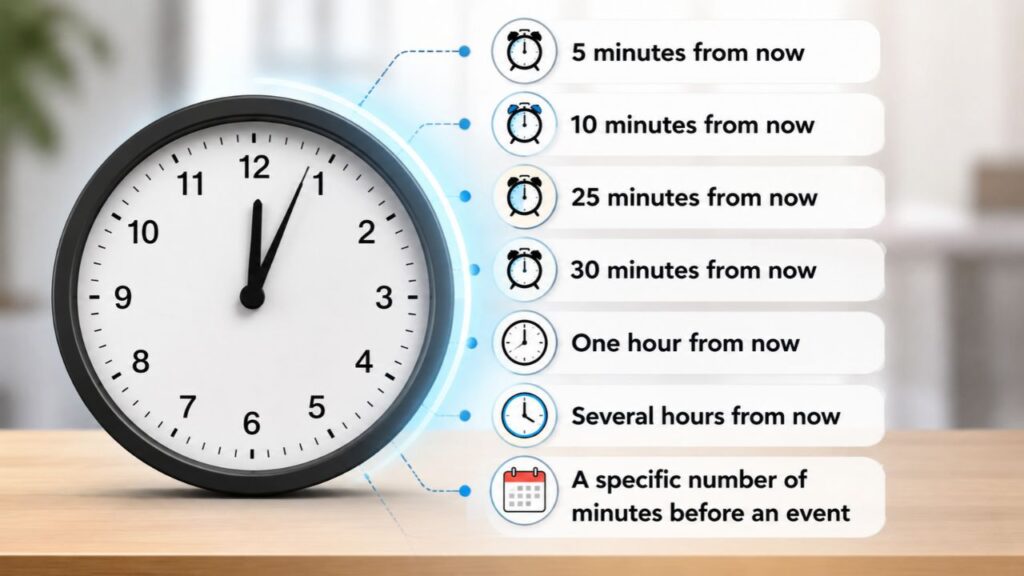
Once you understand fifteen minutes, other short intervals follow almost exactly the same logic.
You might ask for:
- 5 minutes from now
- 10 minutes from now
- 25 minutes from now
- 30 minutes from now
- One hour from now
- Several hours from now
- A specific number of minutes before an event
A minutes from now calculator can handle these variations quickly. A broader time difference calculator can compare two separate times, while a future date and time calculator can work with larger periods.
The important concept remains the same: establish the starting point, identify the duration, perform the addition, and check whether the calculation crosses an hour or date boundary.
How an Online Time Tool Can Help
An online time tool is especially helpful when you need a quick result and dont want to calculate manually. Depending on the design, the tool may include a clock interface, digital format, analog format, date information, and automatically refreshed results.
A well-designed online clock calculator should be easy to understand without requiring instructions that are longer than the calculation itself. Clear labels, readable numbers, and an uncluttered interface improve the user experience.
For a website or blog, an embedded calculator can also provide practical value to visitors. Instead of reading a long explanation and doing the calculation themselves, they can enter or view the relevant time and get the result immediately.
Accuracy: The Small Detail That Matters
A fifteen-minute calculation is mathematically simple, but the starting time must be accurate. If your device clock is five minutes slow, your “15 minutes from now” answer will also be five minutes behind the actual moment.
For important events, appointments, transport, or deadlines, use a reliable accurate time source.
Modern phones and computers often synchronize their clocks automatically, but differences can still appear because of device settings, network problems, daylight-saving rules in certain regions, or incorrect time-zone configuration.
The calculation can be perfect while the input is wrong. Thats a useful lesson in many kinds of everyday math, actually.
How to Add 15 Minutes to Any Time
A quick method is to separate the hour and minutes.
Take a time such as 7:25 PM.
Add fifteen to the minutes:
25 + 15 = 40
So:
7:25 PM → 7:40 PM
Now try 7:55 PM:
55 + 15 = 70
Because 70 minutes cannot remain inside one hour, subtract 60:
70 − 60 = 10
Then increase the hour:
7:55 PM → 8:10 PM
This is basic time arithmetic, but practicing it a few times makes future time calculation almost automatic.
Common Mistakes When Calculating 15 Minutes Ahead
One common mistake is forgetting the hour transition. Someone may calculate 4:55 + 15 and write 4:70, which looks mathematically plausible for a second but is not a valid clock time.
Another mistake is mixing AM and PM. For example, 11:55 AM plus 15 minutes becomes 12:10 PM, not 12:10 AM.
A third mistake involves midnight. At 11:55 PM, fifteen minutes later is 12:10 AM on the next day. This is where today’s date matters.
Finally, people sometimes confuse a time duration with a clock reading. “Fifteen minutes” is an interval. “3:31 PM” is a specific point in time. Keeping those ideas separate makes the calculation much cleaner.
Why Short Time Calculations Feel So Useful
There is a quiet psychological benefit to knowing exactly when something will happen. Uncertainty takes up mental space, even when the thing itself is tiny.
Knowing that your timer ends in fifteen minutes, your ride arrives at a certain time, or your break finishes at 2:45 can create a little structure around an otherwise messy day.
This is one reason people repeatedly search phrases such as 15 minutes later, exact time 15 minutes from now, and calculate the time 15 minutes ahead. They are not really searching for mathematics. They’re searching for certainty.
And certainty, even in tiny doses, is pretty comforting.
When a 15-Minute Window Is More Useful Than an Exact Minute
Sometimes you don’t need an exact second-by-second answer. You simply need a reasonable window.
If someone says, “I’ll call you in about 15 minutes,” that is usually a practical estimate rather than a scientific measurement. In casual communication, the phrase creates an expectation without requiring everyone to stare at a digital clock.
For formal appointments, however, exact times matter more. A meeting invitation may need a precise starting time, while a friend asking you to wait “fifteen minutes” probably isnt operating a railway timetable.
Understanding the context helps you decide whether you need a precise time calculation or just a rough estimate.
How to Use a 15-Minute Calculation for Better Time Management
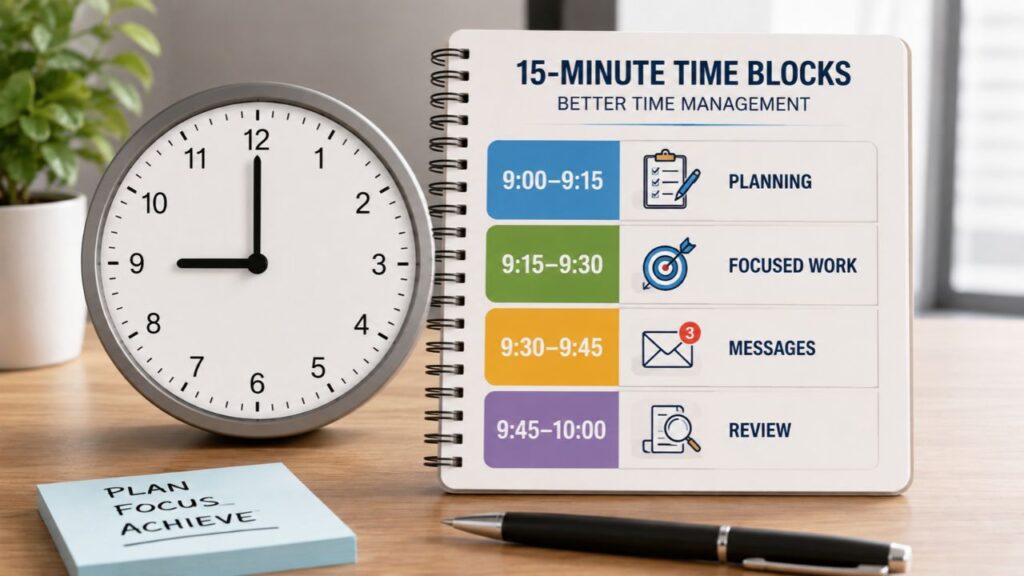
A simple way to use fifteen-minute intervals is to divide a busy hour into smaller sections.
For example:
- 9:00–9:15 — planning
- 9:15–9:30 — focused work
- 9:30–9:45 — messages
- 9:45–10:00 — review
This turns time management into something visible and manageable.
You can also use the same method for breaks. Instead of taking an undefined break that somehow grows from five minutes into forty, set a clear fifteen-minute window and return when it ends.
A calculator does not create discipline by itself, of course. It simply makes the boundaries easier to see.
The Human Side of Knowing What Comes Next
There is something almost poetic about asking what the clock will say fifteen minutes from now. We spend much of life moving toward moments we cannot yet see.
Fifteen minutes from now might be a meeting, a meal, a message, a train, a bedtime routine, or absolutely nothing. Still, the clock keeps moving toward it.
A 15 Minutes From Now Calculator turns that invisible movement into a visible answer. It gives the future a small label, and sometimes that’s exactly what people need.
The calculation may be tiny, but the reason behind it can be surprisingly personal.
Read more blog: What Time Is 20 Minutes From Now?
Frequently Asked Questions
what time will it be in 15 minutes from now
The time in 15 minutes is found by adding 15 minutes to the current time. For example, if it is 3:16 PM now, it will be 3:31 PM.
what time will it be in 15 minutes
To find the time in 15 minutes, simply add 15 minutes to the current time. If the calculation passes the hour, move to the next hour accordingly.
15 minutes from now is what time
15 minutes from now means the current time plus 15 minutes. For example, 7:45 PM becomes 8:00 PM after 15 minutes.
15 mins from now
To calculate 15 mins from now, check the current time and add 15 minutes. A time calculator can give you the result instantly.
what time will it be 15 minutes from now
The answer depends on the current time, because the clock keeps changing. Add 15 minutes to the exact current time to find the future time.
Conclusion
So, what time is 15 minutes from now? Take the current time and add 15 minutes. If the minutes pass 59, move into the next hour. If the calculation crosses midnight, remember that the calendar date changes too.
For simple situations, mental time addition is usually enough. For more complicated scheduling, a 15 Minutes From Now Calculator, time calculator online, or real-time clock can provide a faster and more convenient answer.
The larger lesson is about time awareness. Fifteen minutes may be only a small slice of a day, but small slices are what eventually make up the whole thing. Use them intentionally, leave yourself breathing room when possible, and dont let every minute become another thing you have to chase.
Whether you’re preparing for an appointment, organizing your day, timing a task, or simply wondering what the clock will say after a short wait, knowing how to calculate future time is a wonderfully practical little skill.
Sometimes the future doesn’t need to be far away to be worth knowing. Sometimes it’s just fifteen minutes down the road.
