
There is something strangely satisfying about knowing exactly when the next little piece of your day will arrive. Thirty-five minutes sounds short, almost too ordinary to bother calculating, yet it can be enough time to finish a meeting, bake something, take a proper break, answer a few messages, or simply wait for an appointment without constantly checking the clock. That is why people search what time is 35 minutes from now more often than you might think. They are usually not looking for a complicated lesson in mathematics, they just want the answer quickly and clearly.
The easiest way to think about 35 minutes from now is simple: take the current time, then add 35 minutes. If your clock says 2:15 PM, for example, the future time will be 2:50 PM. If it says 2:45 PM, adding 35 minutes takes you to 3:20 PM. It sounds easy, and it is, but when you’re busy or moving between tasks, even basic time calculation can become surprisingly annoying.
A reliable 35 Minutes From Now Calculator removes that tiny bit of mental work. Instead of counting minute marks on an analog clock or repeatedly checking a digital clock, you can enter a starting time and find the exact time ahead. It is a small tool, but small tools are sometimes the ones that make a busy day feel less messy.
What Time Is 35 Minutes From Now?
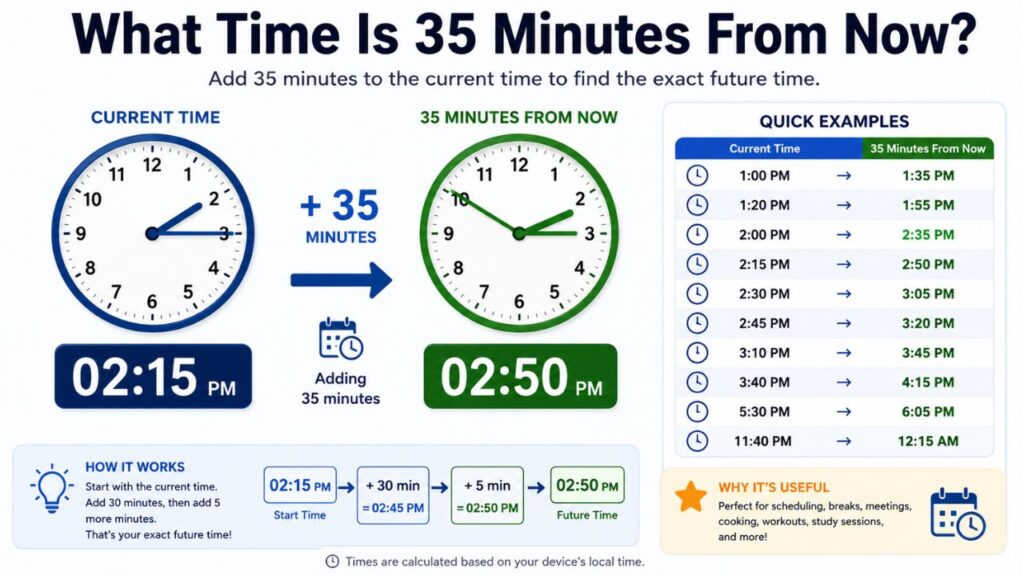
To find what time is 35 minutes from now, you simply add 35 minutes to the starting point. The phrase “from now” means that the calculation begins with the current time, not with a fixed time such as noon or midnight. Your answer therefore changes depending on when you perform the calculation, which is why an automatic clock tool can be handy.
Suppose the current time is 2:15 PM. Add 35 minutes and you get 2:50 PM. The first 30 minutes take you to 2:45 PM, and the remaining 5 minutes bring you to 2:50 PM. Nothing dramatic happening there, but breaking it into smaller pieces makes manual calculation easier when your brain is already busy with other things.
Here are a few quick examples:
- 1:00 PM → 1:35 PM
- 1:20 PM → 1:55 PM
- 2:00 PM → 2:35 PM
- 2:15 PM → 2:50 PM
- 2:30 PM → 3:05 PM
- 2:45 PM → 3:20 PM
- 3:10 PM → 3:45 PM
- 3:40 PM → 4:15 PM
- 5:30 PM → 6:05 PM
- 11:40 PM → 12:15 AM
That final example is where people often make mistakes. Adding 35 minutes can push the clock into the next hour, and sometimes into the next day. The arithmetic is still simple, but the AM/PM change makes the result easier to get wrong if you are doing it quickly.
35 Minutes From Now Calculator: A Faster Way to Find the Future Time
A 35 minutes from now calculator is basically a shortcut for a very small piece of everyday mathematics. You give the tool a starting time, add the desired number of minutes, and it returns the resulting future time. Some tools use the real current time, while others allow you to enter a specific starting time yourself.
The useful thing about an online calculator isn’t that adding 35 is difficult. It is that the calculator does the boring checking for you. If you’re rushing between appointments, preparing a class, planning a workout, or trying to figure out when a delivery window ends, you don’t really want to stare at the clock and count little marks.
A well-designed calculator may include a live clock, automatic updates, and a clear time display. That makes the calculation feel almost invisible. You look, enter or select the time, and move on with your day, which is exactly what a good utility should do.
For people building a website or blog, an embedded calculator can also make a page more useful. Through calculator embedding, a site owner can offer a practical tool instead of forcing visitors to leave the page and search somewhere else. With suitable customizable options, the calculator can fit the design and provide a smoother user experience.
How to Calculate 35 Minutes From the Current Time Manually
Learning how to calculate 35 minutes from now is useful even if you normally use a calculator. There will always be moments when your phone isn’t nearby, your browser is closed, or you’re standing in a kitchen wondering when something needs to come out of the oven.
Start with the hour and minute shown on your clock. Then add 35 to the minute value. If the resulting number stays below 60, the hour doesn’t change. If it reaches 60 or more, subtract 60 and move the hour forward by one.
For example, imagine the clock says 4:10 PM. Add 35 minutes:
- Start: 4:10 PM
- Add 30 minutes: 4:40 PM
- Add 5 more minutes: 4:45 PM
- Result: 4:45 PM
Now consider 4:40 PM:
- Start: 4:40 PM
- Add 20 minutes: 5:00 PM
- Add 15 more minutes: 5:15 PM
- Result: 5:15 PM
The second example demonstrates why adding minutes directly can sometimes feel confusing. Once you cross the 60-minute boundary, the extra minutes become part of the next hour. It’s not hard, but under pressure we all do the occasional “wait, was that 5:05 or 5:15?” thing.
What Time Will It Be in 35 Minutes?
The answer to what time will it be in 35 minutes depends entirely on the starting time. There is no single universal answer because the current time keeps moving. A result that is correct at 2:15 PM will obviously not be correct twenty minutes later.
Think of 35 minutes as a time interval. You’re moving forward across that interval from one point on the clock to another. In that sense, the question is less about a particular clock reading and more about the relationship between two points in time.
For instance, if the starting time is 2:15 PM, the answer is 2:50 PM. If the starting time is 2:45 PM, the answer is 3:20 PM. And if the starting time is 11:50 PM, 35 minutes later is 12:25 AM on the following day.
This is also why phrases such as 35 minutes later, 35 minutes ahead, and time after 35 minutes all describe essentially the same forward movement. The wording changes, but the basic time duration remains 35 minutes.
Examples of Time 35 Minutes From Now
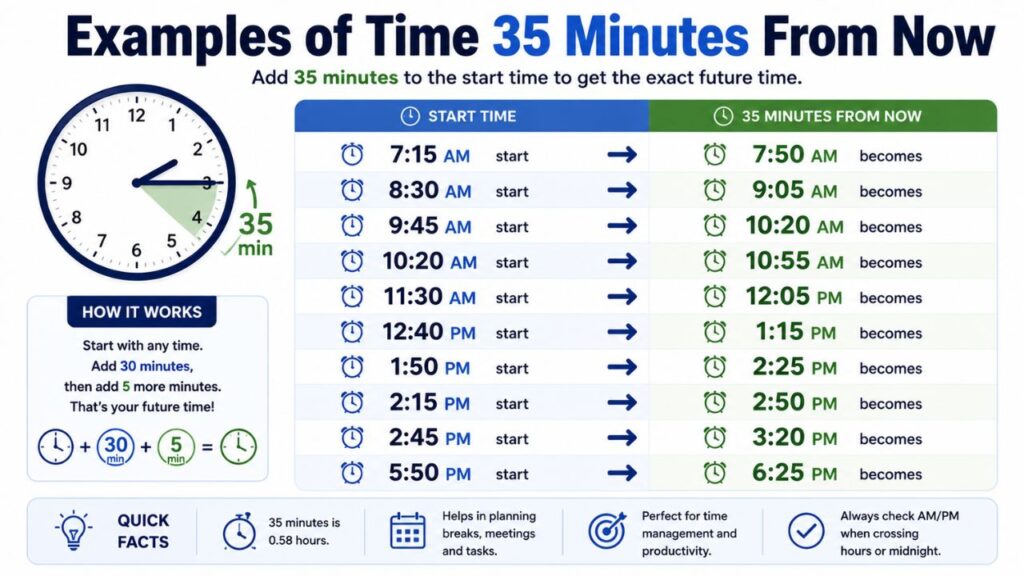
Real-life examples make this kind of calculation much easier to understand. A person rarely asks for 35 minutes just because they love arithmetic. Usually, there is something waiting at the other end of that interval.
Imagine you start a work session at 9:25 AM. Thirty-five minutes later, it will be 10:00 AM. That gives you a neat boundary for a focused task. You might write, read, answer emails, or work on a project until the clock reaches the hour.
A break can work the same way. If you step away at 10:40 AM and want to return after 35 minutes, you’ll be back at 11:15 AM. The calculation is simple enough to do mentally, but having an online time calculator can remove any doubt when the schedule matters.
Here are more everyday examples:
- A 7:15 AM start becomes 7:50 AM.
- An 8:30 AM start becomes 9:05 AM.
- A 9:45 AM start becomes 10:20 AM.
- A 10:20 AM start becomes 10:55 AM.
- A 11:30 AM start becomes 12:05 PM.
- A 12:40 PM start becomes 1:15 PM.
- A 1:50 PM start becomes 2:25 PM.
- A 2:15 PM start becomes 2:50 PM.
- A 2:45 PM start becomes 3:20 PM.
- A 5:50 PM start becomes 6:25 PM.
Notice how the hour changes whenever the added minutes pass the next 60-minute mark. This is the tiny detail that makes adding minutes to time slightly less automatic than adding ordinary whole numbers.
Why 35 Minutes Is a Surprisingly Useful Time Interval
Thirty-five minutes sits in an interesting place. It is longer than the classic quick break, but shorter than a full hour, so it fits neatly into many everyday activities. You can do quite a lot in 35 minutes if you don’t spend the first ten deciding what you’re going to do.
For productivity, a 35-minute session can be used for focused writing, studying, cleaning, planning, or responding to messages. Instead of thinking about an enormous afternoon, you only have to commit to one manageable time interval.
It can also help with time management. When people see a large block of free time, they sometimes postpone starting because the block feels vague. A clearly defined 35-minute period feels more concrete. “I’ll work on this for 35 minutes” is psychologically a different promise than “I’ll work on this sometime this afternoon.”
The same idea applies to time scheduling. A 35-minute window can sit between two appointments, become a preparation period, or act as a buffer. It isn’t magic, of course, but having a specific number creates boundaries, and boundaries make planning easier.
Using a Digital Clock or Analog Clock
Both a digital clock and an analog clock can help you calculate future time, but they show information differently. A digital display gives you exact numbers immediately, which makes adding 35 minutes straightforward. You can see something like 2:15 PM without translating clock-hand positions first.
An analog clock, meanwhile, gives you a visual sense of movement. The minute hand travels through 35 minute marks, which can actually make the idea of elapsed time feel more physical. You can almost watch the future arriving, minute by minute.
A modern clock interface may combine both approaches. Some online tools show a digital time display alongside an analog representation, while a live clock updates automatically. That can be particularly useful when a user wants to see both the current moment and the calculated future time.
For an online utility, automatic updates matter. A calculation based on a clock from ten minutes ago isn’t much use when the question is “from now.” A real-time clock helps keep the starting point fresh, although users should still understand whether a particular calculator is using their device time or another time setting.
35 Minutes Ahead and Everyday Productivity
The idea of being 35 minutes ahead can be surprisingly useful for people who are trying to organize their day. You might set a reminder 35 minutes before an appointment, reserve 35 minutes for preparation, or use the period as a focused work block.
For example, suppose an appointment begins at 3:30 PM. You may want to start preparing 35 minutes earlier, at 2:55 PM. In that situation, you’re not calculating a future time but a past time, which means you would subtract rather than add. This small distinction is important when using a time calculator.
The broader lesson is that time planning becomes easier when you stop treating every hour as an indistinct blob. Giving tasks precise durations makes the day more visible. Thirty-five minutes for email, 35 minutes for study, 35 minutes for errands it begins to create a map rather than a pile of intentions.
This is also where time tracking can help. If you record how long tasks actually take, you may discover that something you thought required an hour usually takes 35 minutes. Or maybe the opposite. Either way, the clock is giving you information you can use to improve your schedule.
Common Mistakes When Adding 35 Minutes
The most common mistake in manual time calculation is forgetting that an hour contains 60 minutes. Someone may see 2:40 and mentally add 35 as though it were ordinary decimal arithmetic, landing on a strange answer that doesn’t belong on a clock.
Another common error is overlooking the transition between AM/PM. If you calculate from 11:50 PM, 35 minutes later is 12:25 AM, not 12:25 PM. That difference is massive when you’re scheduling something important, even though the numbers look almost identical.
People also sometimes forget the date when crossing midnight. If an event begins late at night and the calculated future time falls after midnight, the clock has entered the next calendar day.
A few useful habits can prevent these mistakes:
- Break 35 minutes into 30 + 5.
- Check whether the calculation crosses an hour.
- Watch for an AM/PM change.
- Check whether midnight is crossed.
- Use a calculator when the exact result matters.
- Recheck appointments and deadlines before relying on the answer.
None of this is complicated. It is just the sort of tiny detail that deserves a second look when you’re tired.
When an Online Time Calculator Makes More Sense
A future time calculator becomes especially useful when you are doing many calculations in a row. If you’re planning a timetable with several intervals, doing everything manually can become repetitive and error-prone.
A minutes calculator can also be useful when the intervals are not always 35 minutes. You might need 5 minutes, 10 minutes, 20 minutes, 25 minutes, or 35 minutes depending on the task. Instead of doing each calculation separately, a flexible tool can handle the different inputs.
For websites and blogs, this type of utility can improve engagement too. A visitor searching for 35 minutes from current time may only need one answer, but a page that also offers useful related calculators can become a handy reference point.
Possible companion tools include:
- 5 Minutes From Now
- 10 Minutes From Now
- 20 Minutes From Now
- 25 Minutes From Now
- 30 Minutes From Now
- Time Duration Calculator
- Time interval tools
- Minutes and hours calculators
The goal isn’t to overwhelm visitors with tools. It is to give them the next useful calculation when they need it, without sending them on another search.
How Websites Can Use an Embedded Calculator
If you run a website or blog, an embedded calculator can turn an ordinary informational page into something interactive. Instead of simply explaining how to calculate future time, the page can allow readers to perform the calculation immediately.
This is where a calculator widget becomes useful. With suitable website embedding and blog integration, visitors can interact with the tool without leaving the article. The experience feels more direct because the information and utility are sitting together.
Good calculator embedding should remain simple, though. Too many controls, confusing labels, or unnecessary animations can actually make the tool harder to use. The best user experience usually comes from a clear input, a clear result, and enough context to understand what the answer means.
An effective embedded tool may offer customizable options, automatic time updates, and different display formats. A site owner might also provide an explanation below the calculator for readers who want to understand the time calculation rather than simply receive the result.
35 Minutes From Now in Daily Planning

There are many small moments where knowing what time is 35 minutes from now can make planning easier. Consider a student who wants to study before dinner, a freelancer timing a focused work session, or someone waiting for a meeting to begin.
You could use 35 minutes for:
- Focused study
- A writing session
- Meal preparation
- A short workout
- Cleaning one area of the house
- Reading a chapter
- Preparing for an appointment
- Taking a structured break
- Reviewing a day’s tasks
- Finishing a small work assignment
The value is not really in the number 35 itself. The value is in giving a task a beginning and an ending. When you know the time duration, you can make a better decision about what fits inside it.
Sometimes 35 minutes will be enough. Sometimes it won’t. That’s actually useful information too, because realistic time management is partly about knowing the limits of a schedule instead of hoping everything somehow fits.
A Simple Way to Think About Future Time
If you remember only one method, make it this: start with the current time, add 30 minutes, then add the remaining 5 minutes. This approach is usually easier than trying to jump 35 minutes in one mental leap.
For example, if the clock reads 6:25 PM, first move to 6:55 PM by adding 30 minutes. Then add 5 minutes and arrive at 7:00 PM. Clean, simple, done.
If the clock reads 6:40 PM, add 20 minutes to reach 7:00 PM, then add the remaining 15 minutes to reach 7:15 PM. Different route, same destination.
This is essentially what a time duration calculator or time interval calculator is doing behind the scenes. It handles the movement across minute increments and keeps the clock format consistent.
What Makes an Exact Time Tool Helpful?
People often search for an exact time because “around then” isn’t good enough for every situation. A reminder, online meeting, cooking timer, medication schedule, transportation connection, or work deadline can depend on accurate timing.
A useful time tool should therefore make the result easy to read. A clear time display, obvious starting point, and understandable result are more important than fancy features. Nobody wants to solve a puzzle just to discover what time it will be 35 minutes later.
A real-time clock can also help by showing the starting point continuously. If the tool provides an automatic time update, the user doesn’t need to refresh the page every few seconds just to keep the calculation relevant.
Of course, no calculator can control real-world delays. If your train is late or your meeting runs over, the arithmetic remains correct while the schedule changes. Time tools tell you what the clock says, not what life will decide to do with those minutes.
Read more blog: How Much Time Till 3 PM
Frequently Asked Questions
what time will it be in 35 minutes
To find the time in 35 minutes, simply add 35 minutes to the current time. For example, if it is 2:15 PM now, it will be 2:50 PM in 35 minutes.
35 minutes from now
35 minutes from now means adding 35 minutes to the current time. The exact answer changes depending on what time it is when you make the calculation.
35 minutes from now is what time
The answer depends on the current time. Add 35 minutes to the clock time to find the exact future time.
what is 35 minutes from now
To calculate 35 minutes from now, add 30 minutes first and then add 5 more minutes. This makes the calculation quick and easy to check.
what time is 35 minutes from now
The time 35 minutes from now is simply the current time plus 35 minutes. For example, 5:30 PM becomes 6:05 PM after adding 35 minutes.
Conclusion
So, what time is 35 minutes from now? The answer depends on the current time, but the method is wonderfully simple: add 35 minutes to the starting time and adjust the hour whenever you cross the 60-minute mark. If you’re starting at 2:15 PM, for instance, 35 minutes from now is 2:50 PM. If you’re starting at 2:45 PM, it becomes 3:20 PM.
For quick questions, mental math is perfectly fine. For repeated calculations or situations where the exact time matters, a 35 Minutes From Now Calculator or general time calculator is faster and less tiring. It can also be useful when you’re planning tasks, setting reminders, managing breaks, or organizing a packed schedule.
The bigger idea is rather nice when you think about it. Thirty-five minutes isn’t just a number on a clock. It is a little container for something a task, a conversation, a journey, a rest, a lesson, maybe even a moment to do absolutely nothing. We tend to think productivity requires huge stretches of time, but sometimes a clearly defined 35 minutes is all you need to finally begin.
If you use a time calculator regularly, consider pairing it with simple time management, time scheduling, and time planning habits. Set realistic intervals, leave small buffers between activities, and don’t forget that the clock is a guide rather than a race.
And if you’re building a useful website or blog, an accessible calculator can turn a simple explanation into something visitors actually use. Whether they need to calculate future time, find the time in 35 minutes, or compare several minutes from now options, a clear tool saves them a few seconds and sometimes those few seconds are exactly what they came looking for.
Ultimately, the beauty of calculating 35 minutes later is its simplicity. Look at the clock, add the minutes, check the hour, and keep going. The next 35 minutes are already on their way; you might as well decide what you want to do with them.
