
There is something oddly comforting about knowing exactly when a future moment will arrive. Maybe you are waiting for an important call, planning a family gathering, checking when a work shift ends, or simply wondering when the next six hours will be gone. The question what time is 6 hours from now looks tiny, almost too simple to bother asking, yet it can quietly shape the rest of a day. Time has a funny habit of feeling both slow and very fast, depending on what we are waiting for.
For a family preparing to welcome a baby girl, for example, six hours can feel enormous. One parent may be arranging transport, another calling relatives, and a grandparent may be staring at the clock every few minutes. In ordinary life too, knowing the future time can make plans less fuzzy. Instead of saying “later today,” you can say, “It will be around 8:07 AM,” and suddenly the moment has a shape.
So, if you are asking what time will it be in 6 hours, the basic answer is simple: take the current time and add six hours. If the calculation passes midnight, the answer moves into the next day. That little detail is where many otherwise easy calculations become confusing, honestly.
| Current Time | Add | Time 6 Hours From Now |
|---|---|---|
| 9:00 AM | +6 hours | 3:00 PM |
| 12:00 PM | +6 hours | 6:00 PM |
| 2:30 PM | +6 hours | 8:30 PM |
| 6:00 PM | +6 hours | 12:00 AM |
| 11:00 PM | +6 hours | 5:00 AM (next day) |
What Time Is 6 Hours From Now?
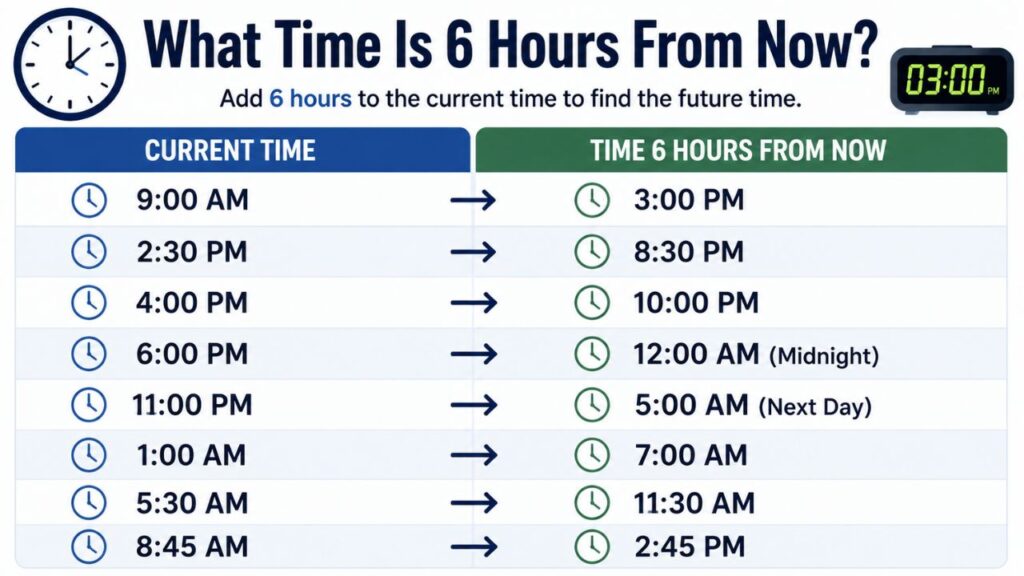
The easiest way to understand 6 hours from now is to imagine the clock moving forward six complete hours. You are not changing the minutes, unless your starting time itself contains a special situation such as crossing midnight or changing time zones.
For example, if the current time is 9:00 AM, then six hours later it is 3:00 PM. If it is 2:30 PM, adding six hours gives 8:30 PM. Nothing mysterious is happening behind the curtain, it is simply a forward time calculation.
Here are a few straightforward examples:
- 9:00 AM → 3:00 PM
- 2:30 PM → 8:30 PM
- 4:00 PM → 10:00 PM
- 6:00 PM → 12:00 AM
- 11:00 PM → 5:00 AM next day
- 1:00 AM → 7:00 AM
- 5:30 AM → 11:30 AM
- 8:45 AM → 2:45 PM
The important thing is to preserve the minutes. Six hours means six hours, not six hours and thirty minutes because the clock “looks closer” to another number. Human brains do that sometimes, especially when we are tired.
How to Calculate 6 Hours From Current Time Manually
You do not need a special time calculator to calculate 6 hours from now. A little manual time calculation works perfectly well when the situation is ordinary.
Start by looking at your current moment. Suppose the clock says 10:15 AM. Move forward one hour at a time:
10:15 AM → 11:15 AM → 12:15 PM → 1:15 PM → 2:15 PM → 3:15 PM → 4:15 PM.
The final answer is 4:15 PM. That is six hours ahead.
Another useful method is to add the hours in one jump. If you have 10:15 AM and add six hours, you reach 4:15 PM. The minutes remain at 15. This makes time addition much faster once you get comfortable with it.
For people who regularly calculate future appointments, medication reminders, study sessions, travel departures, or work breaks, this simple skill is surprisingly useful. It creates a bit more time awareness, which can be more valuable than it sounds.
What Time Will It Be in 6 Hours When It Crosses Midnight?
Midnight is the part that causes most of the confusion. If the starting time is 11:00 PM, adding six hours does not produce 5:00 PM. Instead, the clock passes midnight and continues into the following day.
The calculation looks like this:
11:00 PM → 12:00 AM → 1:00 AM → 2:00 AM → 3:00 AM → 4:00 AM → 5:00 AM
So, 11:00 PM → 5:00 AM next day.
This is called a next day calculation, and it matters whenever the six-hour period crosses midnight. A late-night worker, traveler, parent with a newborn, or someone planning an early-morning event may need this detail more often than they expect.
If you are recording something formally, it can help to include the date as well as the time. “5:00 AM tomorrow” is usually clearer than simply writing “5:00 AM,” especially when several dates are involved.
6 Hours From Now in 12-Hour and 24-Hour Time
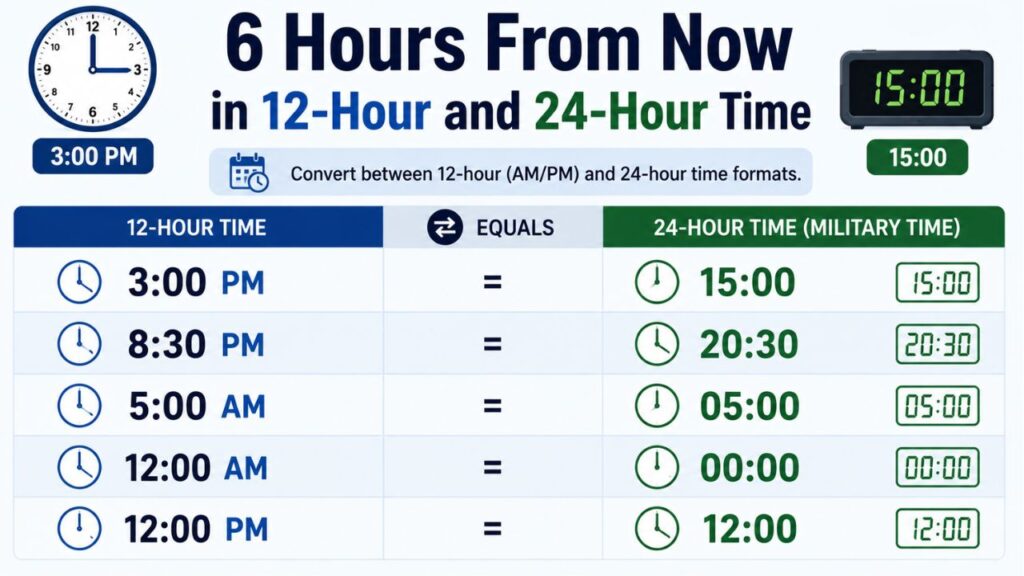
Time can be displayed in different ways, and understanding both makes time conversion much easier. The common 12-hour format uses AM and PM, while the 24-hour format runs from 00:00 through 23:59.
For example:
- 3:00 PM = 15:00
- 8:30 PM = 20:30
- 5:00 AM = 05:00
- 12:00 AM = 00:00
- 12:00 PM = 12:00
Suppose your starting time is 2:30 PM. Six hours later is 8:30 PM, which becomes 20:30 in a 24-hour clock. Similarly, 11:00 PM plus six hours becomes 5:00 AM the following day, written as 05:00.
The 12-hour time format is common in everyday conversations, while military time and other 24-hour systems are useful in transportation, healthcare, technology, and international scheduling. Neither system is more “correct,” they simply show the same moment differently.
What Time Is 6 Hours From Now on a Digital Clock?
A digital clock makes future-time calculations feel almost mechanical because the numbers are very easy to read. A typical digital time display might show 02:07 AM, 14:07, or another numerical representation depending on the selected time format.
If the starting time is 9:00 AM, six hours later the digital display will show 3:00 PM in a 12-hour system. In a 24-hour system, it will show 15:00.
The advantage is clarity. You can see the hour and minutes without interpreting the hands of a traditional clock. For people who frequently check an exact time display, this can make schedule tracking less annoying.
Some websites also provide an automatic clock update, so the displayed time changes continuously. When paired with a future-time feature, an online clock calculator can determine the answer almost instantly.
What Time Is 6 Hours From Now on an Analog Clock?
An analog clock tells the same story visually, but you have to read the hands instead of simply reading numbers. The hour hand moves gradually rather than jumping dramatically from one hour to another.
Imagine the clock shows exactly 9:00 AM. Move the hour hand forward six hours and it reaches 3:00 PM. If it shows 8:30 AM, six hours later is 2:30 PM. The minute hand stays aligned with the 30-minute position in that example.
This is a nice reminder that clocks are really a visual time representation of something much more abstract. The hands are not “creating” time, they are giving us a way to observe and organize it. Old-fashioned, maybe, but still pretty clever.
Using a 6 Hours From Now Calculator
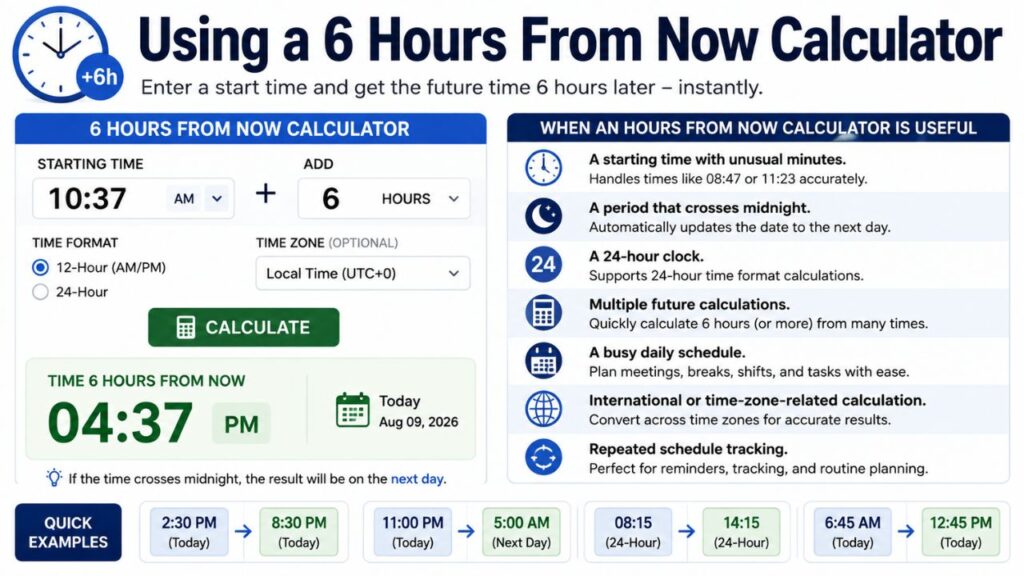
A 6 hours from now calculator is helpful when you need an instant calculation and do not want to count around the clock yourself. You enter a starting time, choose the number of hours, and the tool produces the resulting future timestamp.
An hours from now calculator can be especially useful when the calculation involves:
- A starting time with unusual minutes.
- A period that crosses midnight.
- A 24-hour clock.
- Multiple future calculations.
- A busy daily schedule.
- International or time-zone-related calculation.
- Repeated schedule tracking.
A good time calculation tool removes much of the mental work, but it is still useful to understand the underlying calculation. Tools are wonderful until the internet disappears at exactly the moment you need one, which seems to be a law of nature.
Why Six Hours Ahead Can Matter in Daily Planning
Six hours is long enough to contain a substantial part of a person’s day. It can cover a work shift, a school period, a flight, several meetings, a long journey, or a large chunk of sleep.
That makes six hours ahead useful for time planning. Instead of thinking vaguely about the future, you can anchor a task to a specific point. “I will do it later” is slippery. “I will do it six hours from now” has a much firmer edge.
For example, someone might use six-hour intervals for:
- Checking a long-distance travel schedule.
- Planning work and rest periods.
- Organizing family responsibilities.
- Tracking a study routine.
- Preparing meals or appointments.
- Managing a busy daily schedule.
- Coordinating people in different locations.
Good schedule management is not about filling every minute. It is about knowing where important moments are likely to land.
6 Hours Later and the Psychology of Waiting
The phrase 6 hours later can feel surprisingly different depending on what happens during those hours. Six hours spent working may vanish quickly. Six hours waiting for important news can feel like a whole weekend wearing a disguise.
This is why time awareness has an emotional side. People do not experience every unit of time equally. A minute before an exciting announcement feels different from a minute spent washing dishes, even though scientifically the duration is identical.
Imagine a grandparent waiting to meet a newborn granddaughter. The person might check the clock at 1:00, then 1:12, then somehow 1:13. Those thirteen minutes suddenly become the main event of the afternoon. In another situation, six hours can pass while someone is busy and barely noticed.
Understanding the current moment helps bring some calm to that waiting. Rather than constantly asking when the future will arrive, you can use the present hour for something meaningful.
The Connection Between Time Calculation and Time Management
A simple time difference calculation can become a practical part of better time management. When you know how far away a future event is, you can decide what deserves your attention before that moment arrives.
Suppose your appointment is six hours away. You might divide the remaining time into work, rest, travel preparation, and a final buffer. This turns a vague stretch of hours into manageable pieces.
That is the real usefulness of calculate future time tools. They are not just about clocks. They support daily planning, schedule tracking, and the larger habit of organizing your attention.
You can even combine a future time calculator with a planner. Enter the starting time, calculate the result, and then place the future event directly into your schedule. It sounds simple because it is simple, but simple systems are often the ones people actually keep using.
Six Hours as a Unit of Time
We usually think about hours, minutes, and seconds, but the science of time measurement goes far deeper. A second is a standardized unit of time, and scientists work with extremely tiny intervals when studying physical processes.
One fascinating example is the zeptosecond, an extraordinarily short interval of time. A zeptosecond is one trillionth of a billionth of a second, or 10⁻²¹ seconds. Researchers have used zeptosecond-scale measurements to investigate processes such as light passing through a molecule.
That sounds almost ridiculous beside six hours. Yet both are measurements of duration. One helps you decide when dinner will happen, while the other helps scientists examine events occurring unimaginably quickly.
This is the beauty of scientific time measurement: the same basic idea can describe a family waiting for a baby girl, a commuter checking a train, or a physical event occurring on an almost incomprehensibly small scale.
Time-Zone Calculations Can Change the Answer
A straightforward 6 hours from now calculation assumes that you remain in the same time zone. If you are traveling or coordinating with someone somewhere else, the situation becomes slightly more complicated.
For example, six hours after your local time may be one thing, while six hours after another person’s local clock may appear different because their time zone is different. Daylight-saving changes can add another wrinkle in places where they apply.
This is where a time converter becomes valuable. Rather than manually comparing several clocks, you can convert the relevant time zones and then calculate the future moment.
The key distinction is simple: adding six hours to a timestamp and converting that timestamp to another location are related tasks, but they are not exactly the same task. Keeping that distinction clear prevents plenty of scheduling mistakes.
How a Clock Tool Can Make Future Planning Easier
A modern clock tool can combine several useful features in one clock interface. You may see a digital clock, an analog clock, a time-zone selector, and a future-time calculator together.
For someone planning a day, this can be much easier than opening separate websites. An online clock gives you the current reference point, while a future time calculator tells you what that point becomes after a chosen number of hours.
Some tools are also designed for website embedding. A blog or service website can use calculator integration to offer visitors a built-in time calculation feature rather than sending them somewhere else.
This can improve user experience, especially when readers are already searching for answers such as “what time will it be in 6 hours?” A small embedded calculator can turn a static article into something more useful.
Practical Examples of 6 Hours From Now
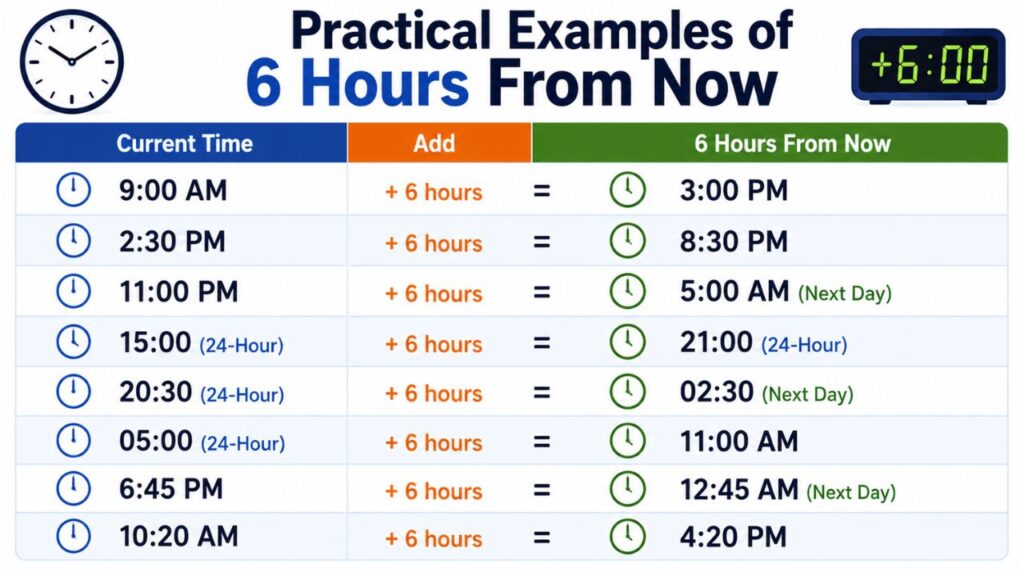
Here are several examples that show how the calculation behaves at different points in the day. These are simple enough to check manually, which is exactly why they make good practice.
- 9:00 AM + 6 hours = 3:00 PM
- 2:30 PM + 6 hours = 8:30 PM
- 11:00 PM + 6 hours = 5:00 AM the next day
- 15:00 + 6 hours = 21:00
- 20:30 + 6 hours = 02:30 the next day
- 05:00 + 6 hours = 11:00 AM
- 6:45 PM + 6 hours = 12:45 AM the next day
- 10:20 AM + 6 hours = 4:20 PM
Notice how the minutes remain unchanged. The major thing to watch is the transition between AM and PM, or between one date and the next. That is where most manual mistakes sneak in.
A Simple Way to Avoid Time Calculation Mistakes
If you need a reliable time calculation, use a small three-step habit. First, write down the current time. Second, add six hours. Third, check whether the result passes midnight.
For instance, starting at 8:30 PM:
8:30 PM + 4 hours = 12:30 AM.
You still need two more hours, so:
12:30 AM + 2 hours = 2:30 AM.
Therefore, six hours from 8:30 PM is 2:30 AM the next day.
This method is slower than pressing a button, but it is excellent for learning. Once the process becomes familiar, your brain starts doing the calculation almost automatically.
How to Use Six Hours for Better Schedule Planning
If you want to plan your day, try looking at six-hour windows rather than thinking about the whole day at once. A six-hour block can become a useful container for focused work, errands, family time, or rest.
You might decide that the next six hours are for completing a project. Or perhaps the first half is for work and the second half for preparing for an evening event. This kind of schedule planning can reduce the feeling that everything needs to happen immediately.
The goal is not to become obsessed with the clock. Quite the opposite. Better time management should give you enough structure that you can stop checking the clock every five minutes.
How to Make a Future-Time Calculation More Personal
A number becomes more useful when you connect it to something real. Instead of merely saying “six hours later,” identify what that future moment means.
It might be:
- The beginning of your next work shift.
- The time a relative is expected to arrive.
- The end of a study block.
- A planned family meal.
- A travel checkpoint.
- A scheduled online meeting.
- A quiet moment reserved for yourself.
For a family welcoming a baby girl, six hours might represent the next visit from grandparents, a planned update to relatives, or simply the time when everyone hopes to hear good news. The clock itself is neutral, but the people waiting around it give the hour its meaning.
Read more blog: Weeks From Today Calculator
Frequently Asked Questions
6 hours from now is what time
To find the time 6 hours from now, simply add 6 hours to the current time. If the calculation passes midnight, the result will be on the next day.
what time will it be 6 hours from now
The time 6 hours from now depends on your current time. Add six hours to the current hour while keeping the minutes the same.
what was 6 hours from now
“6 hours from now” refers to a future time, not a past time. For a past calculation, you would subtract 6 hours from the current time.
what is 6 hours from now
Six hours from now means the exact time that occurs six hours after the current moment. A time calculator can provide the result instantly.
Conclusion
So, what time is 6 hours from now? The practical answer is wonderfully uncomplicated: take the current time and move the clock forward six hours. Keep the minutes the same, watch carefully when AM changes to PM, and remember that crossing midnight means you have entered the next day.
For everyday needs, a clock calculator, time calculator, or hours from now calculator can provide an automatic time calculation in seconds. For simple situations, manual time calculation is just as reliable and can help strengthen your understanding of time.
But there is a slightly bigger lesson hiding inside this small question. Time is not only something we measure. It is something we wait through, plan around, celebrate, and sometimes wish would slow down. Six hours can be a workday, a journey, a nap, a family gathering, or a long stretch of anticipation before a life-changing moment.
A clock gives us numbers, but people give those numbers meaning. Whether you are counting down to an appointment, preparing for tomorrow, organizing your daily schedule, or waiting to welcome a precious baby girl into the family, knowing the exact time can make the future feel a little less distant.
And perhaps that is why questions about 6 hours from now remain so useful. They take an uncertain future and give it a place on the clock. Just six hours. Then another moment begins.
