Ever catch yourself staring at the Clock and suddenly wondering, “What time was it 50 minutes ago?” It sounds like one of those tiny questions that pops into your head for no reason, yet somehow it ends up leading you into a whole trail of thoughts. I had that happen the other day. I was halfway through a cup of coffee, convinced I’d only been sitting for ten minutes, then glanced back at the screen and… nope, almost an hour had drifted off somewhere. Funny how time does that, isnt it? One minute you’re checking a notification on Netflix or scrolling Social media, and the next thing you know the Tick of the clock has quietly stolen part of your afternoon.
We all deal with little moments of Confusion about time. Maybe you’re logging work hours, checking a meeting, remembering when dinner started, or trying to figure out whether your laundry has been sitting in the machine for way too long. Knowing What time was it 50 minutes ago isn’t just random curiosity. It’s a tiny piece of Time calculation that fits into everyday decisions, Daily life, and even our sense of Time awareness.
The nice thing is that this isn’t complicated math. It’s simply Time subtraction, but wrapped inside our busy routines. Whether you’re planning your Morning coffee routine, organizing Work, relaxing at Home, or reviewing your To-do list, understanding how to Subtract minutes makes life a bit smoother. Weirdly enough, these little calculations often become stepping stones toward better Time management and less stress.
Let’s wander through this surprisingly interesting question together.
| Current Time | 50 Minutes Ago |
|---|---|
| 2:00 PM | 1:10 PM |
| 3:30 PM | 2:40 PM |
| 5:15 PM | 4:25 PM |
| 8:00 AM | 7:10 AM |
| 10:45 AM | 9:55 AM |
| 12:00 PM | 11:10 AM |
| 6:50 PM | 6:00 PM |
What Time Was It 50 Minutes Ago? The Simple Answer

If you’re asking What time was it 50 minutes ago, the process is beautifully simple.
Take the Current time and subtract 50 minutes.
For example:
- If the Current time is 2:00 PM, then 50 minutes ago was 1:10 PM.
- If it’s 8:45 AM, then the answer becomes 7:55 AM.
- If it’s 12:30 PM, then it was 11:40 AM.
- If it’s 6:15 PM, then it was 5:25 PM.
- If it’s 10:50 AM, then it was exactly 10:00 AM.
- If it’s midnight (12:00 AM), then 50 minutes before now would be 11:10 PM from the previous day.
- If it’s 1:00 PM, then Current time minus 50 minutes equals 12:10 PM.
- If it’s 4:05 PM, then Calculate previous time gives you 3:15 PM.
That’s all there really is to Clock arithmetic. Yet people ask this question thousands of times because our brains aren’t always in math mode. Sometimes we’re rushing, sometimes we’re tired, and sometimes… honestly, coffee hasn’t kicked in yet.
Why We Keep Asking “What Time Was It 50 Minutes Ago”
It’s funny because this question appears in situations most of us experience every single week.
Maybe you started a Timer before cooking dinner.
Maybe your boss asked when you submitted a report.
Maybe your Friend texted, “I called you about 50 minutes ago.”
Maybe you’re using a Stopwatch during a workout.
Or maybe you’ve been binge-watching Netflix and suddenly wondered when you actually started. Been there, not gonna lie.
These moments all rely on tiny bits of Time math. Instead of estimating, we perform a quick Minute calculation without even realizing that’s what we’re doing.
People also search for:
- what was the time 50 minutes ago
- calculate 50 minutes ago
- find previous time
- subtract minutes from current time
- determine earlier time
- exact previous time
- simple time calculation
- quick time subtraction
- minutes before now
They’re all asking essentially the same thing from different angles.
What Time Was It 50 Minutes Ago During Your Morning Routine?
The Morning has this odd habit of moving both incredibly slowly and ridiculously fast.
Picture this.
You pour coffee.
“I’ll just check one email.”
Then another.
Then headlines.
Then a weather update.
Then somehow a recipe video.
Suddenly you’re asking yourself, What time was it 50 minutes ago?
That simple answer can explain why breakfast disappeared, why the kids are already waiting, or why you’re suddenly late for Work.
A few everyday examples include:
- You started your Morning routine at 7:30 AM. Fifty minutes earlier was 6:40 AM.
- Your coffee finished brewing at 8:10 AM. It started around 7:20 AM.
- You began reading the news at 9:00 AM. Earlier, it was 8:10 AM.
- Your meeting begins now at 10:00 AM. Fifty minutes ago it was 9:10 AM.
- You left Home at 7:50 AM. Earlier it was 7:00 AM.
- You completed breakfast at 8:30 AM. Before that, 7:40 AM marked the earlier point.
- You checked your email at 6:45 AM. Fifty minutes earlier was 5:55 AM.
These little calculations quietly shape our mornings without us even noticing.
Everyday Situations Where Time Subtraction Saves the Day
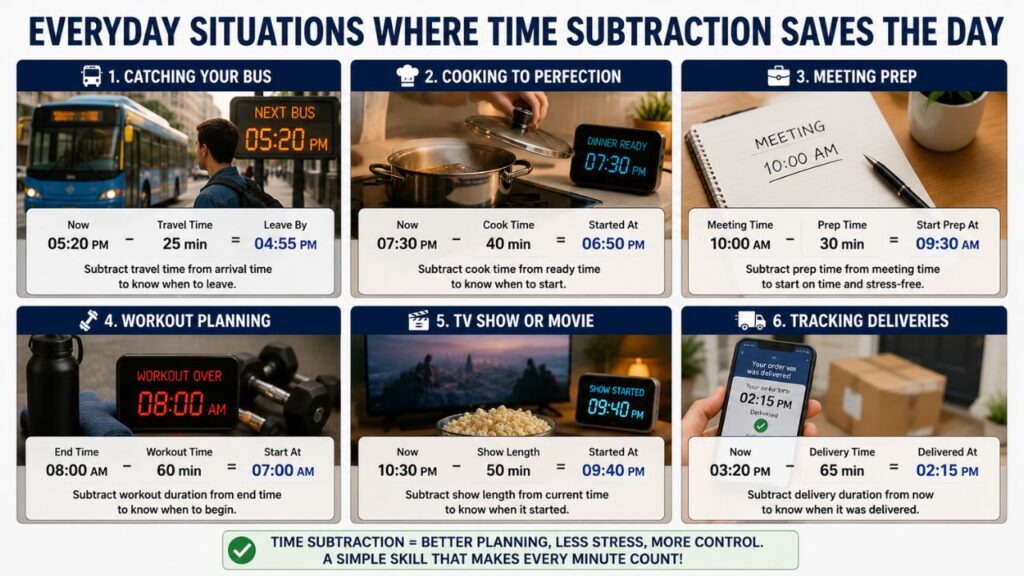
We rarely think about Time subtraction until we actually need it.
Here are situations where it becomes surprisingly useful.
- Tracking a delivery that arrived 50 minutes ago.
- Remembering when you started a Work session.
- Calculating a parking meter.
- Checking a child’s nap schedule.
- Timing recipes with a kitchen Timer.
- Reviewing security footage timestamps.
- Logging employee hours using StaffWatcher.
- Finding when a meeting actually began.
- Measuring a study session.
- Comparing timestamps across a Digital clock and Analog clock.
Small calculations prevent surprisingly big mistakes.
Time Calculation Is More Powerful Than It Looks
Many people think Time calculation is only useful in school math.
Not really.
It’s woven into almost everything we do.
When you Calculate previous time, you’re actually practicing practical reasoning. You’re improving Time perception, strengthening planning habits, and becoming more aware of how your day unfolds.
Professionals in healthcare, aviation, customer support, education, transportation, and software development rely on accurate Elapsed time calculations every single day.
Even parents do it constantly.
“When did the baby fall asleep?”
“When did we leave?”
“When should medicine be given again?”
These questions all depend on understanding Time difference.
Time Management Begins With Tiny Questions
Oddly enough, asking What time was it 50 minutes ago can become the beginning of better Time Management.
Every small calculation encourages reflection.
Maybe that meeting took longer than expected.
Maybe scrolling lasted forty-five minutes instead of five.
Maybe your “quick break” wasn’t exactly quick. Happens to Me more often than I’d like to admit.
Good Time management isn’t about squeezing every second dry.
It’s about noticing where your hours actually go.
That leads naturally toward:
- Time tracking
- Time planning
- Time blocking
- Schedule management
- Goal setting
- Prioritization
- Planning
- Accountability
- Progress tracking
- Personal productivity
One small question often reveals surprisingly large habits.
Using Productivity Techniques to Stay Aware of Time

Modern productivity isn’t really about working harder.
It’s about working smarter.
One of the best-known systems is the Pomodoro Technique, where people alternate focused work sessions with short breaks.
Imagine this rhythm.
Twenty-five minutes of focus.
Five-minute break.
Repeat.
After two sessions, nearly fifty or sixty minutes have passed.
Knowing Current time minus 50 minutes helps you review what you’ve actually accomplished instead of guessing.
Many people combine this approach with:
- A Focus timer
- Countdown timer
- Time tracking software
- Calendar reminders
- Digital planners
- Physical notebooks
These tools encourage:
- Focus
- Deep work
- Time efficiency
- Time optimization
- Better Task management
- Improved Work planning
- Healthier Productivity habits
It’s not perfect every day, of course. Some afternoons just sort of… melt.
Technology Makes Previous Time Calculations Instant
Years ago people mentally counted backward.
Now we have:
- Time calculator
- Minutes ago calculator
- Previous time calculator
- Time difference calculator
- Clock calculator
- Elapsed time calculator
- Online time calculator
- Time subtraction tool
These tools instantly Calculate past time no matter your Timezone or Local time.
They’re especially useful when working across international teams or recording events with precision.
Still, understanding the basic math yourself is worthwhile. Technology is handy, but your brain deserves a little exercise too.
A Tiny Story About Fifty Minutes
A colleague once laughed while telling me this.
“I only opened Netflix because lunch wasn’t ready.”
Fifty minutes later…
Three episodes.
Cold coffee.
One confused dog waiting for a walk.
An untouched To-do list.
We’ve all had versions of that story.
The interesting part isn’t the streaming service.
It’s how our internal sense of passing time can differ wildly from actual Clock time.
Psychologists often describe this as distorted Time perception, especially during highly engaging activities.
That’s why checking the Clock every now and then isn’t obsessive it’s grounding.
Imagining Time Travel… Just for Fun
Suppose you owned a DeLorean like the famous fictional time machine.
Would traveling back exactly 50 minutes ago change much?
Maybe you’d answer that email sooner.
Skip buying that burnt sandwich.
Avoid sending the typo-filled message.
Leave five minutes earlier for traffic.
Or maybe you’d simply enjoy those fifty minutes a little more.
While we don’t have a real DeLorean, we do have something surprisingly valuable.
Reflection.
Looking back by fifty minutes can teach us nearly as much as looking ahead.
Weekly Reflection Starts With Small Moments
A meaningful Weekly reflection doesn’t require complicated spreadsheets.
Sometimes it begins with asking:
“What was I doing fifty minutes ago?”
Then:
“What did I accomplish?”
“What distracted me?”
“What made me smile?”
Those tiny reflections slowly improve:
- Daily productivity
- Schedule organization
- Work routine
- Weekly review
- Reflection
- Goal setting
- Personal organization
- Progress tracking
Little observations accumulate into meaningful change.
Practical Tips for Calculating Previous Time Faster
If you regularly need to Calculate previous time, a few habits make it almost automatic.
- Learn to mentally Subtract minutes from common hour marks.
- Use your phone’s Clock only to verify, not always to calculate.
- Keep a simple Timer running during focused work.
- Build a consistent Coffee routine to anchor your mornings.
- Review your Daily planning before lunch.
- Schedule intentional Breaks instead of accidental ones.
- Create a small Reward system after productive Focus sessions.
- Practice quick Clock arithmetic a few times each day.
- Use a trusted Time calculator when precision really matters.
- Review your Work schedule before ending the day.
Over time these habits become second nature.
Beyond the Math: Why This Simple Question Matters
At first glance, What time was it 50 minutes ago feels almost too simple.
But beneath it lies something bigger.
It’s about awareness.
It’s about noticing where moments disappear.
It’s about understanding the relationship between intention and reality.
Every Time difference tells a tiny story.
Sometimes it’s a productive morning.
Sometimes it’s laughter with Others.
Sometimes it’s unexpected Joy.
Sometimes it’s Stress because deadlines appeared faster than expected.
Sometimes it’s pure Curiosity, wondering where the afternoon wandered off to.
No calculator can tell you whether those fifty minutes were meaningful.
Only you can answer that.
Read more blog: What Time Will It Be in 43 Minutes
Frequently Asked Questions
What time was it 50 minutes ago
To find what time was it 50 minutes ago, simply subtract 50 minutes from the current time. For example, if the current time is 2:00 PM, then 50 minutes ago was 1:10 PM.
What time was it 50 mins ago
What time was it 50 mins ago is calculated by moving the clock back by 50 minutes from the present time. You can do this mentally or use a time calculator for a quick and accurate result.
Conclusion
The next time you catch yourself asking What time was it 50 minutes ago, remember that you’re doing more than simple Time conversion. You’re connecting your present moment with one that has already slipped quietly into the past.
Whether you’re checking Exact time, organizing a Daily schedule, reviewing your Work, planning tomorrow, measuring a Focus session, or simply wondering how your coffee somehow became cold again, understanding Time subtraction helps bring clarity to ordinary life.
The formula never changes: take the Current time, Subtract 50 minutes, and you’ll discover the Previous time. Yet the meaning behind those fifty minutes changes every single day.
So keep an eye on the Clock, appreciate each Tick of the clock, embrace thoughtful Planning, and don’t be afraid to pause for a moment of Reflection. Those little pauses often become the beginning of better habits, stronger Productivity, and a calmer relationship with time itself.
And now I’d love to hear from you. When was the last time you unexpectedly lost track of fifty minutes? Was it during work, a morning coffee, scrolling social media, watching Netflix, or something completely different? Share your experience in the comments your story might remind someone else that every minute, even the unnoticed ones, has a way of shaping the day.
