
It’s a funny thing, time. One moment you’re pouring a second cup of coffee, the next you’re wondering, wait… what time was it 7 hrs ago? That tiny question can pop into your head while checking a meeting, remembering a phone call, or trying to figure out when your sleepy cat, Mr. Whiskers, actually decided that 4 in the morning was breakfast time. It happens more than we’d admit, honestly. Our brains kinda like jumping backwards through the day, even when we didn’t ask them too.
If the current time is 3 PM, then 7 hours ago was 8 AM. That sounds simple enough, yet people search for this every single day because life isn’t lived inside perfect maths. It’s lived between alarms, missed buses, forgotten messages, half-finished to-do list notes, and those little “I’ll remember that later” promises that almost never survive until later. That’s why understanding time calculation isn’t only about numbers it quietly becomes part of better planning, stronger time awareness, and a calmer routine.
Whether you’re checking a work log, remembering when breakfast happened, verifying a delivery, or simply satisfying your curiosity, knowing what time was it 7 hours ago can save a surprising amount of guessing.
| Current Time | Time 7 Hours Ago |
|---|---|
| 12:00 AM | 5:00 PM (Previous Day) |
| 3:00 AM | 8:00 PM (Previous Day) |
| 6:00 AM | 11:00 PM (Previous Day) |
| 8:00 AM | 1:00 AM |
| 9:00 AM | 2:00 AM |
| 12:00 PM | 5:00 AM |
| 3:00 PM | 8:00 AM |
| 6:00 PM | 11:00 AM |
| 9:00 PM | 2:00 PM |
| 11:00 PM | 4:00 PM |
What Time Was It 7 Hrs Ago?
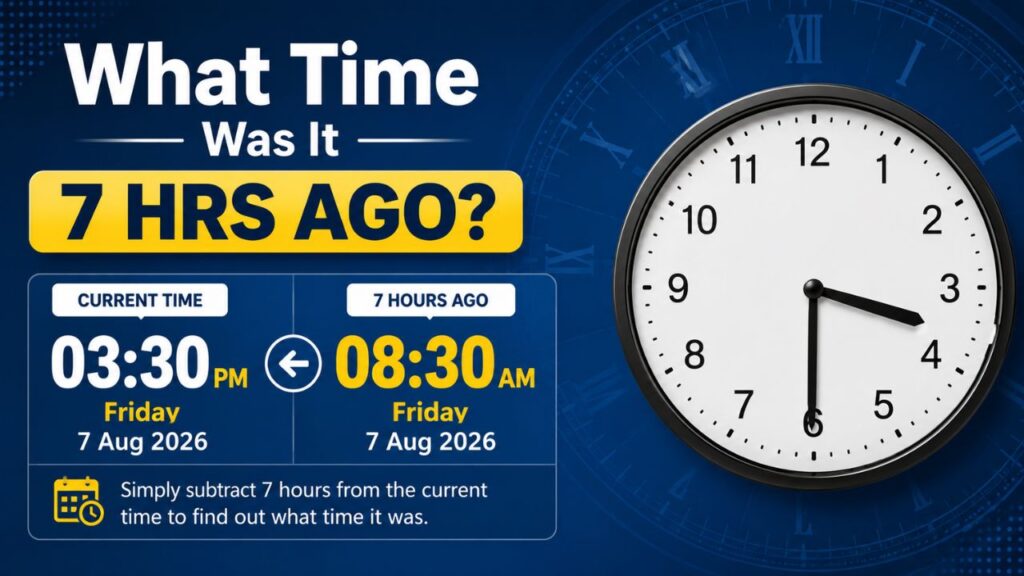
The easiest answer is simple.
If the current time is 3 PM, then 8 AM is the correct answer because you simply subtract 7 hours.
This is an example of time subtraction, one of the most common forms of Time calculation used every day.
Here are a few quick examples:
- 10 PM becomes 3 PM.
- 6 PM becomes 11 AM.
- 4 PM becomes 9 AM.
- 3 PM becomes 8 AM.
- 1 PM becomes 6 AM.
- 9 AM becomes 2 AM.
- Midnight becomes 5 PM on the previous day.
When people ask what time was it 7 hours ago, they’re usually performing a quick Past time lookup. It sounds fancy, but it’s really just moving the clock backward by seven hours.
Why People Search “What Time Was It 7 Hours Ago”
It’s not always because somebody forgot basic math. Nah, there’s usually a story behind the question.
Imagine you left the office after lunch and someone asks when the morning briefing happened. Or maybe your phone says an upload happened 7 hrs ago, and you’re trying to connect it with your morning routine.
Sometimes you wake up wondering when you actually fell asleep.
Sometimes you’re checking whether your medication was taken on time.
Sometimes you’re trying to remember if you posted something on Instagram before or after breakfast.
These little moments make Hour difference calculations surprisingly useful.
People also search:
- what time was 7 hours ago
- what time was it 7 hours ago
- what time was it exactly 7 hours ago
- calculate 7 hours ago
- 7 hours before now
- 7 hours earlier
- current time minus 7 hours
- calculate hours before now
- exact time 7 hours ago
Each search is different, but the need is almost always the same: certainty.
How to Calculate 7 Hours Earlier Without Any Tools
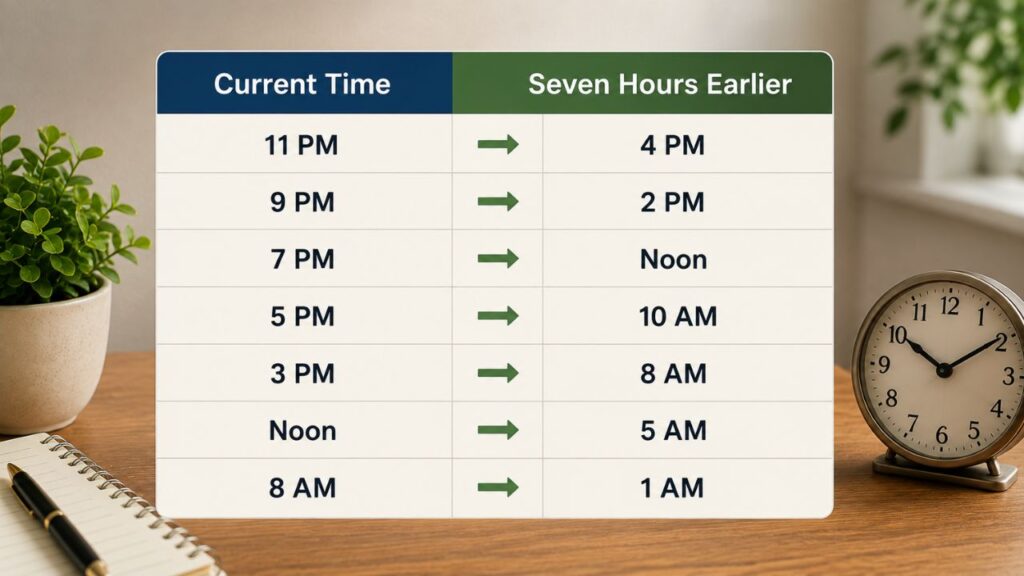
You don’t actually need a calculator every time.
Simply look at the clock and count backwards seven hours.
For example:
Current Time → Seven Hours Earlier
- 11 PM → 4 PM
- 9 PM → 2 PM
- 7 PM → Noon
- 5 PM → 10 AM
- 3 PM → 8 AM
- Noon → 5 AM
- 8 AM → 1 AM
This simple Time subtraction becomes easier after doing it a few times. Eventually your brain starts doing the Mental math automatically, though it still has those weird mornings where nothing works before the first sip of coffee.
Using a Time Calculator Makes Things Faster
There are days when your head is already full.
You’re juggling meetings.
Checking deadlines.
Trying not to forget somebody’s birthday.
Looking after the kids.
Replying inside a noisy group chat.
That’s where a time calculator, hours ago calculator, clock calculator, or time difference calculator becomes useful.
Many people also use a calculator app or dedicated time subtraction calculator because it removes any chance of making a mistake.
Instead of counting manually, simply enter the current time, subtract seven hours, and receive the exact answer instantly.
It’s honestly one less thing to think about.
Everyday Situations Where You Might Need This
You’d be surprised how often this tiny calculation appears.
Maybe your manager asks when a report started.
Maybe your fitness tracker says you exercised 7 hours ago.
Perhaps your delivery app recorded an order earlier today.
Or maybe your child proudly announces they fed Mr. Whiskers “ages ago,” which actually turns out to be exactly seven hours.
Other common situations include:
- Checking work hours
- Reviewing a schedule
- Looking through a notepad
- Reading a digital planner
- Updating a daily planner
- Tracking study sessions
- Reviewing medical reminders
- Confirming travel times
- Organizing household chores
- Remembering when breakfast happened
Each one relies on accurate Clock reading and Time calculation.
How Time Awareness Improves Productivity
People often think productivity starts with motivation.
Actually… not always.
It often starts with noticing where the hours quietly disappear.
Developing better time awareness helps people recognize patterns. Maybe every afternoon disappears into social media scrolling. Maybe binge-watching stretches a planned thirty minutes into three hours. Happens more often than folks admit.
Once you notice those habits, small improvements become possible.
Better Productivity habits usually include:
- Reviewing your daily tasks
- Planning your routine
- Using time blocks
- Avoiding unnecessary distractions
- Scheduling focused work
- Leaving space for breaks
- Ending with an evening review
None of this needs perfection. Just consistency. Well… mostly.
Time Management Is Really About Small Decisions

Good time management rarely looks dramatic.
It’s choosing to finish one task before opening another browser tab.
It’s deciding not to check Instagram every eight minutes.
It’s making your to-do list realistic instead of impossible.
It means accepting that not every email deserves an instant reply.
Tiny decisions accumulate.
That’s why effective time management often feels invisible until weeks later when your stress somehow becomes lighter.
Using schedule planning, better scheduling, and daily organization gives structure without making life feel robotic.
Digital Planning Makes Everything Easier
Modern planning tools have changed how many people organize life.
A digital planner, planner app, or even a simple phone calendar can automatically remind you about meetings, appointments, birthdays, and personal goals.
Many professionals combine:
- A daily planner
- A digital calendar
- A handwritten notepad
- A shared group chat
- A project management app
Together they create an efficient Planning workflow that supports both work and home responsibilities.
These systems aren’t about becoming busy.
They’re about becoming intentional.
Time Tracking and Accountability
If you’ve ever wondered where your day disappeared, you’re not alone.
A time-tracking tool records how your hours are actually spent.
Whether you’re freelancing, studying, or managing an office team, time tracking provides valuable insights.
Businesses often use time tracking software such as StaffWatcher to monitor employee time tracking, project progress, and work hours.
For individuals, tracking creates personal accountability.
You begin noticing:
- How long meetings actually last.
- Which tasks cause delays.
- When procrastination appears.
- Which periods produce your best focus.
Those observations improve work efficiency, time optimization, and overall personal productivity.
Avoiding Social Media Distractions

This one is a little painful.
You open Instagram for “just one minute.”
Twenty-eight minutes vanish.
Then another twelve.
Then you’re somehow watching videos about goats wearing pajamas. Nobody planned that.
Managing social media distractions doesn’t require deleting every app.
Instead:
- Schedule intentional breaks.
- Turn off unnecessary notifications.
- Keep your phone away during deep work.
- Use time blocking sessions.
- Reward yourself after completing important tasks.
Small boundaries protect surprisingly large chunks of your day.
Reflection Helps You Improve Tomorrow
Every evening offers a quiet opportunity.
Before sleeping, spend five minutes reflecting.
Ask yourself:
- Which task mattered most?
- What interrupted my focus?
- Did I stick to today’s schedule?
- Was my morning productivity better than yesterday?
- Did I spend enough time on self-care?
This habit builds stronger reflection and supports continuous Self-improvement.
Nobody gets every day right. That’s okay, really.
Building a Better Morning Routine
Many successful people protect their mornings carefully.
A healthy morning routine doesn’t have to begin at 5 AM.
It simply needs consistency.
A balanced routine may include:
- Drinking water.
- Making breakfast.
- Enjoying coffee.
- Reviewing your to-do list.
- Updating your digital planner.
- Reading for ten minutes.
- Planning today’s priorities.
Strong morning habits often influence the entire day more than people realize.
Work-Life Balance Matters More Than Perfect Scheduling
The goal isn’t squeezing productivity out of every minute.
Life isn’t a spreadsheet.
Healthy work-life balance means making room for family dinners, hobbies, naps, unexpected conversations, and silly moments with Mr. Whiskers chasing invisible enemies across the living room.
Planning should support living.
Not replace it.
That’s why combining self-care routine, realistic expectations, and thoughtful scheduling creates lasting success instead of burnout.
Practical Tips for Calculating Past Time Quickly

Whenever you need an exact past time, remember these ideas:
- Start with the current time.
- Subtract 7 hours carefully.
- Double-check if the calculation crosses midnight.
- Use a time converter when changing time zones.
- Try an hours ago calculator for instant accuracy.
- Save a trusted calculator app for future use.
- Verify important records before making decisions.
This approach works whether you’re performing a simple time lookup or managing professional schedules.
Read more blog: What Time Was 3 Hours Ago
Frequently Asked Questions
what time was it 7 hours ago
The time 7 hours ago is simply found by subtracting seven hours from the current time. This gives you the exact previous clock time while keeping the correct date if midnight is crossed.
what time was 7 hours ago
To find what time was 7 hours ago, subtract 7 hours from the current time. A time calculator can do this instantly and accurately.
what was 7 hours ago
7 hours ago refers to the exact point in time that occurred seven hours before the present moment. It is commonly used for checking schedules, timestamps, and activity logs.
time 7 hours ago
The time 7 hours ago is the previous clock time obtained by moving back exactly seven hours from the current time. This is a simple time subtraction calculation.
7 hours ago was what time
If you’re wondering 7 hours ago was what time, subtract seven hours from the current time to get the exact result. This ensures an accurate previous time without manual calculation.
Conclusion
A simple question like what time was it 7 hrs ago seems tiny at first glance, yet it opens the door to something much bigger. It reminds us that every hour leaves behind a story a finished meeting, a shared laugh over coffee, a completed project, a forgotten note inside a notepad, or maybe just a peaceful breakfast while Mr. Whiskers demanded attention. Time slips by quietly, kinda like socks disappearing in the wash, and noticing it is often the first step toward using it more wisely.
Whether you choose to calculate manually, rely on a time calculator, or use modern planning tools, understanding 7 hours before now helps you stay organized, improve productivity, and strengthen your everyday routine. The next time someone asks what time was 7 hours ago, you’ll know exactly how to find the answer and maybe you’ll pause for just a second to appreciate how much can happen in seven short hours.
