
There is something oddly satisfying about knowing exactly where a moment will land before it arrives. You look at the current time, add a stretch of hours, and suddenly the future feels a little less blurry. Maybe you are waiting for a flight, planning an overnight shift, setting a reminder, arranging an international meeting, or simply wondering, “what time is 15 hours from now?” It sounds like a tiny question, but time has a funny habit of becoming confusing when midnight gets involved.
The good news is that calculating 15 hours from now is much easier than it first appears. You do not need complicated mathematics, and you certainly do not need to stare at a clock while counting every hour one by one. With a simple time calculation, you can find the exact time 15 hours ahead in just a few seconds, even when the answer moves into the next day.
A 15 hour from now calculator makes this even simpler by taking the starting time and automatically adding 15 hours. Still, understanding what is happening behind the little digital answer is useful, because knowing how time works helps when calculators, apps, or devices aren’t available. And honestly, doing the math once in a while keeps the brain from becoming too dependent on buttons.
| Current Time | 15 Hours From Now |
|---|---|
| 7:00 AM | 10:00 PM |
| 8:00 AM | 11:00 PM |
| 10:00 AM | 1:00 AM (Next Day) |
| 1:00 PM | 4:00 AM (Next Day) |
| 3:00 PM | 6:00 AM (Next Day) |
| 7:00 PM | 10:00 AM (Next Day) |
| 10:00 PM | 1:00 PM (Next Day) |
| 11:00 PM | 2:00 PM (Next Day) |
What Time Is 15 Hours From Now?

The answer depends on your current time. There is no single clock time that is always 15 hours from now because “now” keeps moving every second.
For example, if your current time is 8:00 AM, adding 15 hours gives 11:00 PM on the same calendar day. If the starting point is 10:00 AM, then 15 hours later is 1:00 AM on the following day. So the calculation may cross midnight, which is where many people start second-guessing themselves a little.
Here are some easy examples:
- 7:00 AM + 15 hours = 10:00 PM
- 8:00 AM + 15 hours = 11:00 PM
- 10:00 AM + 15 hours = 1:00 AM the next day
- 11:00 AM + 15 hours = 2:00 AM the next day
- 1:00 PM + 15 hours = 4:00 AM the next day
- 3:00 PM + 15 hours = 6:00 AM the next day
- 7:00 PM + 15 hours = 10:00 AM the next day
- 10:00 PM + 15 hours = 1:00 PM the next day
- 11:00 PM + 15 hours = 2:00 PM the next day
The important thing is not memorizing these examples. It’s understanding that adding 15 hours can carry the clock past midnight and into tomorrow, which makes the future time belong to a different date.
How to Calculate 15 Hours From Now
The simplest manual method is to split the calculation into smaller pieces. Instead of thinking about fifteen hours as one big block, first move toward midnight or another convenient point, then add what remains.
Suppose the current time is 10:00 AM. Ten hours takes you to 8:00 PM, and five more hours takes you to 1:00 AM. Therefore, 15 hours from 10:00 AM is 1:00 AM tomorrow. That’s really the whole trick, though it can feel slightly sneaky when the date changes.
Another method is to use the 24-hour clock. If the starting time is 10:00 AM, write it as 10:00. Add 15 hours:
10 + 15 = 25.
Because a clock day contains 24 hours, subtract 24:
25 − 24 = 1.
So the result is 1:00 AM on the next day.
This is a useful form of 24-hour time calculation, especially when you are working with schedules, transportation, computer systems, or international plans where AM and PM can create unnecessary confusion.
What Time Will It Be 15 Hours From Now?
When someone searches “what time will it be 15 hours from now,” they usually want an immediate answer rather than a lesson in arithmetic. That’s completely reasonable. If you’re about to book an appointment or set an alarm, nobody wants to perform mental gymnastics just to discover whether the answer is morning or evening.
A future time calculator can take your starting point and add the required number of hours automatically. This is especially useful when the calculation includes midnight, a date change, or an unusual starting minute such as 6:37 PM.
For example, imagine the clock says 3:00 PM. Fifteen hours later:
- 3:00 PM + 9 hours = midnight
- 5 additional hours = 5:00 AM
Therefore, 15 hours from 3:00 PM is 6:00 AM the next day.
The same approach works with almost any starting point. If the clock reads 11:00 PM, adding one hour reaches midnight, and the remaining 14 hours bring you to 2:00 PM tomorrow. Once you see the pattern, the calculation becomes pretty ordinary.
15 Hours From Now Calculator: Why Use One?
A 15 hours from now calculator is useful when accuracy matters more than mental arithmetic. The calculator can work from the current system time and provide a future result without requiring you to manually count across midnight.
A good online tool may also account for the date automatically. That matters because a result like 1:00 AM is incomplete unless you know whether it means tonight, tomorrow, or some later date. A proper digital clock or time calculator connects the clock time with the calendar date, making the result much clearer.
These tools are handy for:
- Scheduling appointments and events
- Setting reminders
- Planning tasks
- Creating alarms
- Managing overnight shifts
- Organizing travel
- Planning international meetings
- Coordinating deadlines
- Building multi-day plans
- Checking a future delivery or appointment time
The biggest advantage is simple: fewer little mistakes. One missed hour can become an annoying problem later, especially when another person is depending on the schedule.
15 Hours Later: Understanding the Date Change

The phrase 15 hours later does not necessarily mean “later today.” This is one of the most common misunderstandings.
If it is morning, 15 hours later may still be the evening of the same day. If it is afternoon or night, the answer will often fall on tomorrow. So whenever you calculate time 15 hours ahead, ask yourself two questions: What is the starting time, and does the calculation pass midnight?
Consider these examples:
- 8:00 AM → 11:00 PM today
- 10:00 AM → 1:00 AM tomorrow
- 1:00 PM → 4:00 AM tomorrow
- 7:00 PM → 10:00 AM tomorrow
- 11:00 PM → 2:00 PM tomorrow
The clock itself only moves forward, but the calendar quietly changes underneath it. That’s the part people sometimes forget.
15 Hours in Minutes: The Simple Conversion
If you prefer working with minutes, 15 hours in minutes is very straightforward.
One hour contains 60 minutes.
Therefore:
15 × 60 = 900 minutes.
So 15 hours equals 900 minutes.
That means if you want to calculate 15 hours from now in minutes, you are really asking what time occurs after 900 minutes have passed. A time duration calculator may use this same basic relationship behind the scenes.
For comparison:
- 1 hour = 60 minutes
- 3 hours = 180 minutes
- 5 hours = 300 minutes
- 15 hours = 900 minutes
- 24 hours = 1,440 minutes
This conversion becomes especially useful when dealing with timers, software, productivity systems, or schedules that measure durations in minutes instead of hours. It looks more intimidating as 900 minutes, but it’s still just fifteen ordinary hours wearing a different outfit.
Calculate Time Across Midnight Without Confusion
Midnight is where a simple calculation can suddenly look much harder than it is. The trick is to separate the remaining hours of the current day from the hours that continue into the next day.
Imagine the time is 11:00 PM and you need to calculate 15 hours ahead. There is only 1 hour until midnight. That leaves 14 hours.
Midnight + 14 hours = 2:00 PM.
So the answer is 2:00 PM tomorrow.
Now imagine the time is 7:00 PM. There are 5 hours until midnight, leaving 10 hours. Ten hours after midnight is 10:00 AM.
So:
7:00 PM + 15 hours = 10:00 AM the next day.
This method is particularly helpful for calculate future time across midnight situations, because you aren’t forcing the entire calculation into one confusing step.
Adding Hours to Different Starting Times
The beauty of adding hours to time is that the same basic idea works regardless of the starting point. You can start in the morning, afternoon, evening, or right before midnight.
For instance, starting at 1:00 PM:
1:00 PM + 12 hours = 1:00 AM.
Then add the remaining 3 hours:
1:00 AM + 3 hours = 4:00 AM.
Therefore, 15 hours after 1:00 PM is 4:00 AM tomorrow.
Starting at 5:00 PM:
5:00 PM + 7 hours = midnight.
Eight additional hours brings you to 8:00 AM.
Therefore, 15 hours after 5:00 PM is 8:00 AM the next day.
Once you practice a few examples, you can almost feel where the clock is going, even without a calculator. Almost like the clock leaves breadcrumbs behind.
What If the Starting Time Includes Minutes?

You don’t have to start with a neat hour such as 8:00 AM. Real life rarely gives us such cooperative numbers anyway.
Suppose the current time is 8:25 AM. Add 15 hours:
8:25 AM + 12 hours = 8:25 PM.
Add 3 more hours:
8:25 PM + 3 hours = 11:25 PM.
So the answer is 11:25 PM.
Now suppose the starting time is 10:45 AM. Fifteen hours later is 1:45 AM tomorrow.
The minutes remain unchanged when you are adding whole hours. That little detail makes calculate hours and minutes much easier than people sometimes expect.
If you’re adding 15 hours and 20 minutes, however, you would handle the additional 20 minutes separately. This is where a time interval calculator becomes useful for more detailed scheduling.
Why 15 Hours Matters in Daily Planning
Time calculations aren’t only mathematical exercises. They show up in ordinary life more often than we notice.
Someone might need to know when a work shift ends, when a medication reminder occurs, when a travel itinerary reaches its next stage, or when an online event begins. A person preparing for an overnight shift may need to know exactly what time a task will occur after several hours of work.
For students, daily planning can depend on knowing what time a future deadline arrives. For businesses, scheduling can involve multiple appointments, meetings, and reminders. Even a simple question such as “When should I set my alarm?” can become a small time-management problem.
The more precise the plan, the more useful precise timing becomes.
Time Zones and International Scheduling
The phrase 15 hours from current time can become more complicated when different time zones are involved. Your local time may be completely different from the local time of someone attending the same meeting from another country.
For example, suppose a meeting is scheduled 15 hours from your current local time. The other participant may need to convert that future moment into their own time zone. Daylight-saving changes can also matter in countries that observe them, so blindly adding hours to a displayed clock isn’t always enough for international coordination.
This is why time zone coordination, international meetings, and time zone scheduling often rely on software that understands both the date and location.
For a simple local calculation, adding 15 hours is enough. For international plans, use a reliable time-zone tool or calendar system and confirm the actual local time before the meeting. A tiny time difference can make a surprisingly large mess.
Real-Time Clocks and Automatic Calculation
Modern devices make time calculation almost invisible. Your phone, laptop, smartwatch, and other devices usually display the current system time and continuously update it.
A real-time clock can provide real-time updates, while calendar and scheduling applications can calculate future dates automatically. This means you don’t have to manually determine the future date and time every time you create an appointment.
Still, there is value in understanding the basic calculation. Technology is brilliant until the battery dies, the settings are wrong, or someone accidentally schedules a meeting for the wrong time zone. Then suddenly the humble human brain is back on duty.
Practical Examples of 15-Hour Calculations
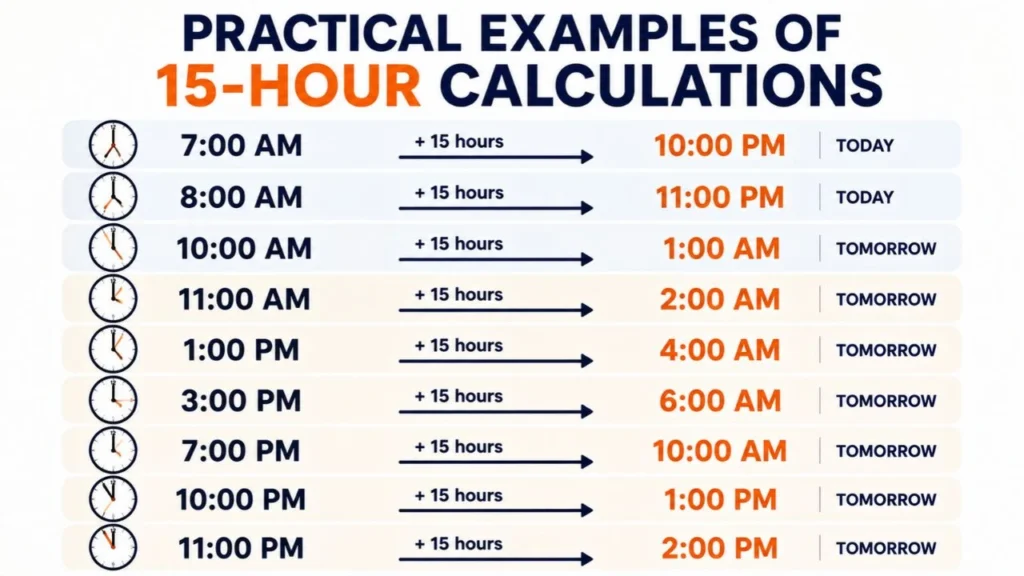
Here are several quick time calculation examples that show how the result changes according to the starting time:
- 7:00 AM + 15 hours = 10:00 PM
- 8:00 AM + 15 hours = 11:00 PM
- 10:00 AM + 15 hours = 1:00 AM tomorrow
- 11:00 AM + 15 hours = 2:00 AM tomorrow
- 1:00 PM + 15 hours = 4:00 AM tomorrow
- 3:00 PM + 15 hours = 6:00 AM tomorrow
- 7:00 PM + 15 hours = 10:00 AM tomorrow
- 10:00 PM + 15 hours = 1:00 PM tomorrow
- 11:00 PM + 15 hours = 2:00 PM tomorrow
Notice the important pattern: the later you begin in the day, the more likely the result is to land on the following day.
15 Hours From Now for Reminders, Alarms, and Events
Imagine you have an event exactly 15 hours away. Rather than guessing, you can calculate the future time and set a reminder accordingly.
If the current time is 7:00 AM, the event will occur at 10:00 PM. If it is 7:00 PM, the same 15-hour interval lands at 10:00 AM tomorrow.
This matters for reminders and alarms, especially when you’re tired or busy. An alarm set for the wrong side of midnight is not a charming little mistake; it can mean missing a flight, meeting, class, or work shift.
For recurring tasks, calendar applications are usually better than manually creating each reminder. But for one-off situations, a quick hours from now calculator can save a surprising amount of mental effort.
How to Calculate 15 Hours From Now Without Mental Math
If mental arithmetic isn’t your favorite activity, don’t force it. There are several easy options.
First, use a 15 hours from now calculator or another hours calculator. Enter the current time and let the tool determine the result.
Second, use your phone’s clock or calendar. Most modern devices make future scheduling fairly painless.
Third, manually split the calculation around midnight. This is the most dependable method when you don’t have access to a calculator.
For example, to calculate 15 hours from now automatically, a digital tool can start with the current system time, add 15 hours, and return both the time and date. For simple questions, that’s all you really need.
The Difference Between 15 Hours and 24 Hours
It is easy to think of 15 hours as almost a full day, but it isn’t. A complete day contains 24 hours, so 15 hours leaves a difference of 9 hours.
That means:
24 hours − 15 hours = 9 hours.
If you wait 15 hours and then wait another 9 hours, you have reached the same clock time on the following day.
This can help when thinking about “same time tomorrow.” Fifteen hours from now is not the same time tomorrow; it is nine hours earlier than that same clock time.
For example, if it is 3:00 PM now, the same time tomorrow is 3:00 PM. Fifteen hours from now is 6:00 AM tomorrow.
Simple, yes, but this distinction matters when precise time planning is involved.
When a Time Calculator Is More Useful Than Guessing
A time calculator is especially valuable when your calculation includes several steps. Maybe you need to add 15 hours, then another 3 hours, then subtract 45 minutes. Doing that mentally is possible, but errors sneak in when the numbers start piling up.
A time duration calculator can help determine the interval between two times, while a minutes from now calculator can handle shorter durations. A time difference calculator can compare two clock times or dates.
These tools are not about avoiding basic mathematics. They are about avoiding unnecessary mistakes when the answer actually matters.
A Quick Formula for 15 Hours Ahead

For a basic calculation, think of the future time as:
Starting time + 15 hours = future time
If the result goes beyond 24:00 on a 24-hour clock, subtract 24 hours and move the date forward by one day.
For example:
10:00 + 15 = 25:00
25:00 − 24:00 = 1:00
Therefore:
10:00 AM + 15 hours = 1:00 AM tomorrow
This formula also works when you need to add or subtract hours in other situations. The only thing you need to watch carefully is the calendar date.
Common Mistakes When Calculating 15 Hours Ahead
One common mistake is forgetting the date change. A person might correctly calculate 1:00 AM but write down today’s date even though the answer belongs to tomorrow.
Another mistake is confusing 15 hours with 15 minutes. Fifteen hours equals 900 minutes, while 15 minutes is only one quarter of an hour. The difference is enormous, despite the numbers looking almost identical at first glance.
People also sometimes add 15 to the clock number without adjusting for the 24-hour cycle. For example, 11:00 AM + 15 does not mean 26:00. The clock loops after 24 hours, and the calendar moves forward.
Finally, time zones can cause problems when the starting time and destination time belong to different locations. For international scheduling, always verify the local time and date.
Making Future Time Easier to Understand
The simplest way to become comfortable with future-time questions is to practice with ordinary examples. Start with a whole-hour time, then try one with minutes, and finally try calculations that cross midnight.
Try these:
- 8:00 AM + 15 hours
- 11:00 AM + 15 hours
- 3:00 PM + 15 hours
- 7:00 PM + 15 hours
- 11:00 PM + 15 hours
After that, try less tidy times such as 6:17 AM or 9:42 PM. You’ll notice that the minutes generally stay the same when you’re adding only whole hours.
The goal isn’t to become a human clock. It’s simply to make time calculation feel ordinary instead of mysterious.
Read more blog: What Time is 15 Minutes From Now?
Frequently Asked Questions
15 hours from now is what time
15 hours from now is the current time plus 15 hours. The exact result depends on your current local time and may fall on the next day.
what time is it in 15 hours
In 15 hours, the clock will show a time that is 15 hours ahead of your current time. You can add 15 hours to the current time to find it.
when was 15 hours from now
“15 hours from now” refers to a future time, not a past time. It means the time that will occur 15 hours after the present moment.
15 hrs from now
15 hrs from now means adding 15 hours to the current time. If the calculation passes midnight, the answer will be on the next day.
what time is 15 hours from now
To find what time is 15 hours from now, add 15 hours to your current local time. A time calculator can provide the exact result instantly.
Conclusion
So, What Time Is 15 Hours From Now? The honest answer is: it depends on your starting time. Add 15 hours to the current time, and if the calculation passes midnight, move the date forward to the next day.
You can calculate it manually, use a 15 hour from now calculator, rely on a digital clock, or let a scheduling application perform the calculation automatically. The mathematics itself is small: fifteen hours equals 900 minutes, and every day contains 1,440 minutes. But the practical usefulness is much bigger than those numbers suggest.
Knowing what time will it be in 15 hours can help with appointments, overnight work, travel, reminders, alarms, deadlines, international meetings, and everyday planning. Once you understand the simple relationship between hours, minutes, midnight, and dates, even a complicated-looking future-time question becomes rather calm.
Time keeps moving whether we calculate it or not. But when we take a moment to understand where those hours are going, planning tomorrow becomes a little easier, and sometimes that’s all we really need.
