
There is something strangely satisfying about looking at a calendar and asking, “How Many Days Until May 1st?” It sounds like a tiny question, almost too ordinary to deserve much thought, yet a date can quietly become the finish line for a plan, a celebration, a deadline, a trip, or simply the day you have been waiting for. May 1st sits there on the calendar with a little bit of promise around it, and counting toward it can make the future feel much more real somehow.
If you are checking the Days Until May 1st from today, August 22, 2026, the answer is 252 days until May 1st, 2027. That is also about 36 weeks, depending on how you prefer to look at the calendar. A May 1st countdown can be useful when you are planning an event, tracking a personal goal, preparing for a holiday, organizing a project, or just wondering how quickly the months are disappearing.
The interesting part is that counting days is not always as simple as staring at two dates. Months have different lengths, leap years can interfere with ordinary date arithmetic, and time zones can even matter when a precise deadline is involved. So, whether you want a quick answer or want to understand the calculation yourself, this guide walks through it without turning the calendar into a maths exam, which is probably for the best.
| Question | Answer |
|---|---|
| How Many Days Until May 1st? | 252 days |
| Target Date | May 1, 2027 |
| Today | August 22, 2026 |
| Weeks Remaining | 36 weeks |
| Hours Remaining | 6,048 hours |
How Many Days Until May 1st 2027?

As of today’s date, August 22, 2026, there are 252 days until May 1st, 2027. The calculation treats August 22, 2026 as the start date and May 1, 2027 as the end date, measuring the full number of calendar days between them.
For someone asking how many days until May 1st 2027, this gives a straightforward countdown. If you are building a planner, setting a deadline, preparing a campaign, or counting down to an upcoming occasion, 252 days gives you a rather generous stretch of time. It is long enough to feel distant but close enough that planning today can actually make a difference.
A simple way to visualize the time remaining until May 1st is to break it into months. From August 22 to the end of August there are 9 days, then September contributes 30 days, October 31, November 30, December 31, January 31, February 28, March 31, April 30, and then the calendar arrives at May 1. Add those pieces together and you reach 252 days, nice and tidy.
The number can look slightly different if someone includes the starting day in their counting method. That is why date calculators normally describe the result as the difference between a start date and an end date, rather than simply counting every square on the calendar. Tiny distinction, but it can cause surprisingly large arguments in group chats.
Days Until May 1st: Understanding the Countdown
The phrase Days Until May 1st usually means the number of complete calendar days between the current date and the upcoming May 1st. If today changes tomorrow, the number naturally decreases by one. That is the whole charm of a countdown: it is always moving, even when nobody is watching it.
A Countdown to May 1st can be expressed in several ways. You might say there are 252 days, roughly 36 weeks, or thousands of hours remaining. Each description tells the same basic story but feels different emotionally. Days feel practical, weeks feel manageable, while hours make the future suddenly seem very specific indeed.
People often search phrases such as how long until May 1st, how many days are left until May 1st, or days remaining until May 1 because they want an immediate answer rather than performing calendar arithmetic themselves. There is nothing wrong with that. Calendars are helpful precisely because they save us from having to remember how many days February has while standing in the kitchen wondering where the year went.
The countdown becomes especially useful when connected to an actual objective. If May 1st is a project deadline, 252 days can be divided into smaller milestones. If it is a travel date, you can divide the remaining time into booking, preparation, and final-check stages. If it is simply a date you are excited about, well, watching the number fall is its own little ritual.
May 1st Countdown: Why People Count the Days
Dates become meaningful when we attach stories to them. May 1st might be the beginning of a new work phase for one person, a family gathering for another, or an important personal target for someone else. The calendar does not know why you are waiting, which is perhaps why it can hold so many different meanings at once.
A May 1st countdown can also create a useful sense of urgency. Two hundred and fifty-two days sounds enormous until you start dividing it into weeks. Suddenly, the distant date becomes a series of ordinary Mondays, busy Fridays, quiet Sundays, and the occasional month-end rush. Time is sneaky like that.
For students, a May deadline can be a useful planning anchor. For businesses, it can become part of a marketing or launch calendar. Families might use it when arranging travel or celebrations. Writers and creators may use the date as a publishing target. The important thing is not the countdown itself, but what you decide to do with the remaining time.
A countdown also works psychologically because it turns an abstract future into a measurable interval. Saying “sometime next year” feels vague. Saying “252 days from today” feels concrete. It gives the future a number, and numbers are wonderfully bossy little things when we need to organise ourselves.
How to Calculate Days Until May 1st

If you want to calculate days until May 1st without an online tool, you can use a calendar and basic addition. Start with August 22, 2026, then calculate the remaining days in August before moving month by month toward May 1, 2027.
The calculation looks like this:
- August 22 to August 31: 9 days
- September: 30 days
- October: 31 days
- November: 30 days
- December: 31 days
- January: 31 days
- February: 28 days
- March: 31 days
- April: 30 days
Adding these intervals gives 252 days. The important thing is to avoid accidentally counting both endpoints as full days, because that creates the classic one-day error. It is a very small mistake, but calendars have a talent for making tiny mistakes look embarrassingly official.
You can also use a days calculator, date calculator, or countdown calculator. Enter the current date as the start date, enter May 1, 2027 as the end date, and the tool will perform the date difference calculation for you. An online calculator is particularly handy when you are checking several future dates at once.
May 1st Calculator: A Faster Way to Find the Answer
A May 1st calculator is basically a date difference tool designed to answer questions such as “How many days are left?” without requiring manual calendar work. You provide two dates, and the calculator determines the interval between them. It is especially useful when the dates cross several months or even several years.
A days until May 1st calculator can also show the result in multiple units. Depending on the tool, you may see days, weeks, hours, minutes, or even seconds. For ordinary planning, days are usually the easiest measurement, but hours can be useful when a precise event time is involved.
A countdown timer takes the idea one step further by continuously updating the remaining time. Instead of checking the date difference once, the timer keeps moving as the seconds pass. This is useful for websites, event pages, launch announcements, and personal countdown pages.
If you manage a website or blog, a simple online countdown tool can also improve the user experience. Visitors can instantly see how much time remains until a particular date, rather than reading a paragraph and calculating it themselves. Good website tools should feel effortless, almost like they were waiting there before you arrived.
How Many Weeks Until May 1st?
If you are asking how many weeks until May 1st, the 252-day interval works out to exactly 36 weeks. This is one of the cleaner ways to think about the countdown because 36 weeks is easy to divide into monthly or weekly goals.
For example, someone with a long-term project could divide those 36 weeks into three broad stages of 12 weeks each. The first stage might focus on preparation, the second on active work, and the final stage on polishing and checking everything. It is not a magical productivity formula, but it can make a large date feel less enormous.
Weeks are often more practical than hours for long-term planning. Nobody realistically needs to wake up thinking, “I have 6,048 hours left until May 1st!” unless they enjoy making breakfast sound like a NASA mission. For most people, 36 weeks is much easier to understand.
How Many Hours Until May 1st?

The question how many hours until May 1st depends on the exact time of day and the time zone being used. If you simply convert 252 full days into hours, the result is 6,048 hours. But a real-time countdown can differ because it also considers the current hour and minute.
This distinction matters when planning global events. A person in one country may already be approaching May 1st while another region is still several hours behind. Time zones and different regions can therefore affect precise timing, especially when participants are spread across countries.
For ordinary calendar planning, however, the day-based answer remains much easier: 252 days until May 1st, 2027, based on August 22, 2026. If you need second-by-second precision, use a countdown timer that knows your local time rather than relying on a simple day calculation.
Leap Years, February, and Why Calendar Math Gets Tricky
Calendar calculations become more interesting when February enters the story. Normally, February contains 28 days, while a leap year gives it 29. The extra day, February 29, is added according to rules involving the familiar 4-year cycle, with exceptions for years divisible by 100 and a further exception for years divisible by 400.
The year 2027 is not a leap year, so February 2027 has 28 days. That makes the current calculation straightforward. Still, if you were calculating a date in a leap year, forgetting February 29 could shift the result by an entire day, which is enough to make a supposedly accurate deadline suddenly rather less accurate.
Different calendar systems can also have different conventions, though the Gregorian calendar is the standard reference for most modern date calculations. When using a calendar date in an online system, spreadsheet, or software application, it is worth knowing which calendar assumptions are being used.
This is why automated tools can be useful. They quietly handle month length, leap-year rules, and date arithmetic while you get on with whatever you were actually trying to accomplish. Sometimes the best technology is the technology that lets you stop thinking about the technology.
Calculate Days Until May 1st Using Excel
If you prefer a spreadsheet, Excel can calculate the number of days between two dates with very little effort. Enter the starting date in one cell and May 1, 2027 in another, then subtract the earlier date from the later date.
For example, if the start date is stored in cell A1 and the end date is in B1, a simple formula can be:
=B1-A1
Excel will return the number of days between those dates when the cells contain valid date values. It is a wonderfully boring solution, which in spreadsheet work is generally a compliment.
You can also use the DATEDIF function for date intervals. A commonly used formula is:
=DATEDIF(start_date, end_date, "D")
The "D" tells Excel to return the difference in complete days. This can be useful when building project trackers, deadline sheets, event schedules, or a personalized days remaining calculator.
Spreadsheets become particularly powerful when several dates need tracking at once. You can create columns for the event name, start date, end date, remaining days, and status. Suddenly, a simple question about May 1st becomes part of a much larger calendar-planning system.
Calculate Days Between Dates Without an Online Tool
There are times when you do not have access to a website or spreadsheet, and that is where old-fashioned pen and paper calculation still earns its place. Write down the two dates, count the remaining days in the first month, add the complete months in between, and then add the days in the final month.
The key is consistency. Decide whether your calculation measures the elapsed interval between dates or includes the starting date as part of the count. Most date calculators use the elapsed interval approach, which is why the result from August 22, 2026 to May 1, 2027 is 252 days.
Manual calculation can also help you understand what a date difference calculator is actually doing. Instead of treating the result as mysterious digital wizardry, you can see how each month contributes to the total. It is slower, sure, but occasionally slower is exactly how understanding arrives.
Planning Projects Around the May 1 Countdown
A countdown becomes much more useful when you turn it into a planning framework. With 252 days available, you can create milestones instead of waiting until April to discover that the task you thought would take three days has apparently developed opinions of its own.
Start by identifying the final objective for May 1st. Then work backward. Determine what needs to be finished one month before, two months before, and several weeks before. This is essentially calendar planning, and it can reduce the stress that comes from treating a large deadline as one giant task.
You might divide the remaining weeks into preparation, execution, review, and finalization. The exact structure depends on the project, but the principle stays the same: transform one future date into several smaller checkpoints.
This approach also supports better time management. Instead of asking every morning whether you are “on track,” you can compare your current position with a planned milestone. A countdown is most helpful when it changes behavior, not merely when it sits on a screen looking dramatic.
May 1st and Other Date Calculations
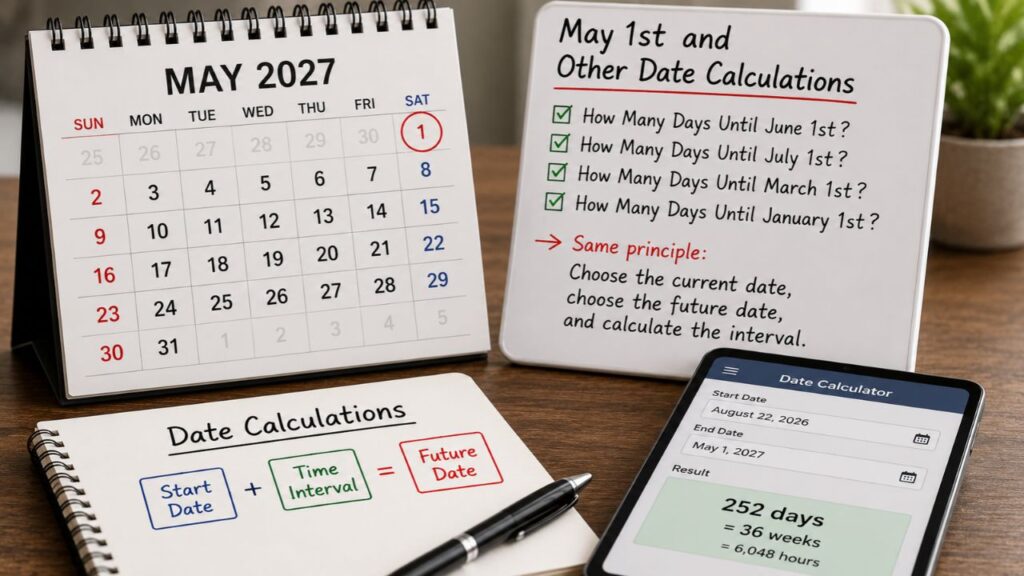
Once you understand how a May 1 countdown works, the same method can be used for almost any date. You may search for How Many Days Until June 1st, How Many Days Until July 1st, How Many Days Until March 1st, or How Many Days Until January 1st. The principle remains the same: choose the current date, choose the future date, and calculate the interval.
A future date calculator can make these questions almost instant. It can also answer questions such as how many days are between two appointments, how far away a deadline is, or what date falls a certain number of days from today.
The broader idea is days until a specific date rather than May 1st alone. Once you start using date calculations regularly, you may find yourself looking at calendars differently. Dates stop being isolated boxes and start becoming connected points in a timeline.
Time Zones and Global Events
Precise countdowns become slightly more complicated when an event involves people in multiple countries. If a global event is scheduled for May 1st at a particular hour, participants may experience the transition to that date at different local times.
For example, an event scheduled around midnight in one location may still occur on April 30 in another. This is why time zone differences, local calendars, and accurate timing matter for international meetings, online launches, webinars, and global events.
For simple date questions, you usually only need the local calendar date. For exact timing, however, specify the location or time zone. A good countdown system should make that distinction clear instead of pretending every clock on Earth shares one enormous wall.
How to Use a May 1st Countdown Productively
Knowing there are 252 days remaining is useful, but knowing what to do with those 252 days is much more valuable. If May 1st represents a goal, write down the result you want to see on that date and then identify the actions that must happen before it.
Try creating monthly checkpoints first. Then break each checkpoint into weekly tasks. Finally, choose only a few priorities for each week. This prevents the countdown from becoming a giant pressure machine where every remaining day feels like it is shouting at you.
You can also place the date in a digital calendar and create reminders at meaningful intervals. For example, reminders at 180, 120, 90, 60, 30, and 7 days before the event can provide natural moments to review progress. A little structure here can save a whole lot of frantic clicking later.
Most importantly, do not confuse counting time with using time. A beautiful countdown timer cannot complete your project, book your trip, write your article, or prepare your event. It can only tell you how much runway remains. The walking, unfortunately, is still your job.
Why Accurate Date Calculation Matters
An incorrect date can create surprisingly real problems. Missing a deadline by one day, arriving for an event on the wrong date, or publishing an announcement too early can all happen when a calculation is made casually.
That is why accurate calculation matters when the date has financial, professional, academic, or logistical consequences. For casual curiosity, a quick mental calculation is usually enough. For something important, verify the result using a date calculation tool, spreadsheet, calendar, or trusted online service.
The good news is that modern tools make verification easy. You can compare a manual calculation with an online days calculator, check it against Excel, or simply inspect the calendar month by month. When the consequence of being wrong is significant, taking an extra minute is usually worth it.
A Simple Way to Keep the Countdown Useful
If you are using a May 1st countdown for a meaningful goal, avoid checking the number every five minutes. The number will change, but your progress probably will not. Instead, check it at useful milestones and connect each milestone to an action.
You could write “252 days remaining” at the top of a planner today, then update it at the beginning of each month. Pair the number with one question: What should be different by the next checkpoint? That small question turns passive counting into active planning.
A countdown should make the future feel reachable, not frightening. Thirty-six weeks is enough time to learn something, build something, organize something, repair something, or prepare for something important. The calendar is not chasing you, even if Tuesday sometimes feels like it is.
Read more blog: What Time Is 15 Hours From Now?
Frequently Asked Questions
how many months until may 1
There are about 8 months and 9 days until May 1, 2027, from August 22, 2026.
how many days until may 1st
There are 252 days until May 1, 2027, from August 22, 2026.
how many days till may 1st
There are 252 days till May 1, 2027.
days until may 1
The countdown to May 1, 2027 is 252 days.
how many days until may 1
There are 252 days until May 1, 2027.
Conclusion
So, How Many Days Until May 1st? If today is August 22, 2026, the answer is 252 days until May 1st, 2027. You can express that as 36 weeks, or convert it into hours when you need a more detailed measurement. A May 1st calculator, online countdown tool, Excel spreadsheet, or simple calendar can all help you verify the number.
But the more interesting question is what those 252 days can become. A date is only a point on the calendar until somebody gives it meaning. Maybe May 1st is a deadline, a celebration, a journey, a personal milestone, or simply a day you are curious about. Whatever the reason, counting toward it gives you a chance to notice the time rather than letting it quietly disappear.
Use the Days Until May 1st as a planning tool, not just a number. Break the remaining days into weeks, turn weeks into practical steps, and let the calendar help you see progress. And when May 1st finally arrives, the best part will not be that the countdown reached zero. It will be that you actually did something with all the time that came before it.
