
There is something oddly exciting about watching a calendar turn toward September 1st. It is not only another square on the calendar, really; for many people, it feels like a small doorway into a different part of the year. Summer starts packing its bags, school schedules begin appearing everywhere, routines become a little more serious, and suddenly the year seems to be moving faster than we expected. If you have been wondering how many days until September 1st, the answer depends on the Current Date you are counting from. As of August 23, 2026, there are 9 days until September 1st, 2026.
That little number can mean different things to different people. Nine Days might be nine mornings before school begins, nine evenings before a work deadline, or nine chances to finish something you kept saying you would do “later.” And sometimes a date becomes important for a much softer reason, like preparing to welcome a baby girl into the family, planning a celebration, or simply marking a new beginning. Calendars are funny like that; they measure time without really measuring what the time means to us.
So, if you are searching for a September 1st countdown, a quick Date Calculator, or simply trying to understand the Time Remaining, this guide explains the calculation in a simple way. It also explores several ways to count toward September, because sometimes counting nine days is easy, while larger date gaps can become surprisingly sneaky.
| Current Date | Target Date | Days Until September 1st |
|---|---|---|
| August 23, 2026 | September 1, 2026 | 9 days |
How Many Days Until September 1st, 2026?

If today’s date is August 23, 2026, and the Target Date is September 1st, 2026, the calculation is straightforward. August has 31 days, and August 23 is the starting point. There are eight full days after August 23 before reaching August 31, and then September 1 arrives one day later. That gives us 9 days in total.
In other words:
- Current Date: August 23, 2026
- Target Date: September 1st, 2026
- Days Remaining: 9 days
- Time Remaining: 1 week and 2 days
- Approximately 216 hours, if counting complete 24-hour periods
The result is small enough to calculate mentally, which is handy. Still, people often ask the question because they want an exact countdown without doing calendar gymnastics at nine o’clock at night, which is completly understandable.
A Simple September 1st Countdown
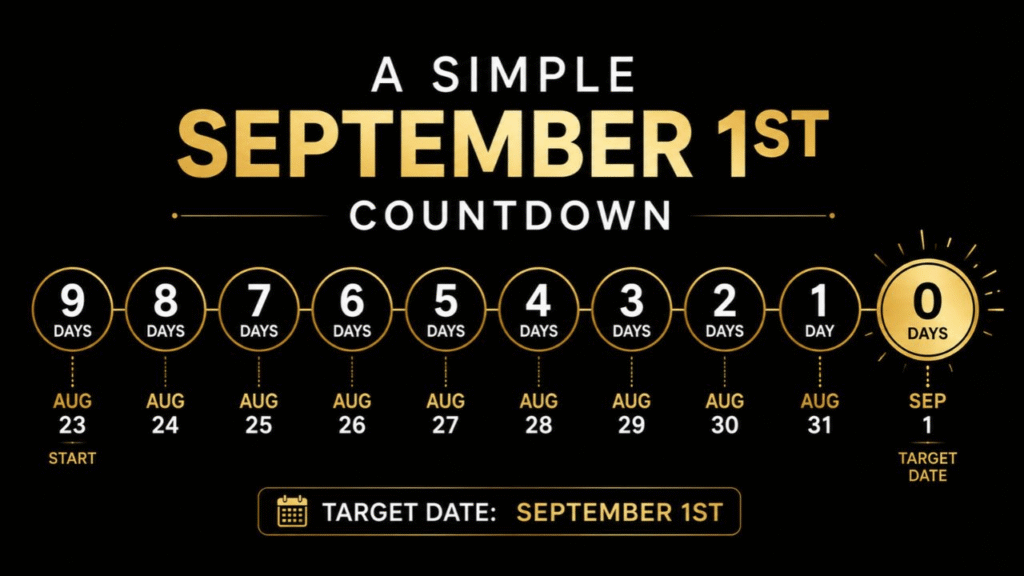
A countdown gives the coming days a shape. Instead of thinking about the entire remaining month, you can look at the final stretch one day at a time. For someone preparing for a new semester, for instance, August 24 can become “one step closer,” while August 31 feels like the final page before September begins.
The countdown from August 23 looks like this:
- August 23
- Starting point
- August 24 — 8 days remaining
- August 25 — 7 days remaining
- August 26 — 6 days remaining
- August 27 — 5 days remaining
- August 28 — 4 days remaining
- August 29 — 3 days remaining
- August 30 — 2 days remaining
- August 31 — 1 day remaining
- September 1 — The Target Date
There is a small psychological trick hidden inside this. “Nine days” can sound like plenty of time, but “tomorrow is August 24” feels much more immediate. Breaking Time Remaining into tiny pieces makes a distant event feel more real, and sometimes thats exactly what a person needs.
Why September 1st Feels Like a Fresh Beginning
September often carries a strange mixture of ending and beginning. August is still warm in many places, but September arrives with the suggestion that routines should be reorganized. Students return to classrooms, workplaces become busier, planners get filled again, and families begin preparing for the final stretch of the year.
For some families, September also becomes a meaningful month for welcoming a daughter or celebrating a newborn. A baby’s arrival can make a normal calendar date feel almost magical. Suddenly, September 1 isn’t simply September 1; it might be the first month of a child’s story, the day a family begins using a new nickname, or the date grandparents remember forever.
One parent might look at the calendar and say, “Only a few more sleeps.” A grandparent may count differently, perhaps by imagining the first tiny socks, first photograph, or first cuddle. The mathematics remains the same, but the emotional arithmetic changes quite a lot.
How to Calculate Days Until September 1st Manually
You do not need an Online Calculator to calculate every date difference. Sometimes the old-fashioned Manual Method works perfectly well, especially when the dates are close together.
Start by identifying your Current Date and the Target Date. If the current date is August 23 and your target is September 1, first determine how many days remain in August. August contains 31 days, so you subtract 23 from 31. That leaves 8 days. Then add the first day of September, producing 9 days.
The basic idea is:
Days remaining in current month + days into target month = total date difference.
This approach becomes more useful when the dates are farther apart. For example, if someone asks about July 1 and September 1, you can count the remaining days in July, all the days in August, and then arrive at September 1. It takes a little longer, but it keeps the calculation visible instead of turning it into a mystery number.
Using the Knuckle Method for Days in Each Month
The Knuckle Method is one of those wonderfully old-school tricks that people remember from school and then suddenly rediscover twenty years later. It helps you remember which months have 31 days.
Make a fist and use the knuckles and spaces between them. Each knuckle represents a 31-day month, while each dip represents a month with fewer days. January lands on a knuckle, February in a dip, March on a knuckle, and so on.
This method is particularly useful when doing a manual date calculation across several months. July and August, for example, both have 31 days, which can make calculations between July 1, August 1, and September 1 easier to organize.
Still, remember that February is the troublemaker of the calendar family. It usually has 28 days, but during a Leap Year, it gets 29. That single extra day can change a larger date difference calculation, so don’t casually ignore it.
What Happens When the Dates Are Far Apart?

Calculating Days Until September 1st is easy when you’re already in August. But imagine someone asking the same question on July 1. Now the calculation includes the rest of July and all of August before reaching September.
From July 1 to September 1, the date difference is 62 days. From July 15 to September 1, the difference is 48 days. From August 1 to September 1, it is 31 days. From August 15 to September 1, it is 17 days.
These examples show why a Date Calculator becomes useful as the gap grows:
- July 1 to September 1 — 62 days
- July 15 to September 1 — 48 days
- August 1 to September 1 — 31 days
- August 15 to September 1 — 17 days
- August 23 to September 1 — 9 days
- August 31 to September 1 — 1 day
The numbers become a kind of shrinking staircase. Every day you move forward, the countdown loses one step, which is obvious but still oddly satisfying to watch.
September 1st Calculator: A Faster Way to Count
A September 1st Calculator can make date counting almost effortless. Instead of remembering how many days are in every month, you enter the Current Date, select September 1 as the Target Date, and let the calculator determine the Days remaining.
An Online Date Calculator can be especially useful for people planning deadlines, trips, appointments, school schedules, events, or personal milestones. You may also see tools described as a days calculator, countdown calculator, date difference calculator, or remaining days calculator. They all solve a similar problem, although their interfaces may be a little different.
The advantage isn’t just speed. An online tool can reduce simple human mistakes, particularly when you are dealing with larger date gaps, different months, or Leap Year calculation. We humans are very good at remembering birthdays and very bad at remembering whether November has 30 or 31 days. Strange species, honestly.
September 1st in Weeks, Hours, and Months
Some people prefer thinking in Weeks rather than Days. From August 23 to September 1, there are 9 days, which equals 1 week and 2 days. If you convert the entire period into hours, assuming complete 24-hour periods, you get 216 hours.
This way of expressing Time Remaining can be helpful when planning. Nine days feels short. Two hundred sixteen hours feels enormous. One week and two days sounds somewhere in the middle. Same amount of time, completely different emotional outfit.
For larger countdowns, you may also think in Months, but months are not always equal lengths. A month can contain 28, 29, 30, or 31 days, so saying “one month” is not always the same as saying 30 days. That’s why an exact date calculation is better when accuracy matters.
Common Date Calculation Mistakes
One common mistake is accidentally counting the starting date as a full remaining day. If today is August 23, you generally count the days after August 23 when calculating how long until September 1. Including August 23 itself would give you the wrong answer.
Another mistake is forgetting that months have different numbers of days. August has 31 days, September has 30, and July has 31. February is different again. These little details seem harmless until they quietly add or remove a day from an important deadline.
A third mistake happens when people confuse a calendar date with an exact number of hours. Saying “September 1 is nine days away” is a calendar calculation. Saying “216 hours remain” assumes you are measuring nine complete 24-hour periods from a particular time. If the exact hour matters, the time remaining calculator needs the current time as well.
September 1st for Students, Families, and Planners
For students, September 1 can represent a return to structure. New notebooks appear, bags are reorganized, schedules are printed, and somebody inevitably realizes their favorite pen disappeared sometime in July.
For families, the date can be connected with travel, birthdays, school preparation, seasonal plans, or a baby’s arrival. If a family is preparing to welcome a baby girl around this period, the countdown may become emotionally important. Every remaining day feels like another little page before the family story changes.
For planners and professionals, September can be the month when unfinished summer projects finally become urgent. A Countdown Tool placed on a Website or Blog can make deadlines visible without requiring visitors to perform their own calculations.
How to Use a Countdown Tool on a Website or Blog
A Countdown Tool can be useful when a specific date matters to your audience. A website owner might create a countdown to September 1 for a school reopening, event, product launch, seasonal sale, registration deadline, or personal celebration.
Some Online Calculator platforms provide an Embedding Link or simple embed option that allows the calculator to appear on a blog page. This can be useful because visitors do not have to leave the page to calculate the date difference themselves.
A good website countdown calculator should be simple, readable, and up-to-date. If you are adding a date calculator for blogs, avoid filling the page with unnecessary distractions. The visitor usually came for one answer: how many days are left. Give them that answer first, then offer the extra details.
September 1st and the Feeling of New Beginnings
Dates become meaningful because people attach stories to them. September 1 can be the first day of a new class, the beginning of a personal challenge, the start of a new work routine, or simply a promise to stop postponing something.
That is why a countdown can feel more emotional than mathematical. Watching the September 1st countdown move from 31 days to 17, then 9, then 1 creates anticipation. The calendar doesn’t become more important by itself; our expectations make it important.
If you are preparing for the arrival of a baby girl, this feeling becomes even stronger. A family might have a nursery waiting, tiny clothes folded into drawers, and grandparents checking their phones every few minutes. Nobody really needs a Date Calculator at that point, but everyone somehow keeps looking at the calendar anyway.
A Few Simple Ways to Make the Countdown Meaningful
Instead of simply watching the Days Until September 1st, use the remaining time intentionally. If nine days remain, give each day a small purpose. One day might be for organizing your schedule, another for finishing an unfinished task, and another for calling someone you haven’t spoken to recently.
For families, the countdown can become a tiny tradition. Take one photograph each day, write a short note about what happened, or keep a small journal. Later, those ordinary notes may become surprisingly precious because ordinary days are often the ones we forget first.
You can also create a physical calendar and cross off each day. There is something strangely satisfying about putting a mark through yesterday and seeing September getting closer. Digital calendars are convenient, but paper has its own quiet little drama.
Understanding September 1st Through Different Dates

Looking at several starting points can make date calculations easier to understand. Suppose the Current Date is July 1. You have 62 days before September 1. On July 15, there are 48 days. On August 1, there are 31 days. On August 15, there are 17 days.
By August 31, only 1 day remains. Then, at September 1, the countdown reaches zero.
This is the basic principle behind almost every date countdown tool. The calculator isn’t doing anything mysterious. It is determining the number of calendar days between two dates, considering month lengths and, when necessary, leap-year rules. The complicated-looking result is usually just careful calendar arithmetic wearing a fancy hat.
Why Accurate Date Calculation Matters
Accuracy matters more when a date has consequences. Missing a casual personal deadline by a day may be annoying, but missing a registration deadline, appointment, travel date, payment date, or important family event can create real problems.
For that reason, use an Online Date Calculator when precision matters, particularly for larger date gaps. If you’re doing the calculation yourself, check the month lengths and make sure you understand whether the starting date is included or excluded.
For most everyday countdown questions, the process is simple: identify the Current Date, identify the Target Date, calculate the Days between dates, and double-check the result. That’s really the whole engine behind a countdown.
Read more blog: How Many Days Until May 1st?
Frequently Asked Questions
days until september 1st
There are 9 days until September 1st, 2026. The countdown begins from August 23, 2026.
how many days until sep 1
September 1st, 2026 is 9 days away from August 23, 2026.
how long till september
September begins in 9 days, on September 1st, 2026.
how many days until september 1
There are 9 days remaining until September 1st, 2026.
how many weeks until september 1st
There are 1 week and 2 days until September 1st, 2026.
Conclusion
So, how many days until September 1st? If the current date is August 23, 2026, the answer is 9 days. September 1st, 2026 is just around the corner, carrying with it whatever meaning you have attached to the date.
For one person, it may mean school. For another, a deadline. For someone else, a family gathering, a fresh routine, or the much-awaited arrival of a baby girl. The calendar only gives us numbers; we give those numbers their stories, and thats where a simple date becomes memorable.
Whether you use a September 1st Calculator, a Countdown Tool, a Manual Method, or an Online Calculator, the goal remains the same: understand exactly how much time is left. Knowing the exact number of days can make planning easier, reduce uncertainty, and give you a clearer sense of what needs to happen before the Target Date arrives.
And when September 1 finally comes, the countdown disappears, but the reason you were counting remains. Maybe that’s the nicest thing about dates: they quietly move forward whether we’re ready or not, giving us another chance to begin something, finish something, celebrate someone, or simply notice that another season of life has arrived.
If September is bringing you a new chapter, take these remaining days gently. Nine days is not forever, but it is enough time to prepare, to hope, to organize, and maybe to make one small memory you’ll wish you had written down later. Time moves quickly, yes, but sometimes the best way to appreciate it is to count it carefully.
