
There are moments when Time feels strangely slippery. You look at the Clock, check the Current time, and then suddenly wonder, “Okay, but what time will it be in 45 minutes?” It sounds like a tiny question, almost too small to ask, yet it can matter when you are waiting for a meeting, planning dinner, timing a journey, preparing for an appointment, or simply trying not to lose track of your evening.
The useful thing is that 45 minutes is long enough to accomplish something meaningful, but short enough that you can almost watch the interval disappear. If your Current time is 11:13 PM, for example, adding 45 minutes brings you to 11:58 PM. On the other hand, if the starting time is 3:10 PM, then 45 minutes later is 3:55 PM. That’s the whole mystery, really: the clock keeps moving while our brains occasionally refuse to do the tiny arithmetic.
This guide explains what time is 45 minutes from now, how to perform the calculation manually, how a 45 minute time calculator can help, and how a simple 45-minute interval can become surprisingly useful for Time management, Productivity, and everyday planning.
| Starting Time | +45 Minutes |
|---|---|
| 3:10 PM | 3:55 PM |
| 8:00 AM | 8:45 AM |
| 10:30 AM | 11:15 AM |
| 11:30 PM | 12:15 AM |
What Time Is 45 Minutes From Now?

The simplest answer depends on your Current time. To find 45 minutes from now, take the present Hour and Minute, then add 45 minutes. You are not changing the date unless the calculation passes midnight, which is one of those small details people forget when doing a quick calculation.
For example, suppose the Current time is 3:10 PM. Add 45 minutes to 3:10 PM:
- Starting time: 3:10 PM
- Added Time duration: 45 minutes
- Add 40 minutes: 3:50 PM
- Add another 5 minutes: 3:55 PM
- Future time: 3:55 PM
So, what time is 45 minutes after 3:10 PM? The answer is 3:55 PM.
If you are asking what time will it be 45 minutes from now, you simply repeat this process using the actual current clock reading. It sounds obvious, but when you are tired, rushing, or staring at a dozen tasks, even easy time calculation can suddenly feel like a little puzzle.
45 Minutes From Now: A Quick Example
Imagine the Current time is 11:13 PM on Monday, August 24, 2026. Add 45 minutes and you get 11:58 PM on the same date.
That example is useful because it shows that you don’t automatically move to the next day just because you’re close to midnight. You only cross into the next Current date when the added minutes actually pass 12:00 AM.
Now imagine the starting time is 11:30 PM. Adding 45 minutes gives you 12:15 AM, meaning the Future time belongs to the following day. This is where a little care matters, especially when recording appointments or planning something important.
A handy mental trick is to first move forward to the next hour, then add whatever remains. If it is 11:30 PM, there are 30 minutes until midnight. After those 30 minutes, 15 minutes remain, giving you 12:15 AM. Easy enough once you see the clock as a path rather than just a number.
How to Add 45 Minutes to the Current Time
You don’t need a special tool to add 45 minutes to current time. Manual calculation works perfectly well for ordinary situations. Start by looking at the hour and minute, then add the 45-minute interval.
There are several little methods you can use:
- Add 30 minutes first, then add 15 minutes.
- Add 40 minutes, then add 5 minutes.
- Move the Minute hand forward by 45 minutes on an Analog clock.
- Use the Digital display and perform the addition directly.
- Write the starting time down before calculating, if accuracy matters.
- Check whether the calculation crosses an hour.
- Check whether it crosses midnight.
- Confirm the final Hour and Minute before using the result.
The 30-plus-15 method is often the easiest because half an hour is visually familiar. If the starting time is 8:20 AM, adding 30 gives 8:50 AM, then adding 15 gives 9:05 AM. So the answer is 9:05 AM, not 8:65 AM, because clocks don’t keep counting minutes beyond 59 in that way. That little correction is where many manual calculations go slightly sideways.
What Time Will It Be in 45 Minutes?
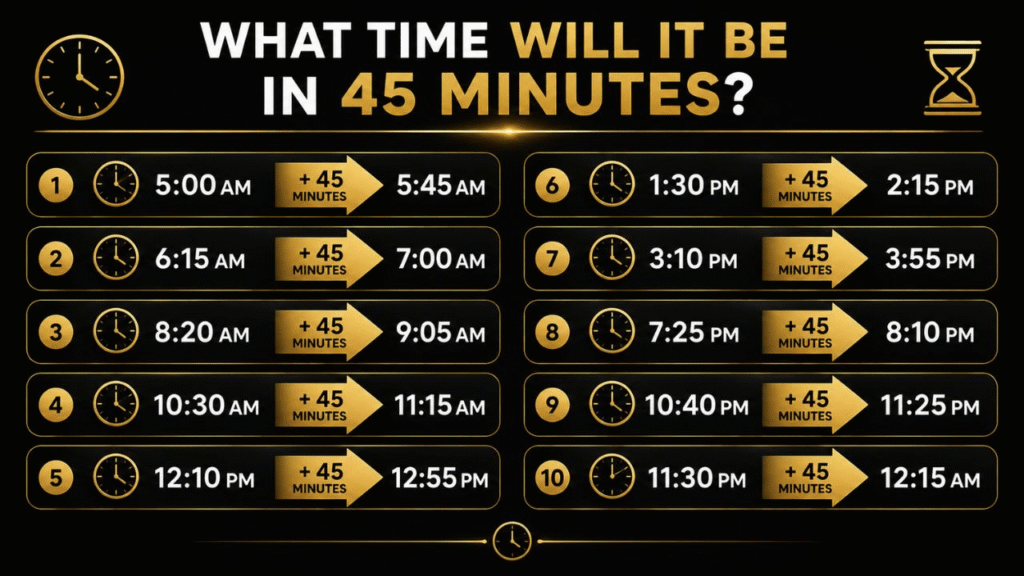
The phrase what time will it be in 45 minutes is really asking for a future point based on the present moment. The calculation doesn’t require knowing tomorrow’s schedule or anything complicated. You just need the starting time and the Time duration.
Consider these examples:
- 5:00 AM → 5:45 AM
- 6:15 AM → 7:00 AM
- 8:20 AM → 9:05 AM
- 10:30 AM → 11:15 AM
- 12:10 PM → 12:55 PM
- 1:30 PM → 2:15 PM
- 3:10 PM → 3:55 PM
- 7:25 PM → 8:10 PM
- 10:40 PM → 11:25 PM
- 11:30 PM → 12:15 AM
Notice how some answers remain in the same hour while others move forward. When the starting minutes plus 45 reach 60 or more, you carry one Hour forward and subtract 60 minutes. Its a tiny rule, but it makes the whole process dependable.
Using a 45 Minute Time Calculator
A 45 minute time calculator is helpful when you don’t want to perform the arithmetic yourself. A Time calculator can take a starting time, add the requested number of minutes, and display the resulting Future time.
This is particularly convenient when you are checking several time intervals in a row. Instead of repeatedly calculating “what time is 45 minutes from now,” you can enter the starting point and let the Calculator handle the addition.
An online 45 minutes calculator may also be useful for people who frequently work with schedules. Teachers, students, office workers, drivers, event planners, and anyone managing appointments can benefit from a simple tool that reduces unnecessary mental arithmetic. It doesn’t make the task more intelligent, but it makes it less annoying, which is sometimes the better invention.
A Time Duration Calculator can go a step further by helping you calculate the amount of time between two points, rather than only adding minutes. That distinction matters when you are planning a schedule and need to understand both the starting point and the length of an activity.
Why Time Accuracy Matters
Being five minutes early might not sound important until you’re sitting outside a meeting room that has already started. Time accuracy becomes especially valuable for appointments, deadlines, medication schedules, transport connections, online meetings, examinations, and timed work.
A modern Digital clock usually makes reading the time effortless. You see hours, minutes, and sometimes the Second displayed clearly. An Analog clock, meanwhile, gives you a more visual understanding of where you are within the hour through the Hour hand, Minute hand, and Second hand.
Both forms communicate the same information, just in different visual languages.
A reliable online clock can be useful when your device clock seems uncertain, particularly if you are coordinating something across locations. Some tools provide a live clock, real-time clock, or automatic clock update, reducing the need for repeated manual checking. Still, no tool can fix a badly interpreted time zone, so always check whether the displayed time matches your location.
The Difference Between Current Time and Future Time
The Current time is your starting point. The Future time is the point reached after the selected interval has passed. Between them sits the 45-minute period.
Thinking in terms of a time interval makes the concept easier. Instead of asking only for a number, imagine yourself standing at one point on a timeline and walking forward 45 minutes. The destination is the answer.
For instance, if you start at 2:35 PM, your timeline looks like this:
- 2:35 PM — starting point
- 3:05 PM — 30 minutes later
- 3:20 PM — 45 minutes later
Therefore, 3:20 PM is the Future time.
This way of thinking can be more natural than trying to force arithmetic into your head. Time isn’t really a pile of numbers; it is movement. We just use numbers because clocks are stubbornly fond of them.
A 45-Minute Interval Can Improve Productivity

A surprisingly useful feature of 45 minutes from now is that it can become a practical Time block. Many people don’t need three uninterrupted hours to make progress on something. They need a clearly defined window where distractions are temporarily not invited.
A 45-minute work session can be used for writing, reading, studying, planning, coding, organizing, or completing one specific task. When the 45 minutes finish, you can take a Short break, stretch, drink water, or simply look away from the screen.
For example, you might create this rhythm:
- 45 minutes of Focused work
- 5–10 minutes of rest
- Another 45-minute block
- Longer break after several blocks
The benefit is psychological as much as practical. A task can feel enormous when it has no boundary. Give it 45 minutes, and suddenly it has walls. Your brain knows where the effort begins and, importantly, where it ends.
Planning Daily Tasks With 45 Minutes
A 45-minute interval is also useful for ordinary daily planning. You might reserve one interval for emails, another for studying, another for household work, and another for creative projects.
This approach can support better schedule planning because you are assigning tasks to realistic chunks of time rather than filling your day with vague intentions.
Instead of writing “work on project” in your planner, you could write “project research 45 minutes.” The difference is small but meaningful. One is an intention without a boundary; the other has a beginning and an ending.
You can even combine several intervals with shorter gaps. A morning could contain a 45-minute study session, a 10-minute break, another 45-minute session, then lunch. Not every day will follow the plan perfectly, of course, and thats normal. A schedule is a guide, not a prison guard.
Common Mistakes When Calculating 45 Minutes From Now
Manual time calculation is easy, but a few mistakes appear again and again. The most common is forgetting that 60 minutes equals one hour.
For example, someone may take 4:30 PM and add 45 minutes to reach “4:75 PM.” That isn’t a valid clock time. Instead, 4:30 PM plus 30 minutes becomes 5:00 PM, and the remaining 15 minutes make it 5:15 PM.
Another mistake is forgetting AM and PM. Adding 45 minutes to 11:40 AM produces 12:25 PM, not 12:25 AM. When calculations happen late at night, this becomes even easier to mix up.
Crossing midnight is another common issue. If you calculate 45 minutes from 11:35 PM, the answer is 12:20 AM on the following day. The Current date matters here, so don’t leave it out when the timing is important.
How Different Clocks Help You Understand Time
The traditional Analog clock provides a physical picture of passing time. The Minute hand moves around the face, while the Hour hand gradually shifts toward the next hour. The Second hand moves much faster, almost like it’s impatient with everybody.
A Digital clock offers a different kind of clarity. Instead of interpreting hand positions, you immediately see something such as 3:10 PM. This makes digital displays especially convenient when performing quick minute calculation.
A modern Clock interface may combine both approaches, showing a digital reading alongside a visual clock face. Some online tools also provide automatic updates, so the displayed time changes continuously without requiring a refresh.
That combination can be useful when accuracy and convenience matter. The technology isn’t complicated from the user’s perspective: look, calculate, and move on with your day.
What Is 45 Minutes From Specific Times?

If you need to calculate 45 minutes from a specific time, the same basic principle always applies. Here are a few examples that cover different parts of the day:
- 1:15 PM + 45 minutes = 2:00 PM
- 2:25 PM + 45 minutes = 3:10 PM
- 3:10 PM + 45 minutes = 3:55 PM
- 4:20 PM + 45 minutes = 5:05 PM
- 6:30 PM + 45 minutes = 7:15 PM
- 8:45 PM + 45 minutes = 9:30 PM
- 10:50 PM + 45 minutes = 11:35 PM
- 11:40 PM + 45 minutes = 12:25 AM
These examples are useful because they show that the answer doesn’t always land on a neat quarter-hour. Sometimes the resulting time looks unusual, but that doesn’t mean the calculation is wrong.
Related Time Intervals You May Search For
Once people start using a minutes from now calculator, they often need other intervals too. The same logic works for 5 minutes from now, 10 minutes from now, 20 minutes from now, 25 minutes from now, 30 minutes from now, or 40 minutes from now.
You can also calculate hours from now, days from now, or even a future date and time. The underlying concept stays the same: identify the starting point, identify the Time duration, then move forward along the timeline.
A useful time management tool doesn’t need to be complicated. Sometimes the most valuable feature is simply answering a question quickly enough that you can return to what you were doing.
When an Online Time Calculator Is Most Useful
An online 45 minutes from current time calculator can be particularly handy when you’re working across different schedules or need an exact answer without doing mental arithmetic. A calculator can also reduce errors when the calculation crosses an hour, midnight, or another date.
For websites, a well-designed Clock interface can improve User experience by showing the current time clearly and making future calculations easy to understand. A simple Website embedding option may allow a live clock or calculator to be placed directly into a Blog, resource page, planner site, or productivity tool.
The goal shouldn’t be to overwhelm visitors with features. If someone arrives asking “find the time 45 minutes from now,” the answer should be obvious. Good design gets out of the way and lets the user leave with the information they needed.
Why 45 Minutes Is Such a Useful Time Duration
There is something oddly practical about 45 minutes. It is long enough for meaningful Concentration, but not so long that the task feels endless. A student can revise a chapter. A writer can draft a section. A worker can complete a focused assignment. Someone at home can finally tackle the messy little job they’ve been ignoring.
This is why the 45-minute period appears naturally in study routines, work schedules, meetings, exercise plans, and productivity systems.
You don’t need to treat every 45-minute block as a productivity competition. Sometimes 45 minutes can simply be 45 minutes of rest, conversation, cooking, walking, or doing absolutely nothing productive. Thats allowed too. Time management should make life more manageable, not turn every spare minute into a performance.
A Simple Formula for Future Time

If you want a reusable method, think of the calculation like this:
Starting time + 45 minutes = Future time
If the minutes remain below 60, keep the same hour. If they reach 60 or more, move into the next hour and subtract 60 minutes.
For example:
3:10 PM + 45 minutes = 3:55 PM
But:
3:30 PM + 45 minutes = 4:15 PM
And:
11:30 PM + 45 minutes = 12:15 AM
That is essentially the entire time calculation. The challenge isn’t the mathematics; it is remembering the hour transition and the AM/PM or date transition when necessary.
Read more blog: How Many Days Until September 1st?
Frequently Asked Questions
What time will it be 45 minutes from now?
It depends on the Current time. Simply add 45 minutes to the time shown on your clock. For example, if it is 3:10 PM, then 45 minutes from now will be 3:55 PM.
What is 45 minutes after 3:10 PM?
45 minutes after 3:10 PM is 3:55 PM. Add 40 minutes to reach 3:50 PM, then add the remaining 5 minutes.
How do I calculate 45 minutes from now manually?
Look at the current hour and minute, add 45 to the minutes, and adjust the hour if the result reaches 60 or more. Remember to check AM/PM and the date if the calculation passes midnight.
Is there a 45-minute time calculator online?
Yes, a 45 minute time calculator or Time Duration Calculator can perform the calculation automatically. Such tools are useful when you want a quick answer without doing the arithmetic yourself.
What happens if 45 minutes crosses midnight?
The calculation moves into the next day. For example, 11:40 PM plus 45 minutes equals 12:25 AM on the following day. This is why checking the Current date can be important.
Is 45 minutes good for focused work?
For many people, yes. A 45-minute Focused work session provides a defined period for concentration while leaving room for a short break afterward. It can be adapted to studying, writing, planning, or other tasks.
Conclusion
The question “what time is 45 minutes from now?” may be simple, but it sits inside something much bigger: our constant attempt to understand, organize, and make use of the hours we are given.
A 45-minute interval can be the difference between arriving on time and arriving late. It can be a productive work session, a peaceful walk, a study period, a cooking window, or simply the amount of time you spend waiting for someone you care about. The clock doesn’t tell us what those minutes should mean; we get to decide that part.
If the Current time is known, the answer is straightforward. Add 45 minutes, adjust the Hour when necessary, and check whether you’ve crossed midnight. For quick calculations, a Time calculator or future time calculator can do the work automatically, while manual calculation remains perfectly reliable for simple cases.
And perhaps that is the nicest thing about this tiny calculation. Forty-five minutes isn’t just a number on a Digital clock. It is a small piece of the future, already waiting for you.
Use it wisely when you need to. Waste it happily when you don’t. Either way, the clock will keep moving, and thats rather beautiful when you stop to notice it.
