
There is something oddly satisfying about knowing exactly what the clock will say a little while from now. Twenty-five minutes is not a long stretch of life, yet it can hold a surprising amount inside it: a quick coffee, a focused task, a short commute, or the quiet few minutes before an important meeting begins. When someone asks, What Time Is 25 Minutes From Now, they are often trying to turn a vague sense of “soon” into something concrete and useful, which is a small thing but quite helpful.
Unlike adding an hour, adding 25 minutes can feel slightly fiddly because the minutes may cross the top of the hour. You might look at the current time, add 25 minutes, and suddenly find yourself in the next hour. No big mystery, of course, but the brain loves making simple clock maths feel more complicated than it really is. With a time calculator, a digital clock, or even a quick mental calculation, you can work it out in seconds.
What Time Is 25 Minutes From Now?
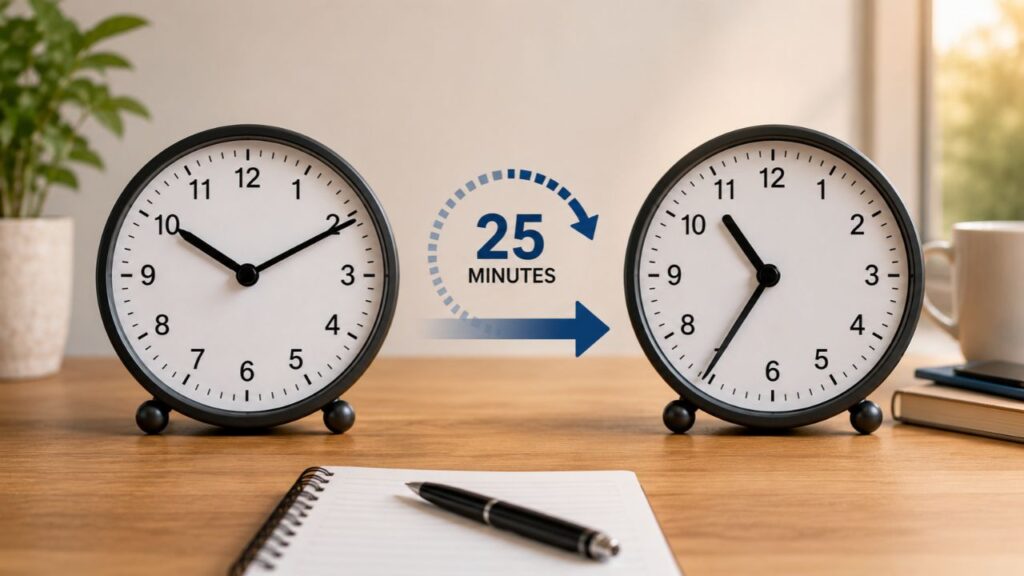
To find 25 minutes from now, start with the exact time shown on your clock. Then add 25 minutes to the minute portion. If the minutes remain below 60, the hour stays unchanged. If they reach or pass 60, move into the next hour and carry the extra minutes forward.
For example, imagine the current time is 8:10 AM. Adding 25 minutes gives you 8:35 AM. Pretty simple, really. If the time is 8:45 AM, however, adding 25 minutes takes you past the hour: 8:45 + 15 minutes = 9:00, then another 10 minutes = 9:10 AM. This second method is often easier when the numbers look a bit untidy.
So, when somebody searches what time will it be in 25 minutes, they are usually looking for a future time rather than a general explanation of minutes. The answer depends completely on the moment when the calculation is made, so the most reliable approach is always to use your updated time or exact time first.
How to Calculate 25 Minutes From Now
The easiest method to calculate 25 minutes from now is to separate the calculation into two small pieces. First, look at the minutes. Then decide whether adding 25 will keep you within the same hour or push you into the next one. It sounds almost too basic, but this little habit prevents quite a few mistakes.
Suppose your digital clock shows 2:20 PM. Add 25 minutes and you get 2:45 PM. If the clock shows 2:40 PM, add 20 minutes first to reach 3:00 PM, then add the remaining five minutes. Your answer becomes 3:05 PM, which is much easier to see when you split the calculation.
Another useful approach is to think of 25 minutes as one quarter of an hour plus 10 minutes. That mental shortcut isn’t perfect for every situation, but it can make quick time planning easier when you’re busy and don’t want to open a calculator.
What Time Is 25 Minutes From Now on a Clock?
A traditional analog clock can also help you understand the calculation visually. Since each number on an analog clock represents five minutes, 25 minutes corresponds to five numbered positions around the clock face. You can literally imagine the minute hand moving forward by five number marks.
If the minute hand starts at the 2, for instance, moving ahead by 25 minutes takes it to the 7. The hour hand will shift slightly as the minutes pass, so don’t forget that part. An analog clock shows this movement beautifully, even though a digital clock gives you the answer more directly.
This is one reason clocks remain useful teaching tools. A child learning time duration may understand “move the hand forward five numbers” more naturally than “add 25 to the minute value.” Time is numbers, yes, but it is also movement, and clocks make that movement visible in a way that a calculator sometimes doesn’t.
25 Minutes Ahead: A Quick Mental Shortcut
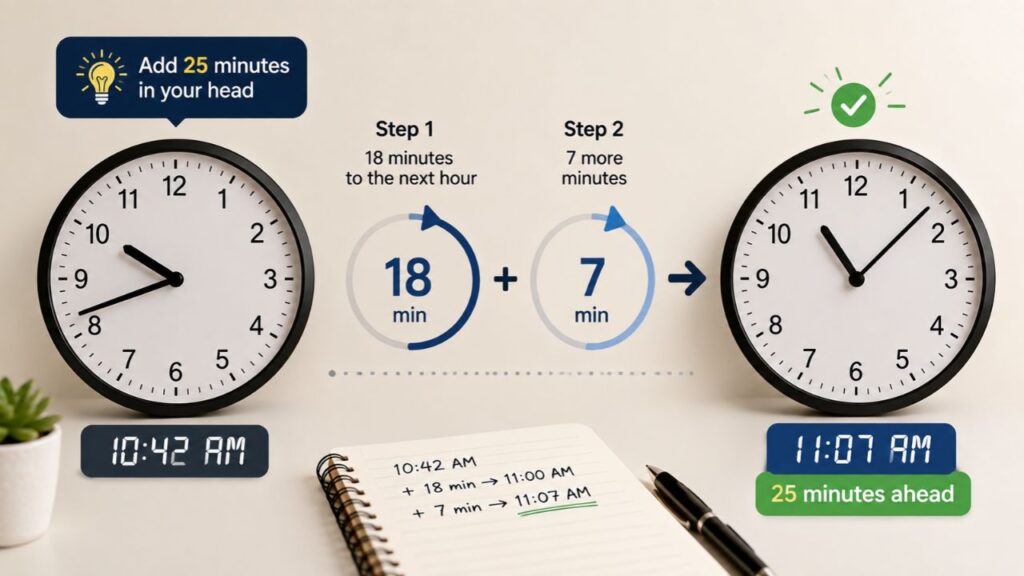
Thinking about 25 minutes ahead is especially useful when you’re away from a calculator. Start with the hour and minute you know, then move toward the next full hour if necessary. This approach is fast because whole hours are easier for the brain to process than awkward minute totals.
For example, if your current time is 10:42, you need 18 minutes to reach 11:00. Since 25 minutes is seven minutes more than that, the answer is 11:07. That little two-step trick works remarkably well and doesn’t require a special app.
You can also write the calculation down:
- Current time: 10:42
- Minutes until the next hour: 18
- Remaining minutes: 7
- Future time: 11:07
It takes hardly any space on paper, and it makes the answer easy to double-check before you leave for an appointment or start something important.
Using a 25-Minute Timer for Short Tasks
A 25-minute timer is more than a way to answer a clock question. It can become a tiny productivity boundary, which is sometimes exactly what a distracted person needs. Set the timer, choose one task, and work until the countdown reaches zero. Twenty-five minutes can feel short enough to begin without arguing with yourself about it.
This method works nicely for emails, reading, cleaning a desk, studying, writing, or organizing files. The point isn’t that every task should fit into 25 minutes; that’s not realistic. Instead, the timer gives you a defined block of attention, and that can make short tasks feel much more manageable.
A short task timer can also be useful when your day is crowded. If you have only a little space between appointments, knowing that you have exactly 25 minutes creates a clear boundary. You don’t need to wonder how long you have left because the countdown is doing that small bit of worrying for you.
What Time Is 25 Minutes From Now for Meetings and Appointments?
Imagine a meeting begins at 11:15 AM and you want a reminder 25 minutes before it. You simply count backward from the meeting time. Twenty-five minutes before 11:15 is 10:50 AM, so that becomes the point for your reminder.
The same idea works in reverse when you’re preparing to leave somewhere. If your bus, appointment, or online meeting begins at a known time, calculating 25 minutes from now can tell you whether you have enough breathing room. A few minutes can matter more than we like to admit, especially when traffic, elevators, or one mysteriously slow cup of coffee gets involved.
For meeting timer use, 25 minutes can also act as a gentle checkpoint. You might set a reminder to review your notes, gather documents, or send a final message. That way, the clock becomes part of the preparation rather than something you notice only when you’re already late.
Everyday Situations Where 25 Minutes Matters
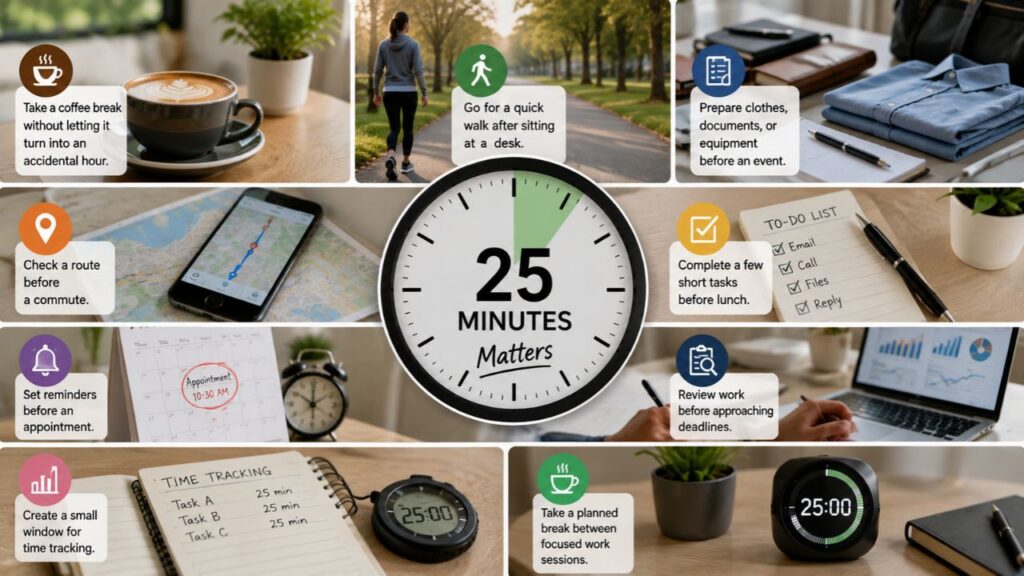
Twenty-five minutes appears in ordinary routines far more often than people notice. It can be the space between leaving home and arriving somewhere, the length of a lunch break, or the amount of time you decide to spend on one household job. Because it is short but meaningful, it fits neatly into many parts of a normal day.
A few examples include:
- Taking a coffee break without letting it turn into an accidental hour.
- Going for a quick walk after sitting at a desk.
- Preparing clothes, documents, or equipment before an event.
- Checking a route before a commute.
- Completing a few short tasks before lunch.
- Setting reminders before an appointment.
- Reviewing work before approaching deadlines.
- Creating a small window for time tracking.
- Taking a planned break between focused work sessions.
The beauty of 25 minutes is that it doesn’t demand a huge commitment. You can start something without feeling that you’ve signed away your entire afternoon. Sometimes, thats exactly the psychological trick we need.
25 Minutes From Now Calculator: When Should You Use One?
A 25 minutes from now calculator is useful when you want a quick answer without doing the arithmetic yourself. You enter the current time, choose the 25-minute duration, and the tool gives you the corresponding future time. This can be particularly convenient when you’re working across schedules or dealing with several reminders.
A minutes from now calculator can also reduce mistakes when the calculation crosses midnight. For example, if the time is 11:50 PM, adding 25 minutes takes you to 12:15 AM on the following day. People often remember the minutes correctly but forget that the date has changed, which is where a calculator earns its keep.
For more complicated situations, a future time calculator or time duration calculator can be even more practical. These tools are useful when you need to calculate several intervals rather than one simple 25-minute period. They’re not replacing basic maths, they just save your attention for things that deserve it more.
How a 25-Minute Countdown Helps With Time Management
A countdown creates a visible ending point. Instead of saying, “I’ll work for a while,” you can say, “I’ll work until the timer finishes.” That difference sounds tiny, but it changes how a task feels. There is a beginning, a middle, and a definite end, which makes it easier to stay engaged.
For time management, short countdowns can help divide a large day into smaller pieces. A person who struggles with a three-hour project may find it easier to begin with one 25-minute session. Afterward, they can take a few minutes to reset before deciding whether another session is needed.
This also helps with track short breaks and manage short tasks without allowing every break to expand endlessly. A timer isn’t a strict boss; it’s more like a polite little doorbell saying, “Your twenty-five minutes are up now.” You can then decide what comes next.
Digital Clock, Analog Clock, or Clock Interface?
Different people prefer different ways of reading time, and there is no prize for choosing the “correct” one. A digital clock gives an immediate numerical answer, making it convenient for calculations. An analog clock, meanwhile, can make the passing of minutes easier to visualize.
A modern clock interface may combine both approaches with alarms, countdowns, reminders, and timers. On a phone, you can usually see the current time and set a 25-minute countdown within moments. The technology is simple, but it can be surprisingly useful when your attention is already scattered in six different directions.
For anyone learning how to calculate time, switching between these displays can actually strengthen understanding. You begin to see that 2:30 isn’t just a number on a screen; it’s halfway through the hour, and 25 minutes later will be 2:55. Once that relationship becomes familiar, calculate time quickly becomes almost automatic.
25 Minutes and Time Planning for Busy Days
A busy schedule doesn’t always need larger blocks of free time. Sometimes it needs better use of the small blocks already available. Twenty-five minutes between two commitments can be enough to answer messages, prepare notes, stretch, eat something, or simply breathe for a moment.
Good time planning means recognizing these small windows rather than treating them as useless gaps. If you have 25 minutes before leaving, you might prepare your bag and check your route. If you have 25 minutes after lunch, you might finish a small piece of work instead of opening a distracting app and wondering where the afternoon disappeared to.
This approach can also help you avoid missing deadlines. When a deadline is approaching, calculate backward from the important time and assign smaller actions to the available minutes. It isn’t glamorous planning, admittedly, but it works in the real world where schedules are often messier than the neat ones in planners.
What Time Will It Be in 25 Minutes During a Commute?
Travel is another situation where the phrase what time is 25 minutes from now becomes practical. If a journey normally takes 25 minutes, knowing the starting time gives you a rough arrival time. If you leave at 7:35 AM, for example, a 25-minute journey would place you around 8:00 AM, assuming the road behaves itself for once.
For a commute, however, remember that a calculated arrival time is not always a guaranteed arrival time. Traffic, delays, weather, and unexpected stops can stretch a 25-minute trip. The calculator tells you the mathematical duration, not what the road has decided to do today.
That distinction is important for responsible time tracking. Use the calculated future time as a planning point, then leave some extra room when being late would create a genuine problem. A little buffer is often worth more than perfect-looking arithmetic.
Why People Search for the Exact Time 25 Minutes Ahead
Searching for the exact time in 25 minutes often comes from a very practical need. Someone may have a medication reminder, an online appointment, a cooking task, a school pickup, or a work deadline. The question looks tiny on a search page, but behind it there is usually a real-world event waiting to happen.
People also search because mental calculations can become unreliable when they are tired. If you’ve been working all morning, even adding 25 minutes to 9:47 can suddenly feel like an unnecessary exam question. There is no shame in checking. Accuracy is more useful than pretending you never need a calculator.
The important thing is to use the updated time when you perform the calculation. If several minutes have passed since you first checked the clock, your original answer may already be outdated. Time has a slightly annoying habit of continuing forward while we’re busy reading about it.
A Simple Table for 25 Minutes Ahead
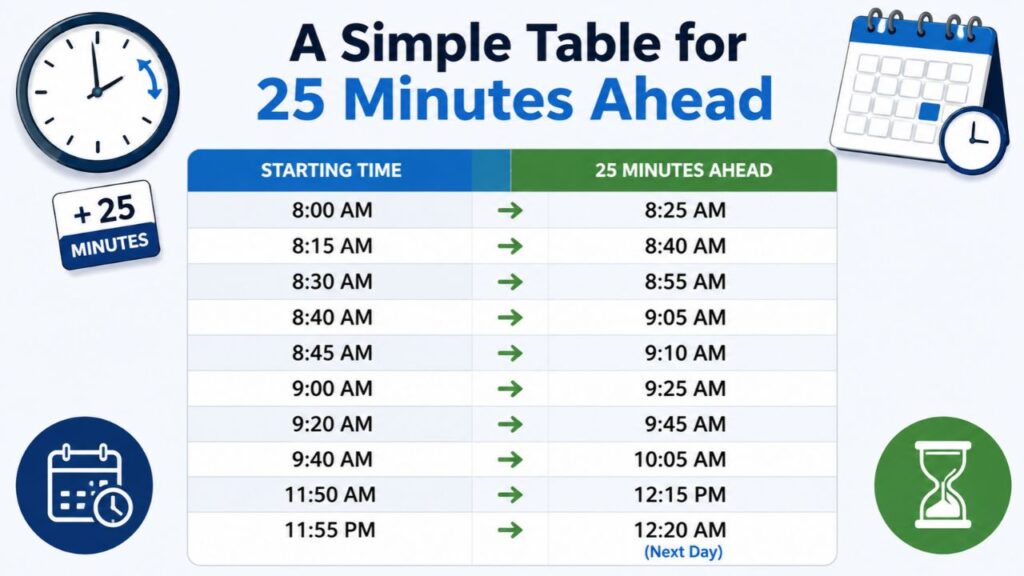
The following examples show how adding 25 minutes changes the time. These are examples for understanding the method, not a substitute for checking your live clock.
| Starting Time | 25 Minutes Ahead |
|---|---|
| 8:00 AM | 8:25 AM |
| 8:15 AM | 8:40 AM |
| 8:30 AM | 8:55 AM |
| 8:40 AM | 9:05 AM |
| 8:45 AM | 9:10 AM |
| 9:00 AM | 9:25 AM |
| 9:20 AM | 9:45 AM |
| 9:40 AM | 10:05 AM |
| 11:50 AM | 12:15 PM |
| 11:55 PM | 12:20 AM |
Notice how the final examples cross into a new hour or even a new day. That is the part most likely to cause a quick calculation error, so always check whether the hour or date needs to change.
How to Use 25 Minutes for Better Time Management
You don’t need an elaborate productivity system to make 25-minute intervals useful. Pick one task, set a 25 minute timer, and decide what “finished enough” means before you begin. That last part matters because otherwise you can spend twenty minutes arranging the task and five minutes actually doing it, which is a very human little trap.
For focused work, put distractions out of reach. Silence unnecessary notifications, close irrelevant browser tabs, and keep the timer visible if that helps. When the countdown ends, take a short break or review your progress before continuing. The goal isn’t to squeeze every possible second out of the day.
Over time, these small sessions can create a surprisingly effective routine. Twenty-five minutes today, another 25 tomorrow, and another the day after can turn into several hours of purposeful work across a week. Time management becomes less about controlling every second and more about making better choices with the minutes you actually have.
Creative Ways to Use a 25-Minute Timer
A timer doesn’t have to be associated only with work. You can use one for activities that deserve a boundary but still need attention.
- Spend 25 minutes organizing a cluttered room.
- Use a 25-minute break timer to step away from your screen.
- Set a reminder for 25 minutes before an appointment.
- Use a meeting timer to keep a discussion moving.
- Give yourself 25 minutes for meal preparation.
- Use the interval for reading a few pages of a book.
- Take a 25-minute walk without checking your phone.
- Prepare for an upcoming event.
- Use the time to review tomorrow’s schedule.
- Set a reminder timer before a task that needs checking.
These activities demonstrate why knowing the time 25 minutes ahead is more than a random calculation. It gives an ordinary slice of the day a purpose, and sometimes purpose is all a small block of time needs.
How to Calculate Future Time Without a Tool
Although an online time calculator is convenient, knowing the basic method yourself is valuable too. Begin with the hour and minute displayed on your clock. Add 25 to the minutes. If the result is less than 60, keep the same hour. If it is 60 or more, subtract 60 and increase the hour by one.
For instance, 4:50 + 25 minutes becomes 5:15. You can reach that answer by adding 10 minutes to reach 5:00, then five more minutes. This method is especially helpful when you’re walking, cooking, or doing something where reaching for your phone isn’t convenient.
If you’re working close to midnight, remember the date as well. 11:45 PM plus 25 minutes is 12:10 AM, which belongs to the next calendar day. That tiny date change is easy to overlook, but it can matter for travel plans, reminders, bookings, and deadlines.
Read more blog: What Time is 55 Minutes From Now?
Frequently Asked Questions
25 minutes from now
25 minutes from now means adding 25 minutes to the current time to find the exact future time.
what time will it be in 25 minutes
To find what time it will be in 25 minutes, simply add 25 minutes to the current time.
what time is it in 25 minutes
The time in 25 minutes depends on the current time, so add 25 minutes to your clock for the answer.
what is 25 minutes from now
25 minutes from now is the current time plus 25 minutes, which gives you the upcoming time.
what time will it be in 25 minutes from now
Add 25 minutes to the current time to determine exactly what time it will be 25 minutes from now.
Conclusion
The question What Time Is 25 Minutes From Now may look like a very small search, yet it connects with some surprisingly important parts of everyday life. Twenty-five minutes can be a meeting window, a focused work session, a coffee break, a commute, a walk, or the final preparation before something meaningful begins. Once you start viewing minutes as useful pieces of time rather than leftovers, the clock feels a little different.
The basic calculation is simple: take the current time and add 25 minutes. Use a minutes calculator, future time calculator, or countdown timer when you want extra convenience, especially when the calculation crosses an hour or midnight. And when accuracy really matters, check the exact time immediately before making your decision.
Perhaps the nicest lesson is that 25 minutes doesn’t have to be spectacular to be valuable. A person can write something meaningful in 25 minutes, walk far enough to clear their head, prepare for an important conversation, or simply sit with a cup of coffee and let the day settle down a bit. Small periods of time have a habit of becoming important only after we use them well.
So next time you wonder what time will it be in 25 minutes, don’t think of it only as a calculation. Think of it as a small appointment with the future. Decide what you want those minutes to hold, set the clock if needed, and let the countdown begin. And if you have a favorite way to use a 25-minute block, share it with others it might be the tiny idea someone else needed today.
