
There are moments when 55 Minutes From Now feels surprisingly important. Maybe you have a meeting coming up, a study session beginning soon, or simply want to know when something will happen without doing mental maths at an inconvenient moment. It sounds like a tiny calculation, but when your schedule is packed, even 55 minutes can sit there like a small puzzle waiting to be solved.
The simple answer is this: take the Current Time and add 55 minutes. If the minutes pass 60, move forward one hour and carry the remaining minutes. It is an easy bit of Time Calculation, but getting it wrong can make a person arrive early, late, or somehow exactly when everybody else is leaving. So, let’s make the whole thing clear and useful.
| Time | Answer |
|---|---|
| Current Time | Add 55 minutes |
| 55 Minutes From Now | Current time + 55 minutes |
| Quick Method | Add 1 hour, then subtract 5 minutes |
| Example | 8:00 AM → 8:55 AM |
| Across the Hour | 9:10 AM → 10:05 AM |
| Across Midnight | 11:20 PM → 12:15 AM (next day) |
What Time Is 55 Minutes From Now?
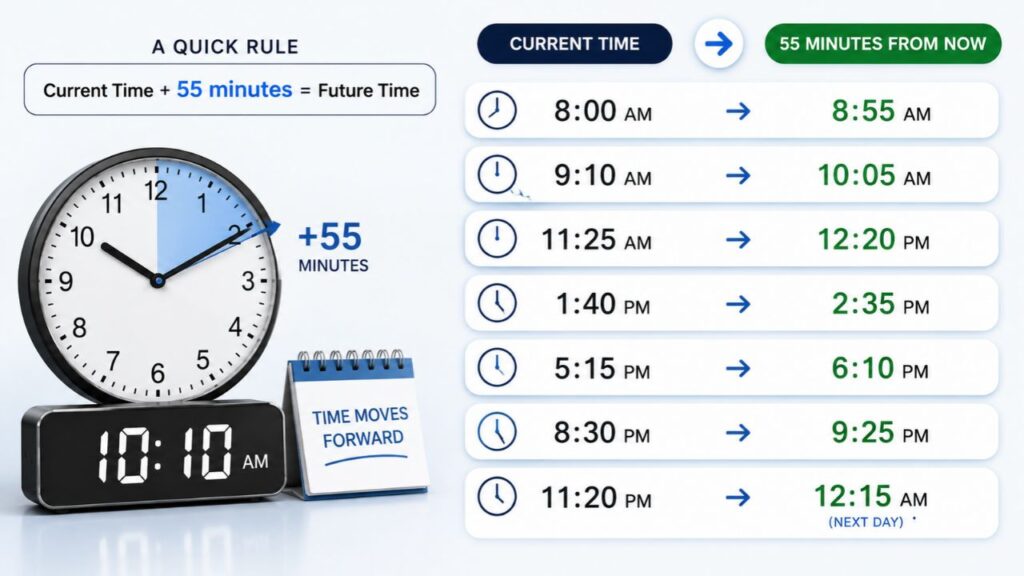
To find what time is 55 minutes from now, start with the time shown on your clock and move forward by 55 minutes. For example, if the Current Time is 3:00 PM, then 55 minutes later it will be 3:55 PM. Nothing mysterious hiding behind the clock, just a little forward movement.
If the starting time is 3:20 PM, adding 55 minutes gives 4:15 PM. Here, the calculation crosses the hour, so you add 40 minutes to reach 4:00 PM and then another 15 minutes. This is why thinking in hours and minutes can sometimes be easier than trying to add everything in one go, specially when you’re tired.
A quick rule is:
Current Time + 55 minutes = Future Time
For example:
- 8:00 AM → 8:55 AM
- 9:10 AM → 10:05 AM
- 11:25 AM → 12:20 PM
- 1:40 PM → 2:35 PM
- 5:15 PM → 6:10 PM
- 8:30 PM → 9:25 PM
- 11:20 PM → 12:15 AM
That last example matters because the calculation crosses midnight. The Future Time is now on the following calendar day, which is one of those tiny details people forget more often than they would admit.
55 Minutes From Now Calculator
A 55 minutes from now calculator is useful when you want an answer immediately without manually working through the minutes. Enter or view the Current Time, add 55 minutes, and the tool provides the resulting time. It is particularly handy when several tasks are already competing for your attention.
A reliable Time Calculator can also reduce simple mistakes involving hour changes, AM and PM, and midnight. If you’re planning a meeting or deadline, that little convenience can save more trouble than the calculation itself seems worth.
The basic process is simple:
- Check the Current Time.
- Add 55 to the minute value.
- If the result reaches 60 or more, move into the next hour.
- Keep the remaining minutes after subtracting 60.
- Check whether AM changes to PM or the date moves forward.
- Confirm the exact time before using it for an important appointment.
For instance, 7:35 PM plus 55 minutes becomes 8:30 PM. The clock does not care that 55 feels like almost an hour; it simply follows the minutes, quietly and without drama.
How to Calculate Future Time Manually
You do not really need an online calculator every time you want to calculate future time. Your own brain is perfectly capable of handling a 55-minute calculation, although it may protest if you’ve just had a very long day.
Suppose the starting time is 2:25 PM. First, notice that 35 minutes are needed to reach 3:00 PM. You have 20 minutes left from the original 55. Add those 20 minutes, and the answer becomes 3:20 PM.
Another approach is to add one hour and subtract five minutes. Since 55 minutes is exactly five minutes less than an hour, this method is often extremely quick.
For example:
6:40 PM + 55 minutes
Add one hour → 7:40 PM
Subtract five minutes → 7:35 PM
This little trick makes calculate future time much easier when you’re doing the calculation mentally. It is especially useful when you need to work out several minutes from now without reaching for your phone.
Using a Digital Clock to Find 55 Minutes Ahead
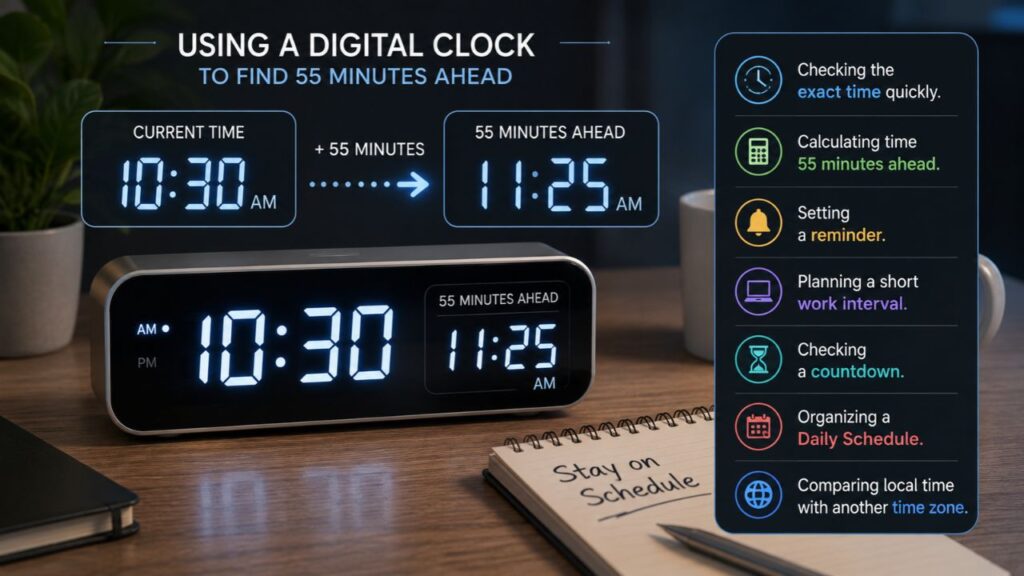
A Digital Clock makes time calculation visually straightforward because the hour and minute values appear as numerical time. You can look at the digital time display, add 55 minutes, and check whether the hour changes.
Imagine your screen shows 10:15 AM. Adding 55 minutes produces 11:10 AM. The minute value does not simply become 70; instead, 60 minutes forms the next hour, leaving 10 minutes behind.
Many online clock tools provide automatic updates, so the displayed time changes continuously. This is useful when you’re trying to determine a future appointment relative to the moment you are actually reading the page.
A digital display can be particularly helpful for:
- Checking the exact time quickly.
- Calculating time 55 minutes ahead.
- Setting a reminder.
- Planning a short work interval.
- Checking a countdown.
- Organizing a Daily Schedule.
- Comparing local time with another time zone.
It is a very ordinary piece of technology, really, but ordinary tools often become most useful when we stop making them complicated.
Reading an Analog Clock for 55 Minutes Later
An Analog Clock tells the same story in a more traditional way. Instead of numerical digits, you follow the minute hand, second hand, and hour hand around the clock face.
If the minute hand begins at the 12, moving forward 55 minutes brings it almost all the way around to the 11. If it starts at the 6, 55 minutes later the minute hand will be near the 5, but the hour hand will have moved forward considerably too.
The traditional clock format can initially seem less convenient than a digital display, but it gives you a strong visual understanding of how time moves. You can almost watch the Future Time being built minute by minute, which sounds poetic for something as practical as a clock.
For children learning time, analog clocks can also make time conversion and minute counting easier to understand. Adults may still benefit from the same visual skill, especially when estimating task duration without calculating every second.
Why 55 Minutes Is a Useful Work Block
A 55-minute work session is long enough to accomplish meaningful work while still being short enough to feel manageable. Instead of thinking, “I need to work all afternoon,” you can say, “I only need to focus until 55 minutes from now.” That psychological difference can be rather powerful.
A 55-Minute Block can be used for writing, research, coding, paperwork, planning, or almost anything requiring concentrated attention. Afterward, a short Break Time gives your mind a chance to step away before the next task.
For example, you could use:
- 55 minutes for Project Work
- 5–10 minutes for a break
- Another 55 minutes for focused work
- A longer break afterward
This resembles common focused-work methods, but there is no rule saying every productive session must follow one famous technique. Sometimes 55 minutes simply fits your day better, and that’s reason enough.
55 Minutes From Now for Studying

Students can turn 55 minutes into a surprisingly effective Study Session. Instead of staring at a huge syllabus and wondering where the afternoon disappeared, choose one topic and give it a defined block.
A useful structure might look like this:
- First 10 minutes: review previous notes.
- Next 25 minutes: learn the main material.
- Next 15 minutes: answer questions or practise.
- Final 5 minutes: summarize what you learned.
This gives the session a beginning, middle, and ending. A study timer can help keep the boundaries visible, while a simple countdown can create just enough urgency to stop you wandering into unrelated tabs.
Even Reading can benefit from this approach. Fifty-five minutes of uninterrupted reading is quite different from reading for five minutes, checking a notification, reading another paragraph, checking something else, and suddenly becoming an expert on a completely unrelated topic.
Using 55 Minutes for Task Scheduling
Good Task Scheduling is not always about filling every minute. It is about giving important tasks enough space to actually happen. A 55-minute interval can fit neatly into a busy schedule because it is close to an hour without occupying the entire hour.
For example, your Daily Schedule might include a 55-minute writing block, a 10-minute break, a 55-minute meeting, and then another focused session. Those small gaps can prevent the day from feeling like one giant pile of obligations.
With Time Blocking, you assign a specific period to one activity instead of constantly deciding what to do next. That can reduce decision fatigue, which is a fancy way of saying you get tired of deciding what you should be doing every five minutes.
A simple project work schedule could therefore use 55-minute blocks for:
- Research
- Writing
- Editing
- Planning
- Client work
- Administrative tasks
- Reviewing completed work
This form of schedule management is flexible enough for school, office work, freelancing, or personal projects.
How 55 Minutes Can Improve Time Management
Time Management becomes easier when time has visible boundaries. Fifty-five minutes gives you a clear beginning and ending, making it easier to estimate what can realistically fit into the day.
You might think you can finish a large task in an hour, only to discover that emails, setup time, interruptions, and tiny decisions consume part of it. A 55-minute block encourages you to leave a little breathing room rather than planning every day as if nothing unexpected will ever happen.
That small distinction matters for Productivity. Being productive does not mean squeezing work into every available second. Sometimes productivity means knowing when to stop, breathe, and return with a clearer head.
A practical habit is to ask yourself, “What can I reasonably finish 55 minutes from now?” The question turns a vague intention into a measurable target, which is much easier to act on.
Planning Break Time 55 Minutes Ahead
Not every 55-minute period needs to be filled with serious work. Sometimes the best use of the next block is rest.
If you have been working for several hours, calculating 55 minutes later can help you create a natural stopping point. You might continue until that point, then step away for water, stretching, a short walk, or simply five minutes of doing absolutely nothing productive—which, honestly, can be productive in its own weird way.
A sensible break schedule can prevent long periods of uninterrupted screen time. Short breaks are especially useful during demanding mental work because they create a boundary between one focused period and another.
The important thing is to decide the break before you begin. Otherwise, “five minutes” has a suspicious habit of becoming thirty.
55 Minutes From Now in Everyday Life
The usefulness of 55 Minutes From Now extends well beyond work and study. You may use the calculation before leaving home, preparing food, calling someone, exercising, waiting for transportation, or getting ready for an appointment.
Imagine you need to leave at 4:00 PM and it currently takes you 55 minutes to get ready and travel. Working backward tells you that around 3:05 PM is your practical starting point. Here, the same Time Calculator idea works in reverse.
Parents can use similar calculations when organizing routines. Someone preparing dinner might know that a dish needs 55 minutes. A person exercising might create a 55-minute training session. Someone reading before bed might set a 55-minute Reading Session.
Time is not merely something that happens to us. Once we understand it, we can arrange small pieces of it around the things that matter.
Common Mistakes When Adding 55 Minutes
The most common mistake is treating the minute number as if it can continue beyond 59. For example, saying 4:20 plus 55 equals 4:75 is not a valid clock time. The correct answer is 5:15.
Another mistake happens when the calculation crosses noon, midnight, or a date boundary. If it is 11:30 PM, adding 55 minutes gives 12:25 AM on the next day. The time changes, and so does the date.
People also sometimes confuse 55 minutes from now with 55 minutes before now. The word “from” indicates movement forward, while “ago” indicates movement backward. It is a tiny language distinction with a very real effect on your schedule.
When accuracy matters, use a reliable Clock Tool or future time calculator and double-check the displayed result.
55-Minute Blocks and Better Daily Planning
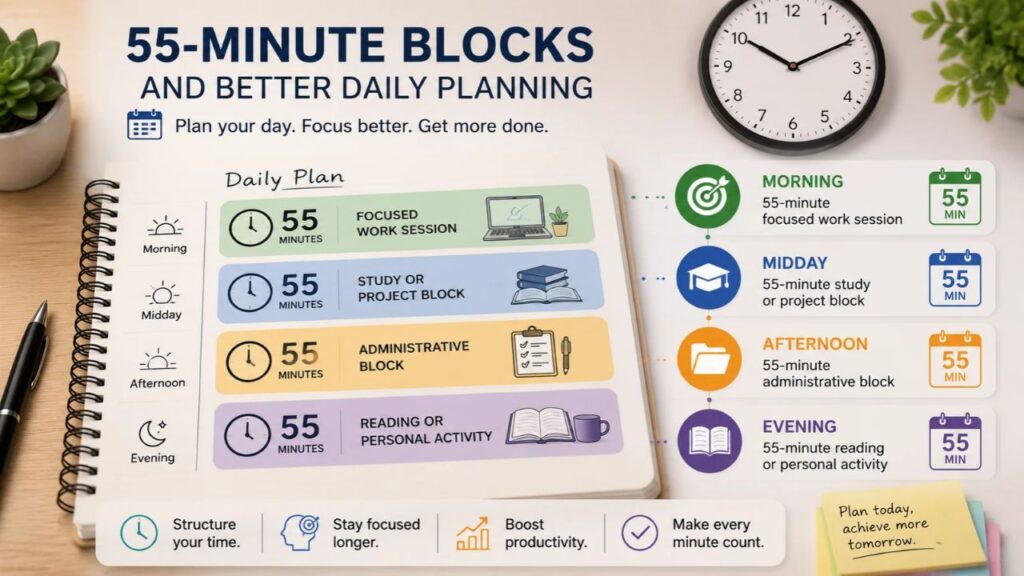
A collection of 55-minute blocks can become a practical system for Time Planning. You do not need to schedule your entire life down to the second; instead, choose a few important blocks and let the rest of the day remain flexible.
For example:
- Morning: 55-minute focused work session
- Midday: 55-minute study or project block
- Afternoon: 55-minute administrative block
- Evening: 55-minute reading or personal activity
This approach can make manage time efficiently feel less like a motivational slogan and more like an actual habit. The goal is not perfect scheduling. The goal is knowing where your attention is supposed to go.
If interruptions happen, don’t treat the schedule as ruined. Move the block. Time planning should serve your life, not become another thing demanding perfection from you.
A Quick Method to Calculate 55 Minutes Ahead
When you need an answer quickly, remember the “one hour minus five minutes” trick. It is probably the easiest mental shortcut for this particular calculation.
Take the Current Time, add one hour, then subtract five minutes.
For example:
9:45 AM + 55 minutes
Add one hour → 10:45 AM
Subtract five minutes → 10:40 AM
Another example:
11:50 AM + 55 minutes
Add one hour → 12:50 PM
Subtract five minutes → 12:45 PM
This method is useful because an hour is an easier mental reference than adding 55 directly. It works especially well when you are walking, cooking, driving as a passenger, or otherwise don’t have a calculator immediately available.
When an Online Time Calculator Is Better
Manual Time Calculation is easy for one or two examples, but an online clock or dedicated productivity tool becomes useful when you are handling multiple calculations.
A good calculator can calculate time automatically, update the displayed result, and sometimes handle dates as well as hours and minutes. This matters when a future calculation crosses midnight or when you’re planning several events.
You might use an online calculator when:
- Scheduling several appointments
- Building a detailed Daily Schedule
- Planning travel
- Creating work intervals
- Setting reminders
- Organizing study periods
- Checking a future date and time
- Comparing different time zones
The point isn’t that humans cannot add 55 minutes. Of course we can. The point is that automation removes one more tiny task from a crowded day.
Creative Ways to Use a 55-Minute Block
A 55-minute period can become whatever your day needs. You can use it for focused work, learning, creative practice, exercise planning, household organization, or simply finishing something you’ve been postponing for far too long.
Try making the block specific instead of vague. “Work on project” is broad. “Draft the introduction and edit two sections” gives your brain a destination.
For Reading, choose a chapter or page range. For study, choose one concept. For project work, define one deliverable. For household tasks, decide exactly what “finished” means.
This is where time tracking can help. After a few days, you may discover that certain tasks consistently take longer than expected, while others finish surprisingly quickly. Those observations make future Time Planning more realistic.
What 55 Minutes Teaches Us About Time
Fifty-five minutes is an odd little measurement. It is almost an hour, but not quite. That makes it useful because it leaves five minutes of space around the hour, and those five minutes can matter more than they appear to.
They can become transition time, a quick note, a glass of water, or simply a moment to reset before the next task. In a busy schedule, those small spaces can stop one activity from crashing directly into another.
Learning to calculate minutes from now is therefore more than a basic clock skill. It can encourage better planning, clearer priorities, and more realistic expectations about what fits into a day.
Read more blog: 18 Months From Today Calculator
Frequently Asked Questions
55 minutes from now
55 minutes from now means adding 55 minutes to the current time to find the future time.
what time will it be in 55 minutes
To find what time it will be in 55 minutes, simply add 55 minutes to the current time.
what is 55 minutes from now
55 minutes from now is the time that occurs exactly 55 minutes after the current time.
what time will it be 55 minutes from now
Add 55 minutes to the current time to calculate the exact future time.
55 minutes from now is what time
The answer depends on your current time; add 55 minutes to get the correct future time.
Conclusion
So, what time is 55 minutes from now? The answer depends on your Current Time, but the method never changes: move forward 55 minutes, account for the next hour when necessary, and check whether the calculation crosses midnight.
You can do it manually, use a Time Calculator, check a Digital Clock, read an Analog Clock, or rely on a dedicated Clock Tool. The best method is simply the one that gives you an accurate answer without making the process harder than it needs to be.
More importantly, 55 minutes can become a useful unit for living and working. A 55-minute work session, a Study Session, a Reading block, or a planned Break Time can give an ordinary part of the day a clear purpose.
And perhaps that’s the nicer lesson hiding inside this tiny calculation: the future is often built in small pieces. One minute follows another, then another, and before you know it, 55 minutes have passed. If you know where you want those minutes to go, they can become something useful rather than simply disappearing into the day.
